Nepali vs Indonesian Rudraksha Bracelet: Origin, Mukhi & Why It Changes the Price
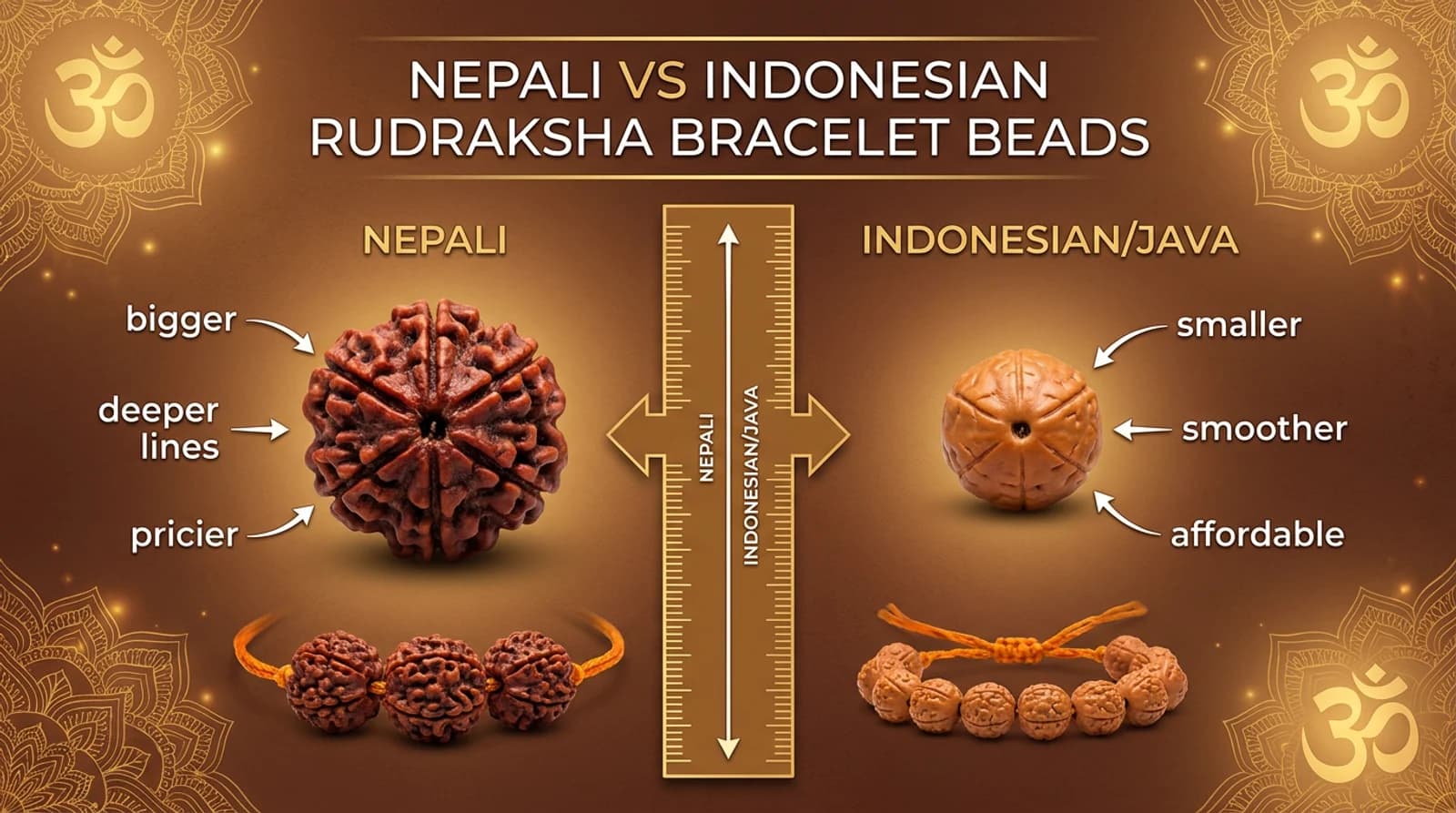
A Nepali rudraksha bracelet is a wrist strand of Rudraksha seeds grown in Nepal's Himalayan belt, prized for larger beads and sharply defined mukhi line-faces. Indonesian (Java) beads are smaller, smoother and cheaper. Origin shifts size, clarity and price — and an honest lab certificate should state which you actually bought.
What a Nepali rudraksha bracelet actually is
A Nepali rudraksha bracelet is a wrist strand of Rudraksha seeds — the dried fruit-stones of the Elaeocarpus ganitrus tree — grown in Nepal's Himalayan foothills. Nepali beads are known for larger size, deeper mukhi (line-face) grooves and a sturdier shell, paired here with Om or Panchtatva elemental charms in gold-plated caps or traditional thread.
The word "mukhi" means face: each natural groove running from top to bottom is one mukhi. Five mukhi (panchmukhi) is the most common and the one most people wear daily. Tradition links Rudraksha to Lord Shiva and to calm, focus and protection from buri nazar. What origin changes is not the spiritual story but the physical bead — its size, clarity and price.
| Botanical source | Elaeocarpus ganitrus seed (a fruit-stone, not a wooden bead) |
| Origin on this page | Nepal (Himalayan belt) vs Indonesia (Java) |
| Common mukhi | 5 mukhi / panchmukhi for everyday wear |
| Designs | Om charm, Panchtatva elemental, pyrite-wealth combo |
| Settings | Gold-plated caps or traditional thread (mauli) |
| What we certify | Species, mukhi count and origin via lab / X-ray |
Nepali vs Indonesian: the differences sellers blur
Most stores show a price and a photo but stay silent on origin. Indonesian (Java) Rudraksha is a genuine, widely worn bead — it is simply smaller, smoother and far cheaper than Nepali. Neither is fake; the problem is selling Indonesian beads at Nepali prices without saying so. Here is the plain comparison.
| Feature | Nepali (Himalayan) | Indonesian (Java) |
|---|---|---|
| Typical bead size | Larger, 8-16 mm+ | Smaller, 4-10 mm |
| Mukhi grooves | Deep, sharply defined | Shallow, finer, smoother |
| Surface | Coarse, pronounced thorns | Smooth, rounded |
| Price band | Higher | Lower / budget |
| Availability | Limited harvest | Abundant |
| Authenticity | Genuine Rudraksha | Genuine Rudraksha |
| Common honesty gap | Often the claimed origin | Often sold as "Nepali" |
Our position is simple: both deserve a buyer, but you should know which one is on your wrist. We state the actual origin on the certificate rather than letting a premium photo imply Nepal.
Mukhi clarity, size and grade
Mukhi count and clarity are where origin shows itself. On a larger Nepali bead the five faces are easy to trace with the naked eye; on a small Indonesian bead the same five lines are tighter and harder to read, which is why miscounting (and mislabelling) is more common. Size also affects how a bracelet sits and how heavy it feels.
- 1Count the lines
Trace each continuous groove from the top hole to the bottom hole. Five clean lines = 5 mukhi / panchmukhi.
- 2Check definition
Genuine grooves are natural and uneven. Painted or carved "mukhi" lines look too perfect and identical — a red flag.
- 3Feel the size
Nepali beads read larger and weightier; a uniform tiny bead at a "Nepali" price deserves a question.
- 4Verify, don't trust
The only conclusive check for mukhi and origin is lab / X-ray imaging, which is exactly what our free certificate provides.
| Most worn | 5 mukhi (panchmukhi) — the all-purpose, daily-wear bead |
| Easiest to read | Larger Nepali beads (clearer faces) |
| Easiest to mislabel | Tiny smooth beads with shallow lines |
| Conclusive test | Lab / X-ray (not the float or copper-coin myths) |
Why origin genuinely changes the price
Price is not arbitrary. A Nepali rudraksha bracelet costs more because the beads are larger, the harvest is smaller and well-defined high-grade beads are harder to source. Add a gold-plated Om cap or a pyrite-wealth combination and the metal and setting add cost too. Honest pricing means the number reflects the bead and the build — not an inflated MRP with a fake discount.
| What you pay for | Adds cost? | Why |
|---|---|---|
| Nepali origin | Yes | Larger beads, limited harvest, clearer mukhi |
| Indonesian origin | No (budget) | Smaller, abundant, smoother beads |
| High-grade matched beads | Yes | Hand-sorted for size and groove clarity |
| Gold-plating / Om cap | Yes | Plating and metal work |
| Pyrite accents | Yes | Additional certified stone |
| Lab certificate | Included free | We absorb it as a trust signal, not an upsell |
We reject "Rs 99,900 MRP, 60% off" theatre. A fair, stable INR price you can verify against the certificate is worth more than a dramatic strike-through. Prices vary by mukhi, size, design and metal — the certificate tells you the bracelet matches what you paid for.
How our lab certificate states origin
This is the wedge: a certificate that openly names the origin. Where competitors offer an unnamed "100% certified" line, a missing PDP proof, or a premium photo that merely implies Nepal, every DivineTatva rudraksha bracelet ships with a free, QR-verifiable lab certificate that states the species, the mukhi count and the origin in writing.
| Species stated | Elaeocarpus ganitrus confirmed |
| Mukhi count stated | e.g. 5 mukhi, verified by imaging |
| Origin stated | Nepali or Indonesian — named, not implied |
| Verification | QR code links to the certificate record |
| Cost to you | Free with every bracelet |
| Made in | Jaipur, India — INR pricing, COD available |
If you ever wondered "is this real, and is it really Nepali?", the certificate answers both before you have to ask. That turns the origin gap others hide into a stated trust signal you can check on your phone.
Tradition, belief and what the evidence shows
We will be straight with you. In Vedic and metaphysical tradition, Rudraksha is associated with Lord Shiva and with calm, focus and protection, and many wearers report exactly that. But peer-reviewed proof of supernatural benefits is lacking. What is documented is the grounding effect of a mindful wearing ritual and the steadying comfort of routine.
People consistently report calm, focus or a sense of protection that is well explained by intention, ritual and the placebo response — and that experience can still be genuinely valuable. A rudraksha bracelet is not a substitute for medical, financial or professional advice. We sell the certified, authentic bead and an honest story; we never over-promise a cure.
| Belief / tradition | Linked to Shiva; calm, focus, protection from buri nazar |
| Documented effect | Grounding ritual, comfort of routine |
| Clinical proof | None for supernatural claims |
| Our promise | Authenticity, mukhi count and origin — certified |
| What it is not | A medical, financial or professional treatment |
Care, cleansing and daily wear
Rudraksha is a seed, so moisture and chemicals are its enemies. Keep your Rudraksha bracelet dry: remove it before bathing, swimming or heavy sweat, and avoid soap, perfume and chlorinated water. Oil the beads with a little sandalwood or coconut oil occasionally, keep any gold-plating and pyrite completely dry, and store in a soft cloth pouch.
Most people wear left wrist as the receiving side, though either hand is fine — daily wear is welcome as long as you keep it dry. To cleanse, simply wipe with a dry soft cloth; some wearers set intention near incense or a Shiva mantra. There are no medical side effects; the only real "side effect" is a damaged bead from water, soap or perfume.
- 1Remove before water
Take it off for bathing, swimming, workouts and washing up.
- 2Keep chemicals away
No soap, perfume, sanitiser or chlorinated water on the beads or plating.
- 3Oil occasionally
A drop of sandalwood or coconut oil keeps the seed conditioned.
- 4Store dry
Soft cloth pouch; keep gold-plating and pyrite completely dry.
Frequently asked
Last reviewed: 17 May 2026 · Verified by the DivineTatva expert panel
Is a Nepali rudraksha bracelet better than an Indonesian one?
Neither is fake — both are genuine Rudraksha. Nepali beads are larger with deeper, clearer mukhi lines and a higher price; Indonesian (Java) beads are smaller, smoother and budget-friendly. "Better" depends on your budget and preference. The real issue is honesty: you should be told which origin you are buying, which is why we state it on the certificate.
How can I tell if my rudraksha bracelet is really Nepali?
Size and mukhi clarity are clues — Nepali beads read larger with deeper, sharply defined grooves, while Indonesian beads are smaller and smoother. But appearance alone can be staged. The only conclusive proof is lab / X-ray testing. Our free, QR-verifiable certificate names the species, mukhi count and origin in writing, so you do not have to guess.
Why is a Nepali rudraksha bracelet more expensive?
Nepali beads are larger, the harvest is smaller and well-defined high-grade beads are harder to source, so they cost more. Gold-plating, Om caps or pyrite accents add to the build cost too. We price fairly in INR without inflated MRP theatre, and the certificate lets you confirm the bracelet matches what you paid for.
What does the rudraksha bracelet certificate actually state?
It states the species (Elaeocarpus ganitrus), the mukhi count (for example 5 mukhi) and the origin — Nepali or Indonesian — confirmed by lab / X-ray imaging. A QR code links to the verifiable record. It is free with every bracelet. This directly answers the two biggest fears: is it real, and is it really the origin claimed?
Does a rudraksha bracelet really work, or is it just belief?
Tradition links Rudraksha to Lord Shiva and to calm, focus and protection, and many wearers report exactly that. However, there is no peer-reviewed proof of supernatural benefits. What is documented is the grounding ritual of mindful wearing and the comfort of routine — effects consistent with intention and placebo. It is not a substitute for medical, financial or professional advice.
Which hand should I wear a rudraksha bracelet on, and can I wear it daily?
Most people wear it on the left wrist, traditionally the receiving side, though either hand is fine. Daily wear is welcome and common. The only condition is keeping it dry — remove it before bathing, swimming or heavy sweat, and keep soap, perfume and chlorinated water away from the beads and any gold-plating.
How do I clean and care for a Nepali rudraksha bracelet?
Keep it dry: remove it before bathing, swimming or heavy sweat, and avoid soap, perfume and chlorinated water. Oil the beads with a little sandalwood or coconut oil occasionally, keep any gold-plating and pyrite completely dry, and store in a soft cloth pouch. To cleanse, wipe with a dry soft cloth; some wearers set intention near incense or a mantra.
Reviewed by the DivineTatva expert panel
Written and reviewed by DivineTatva's consulting Vedic astrologer. Every piece is lab-certified and energised in our Jaipur atelier. Last updated 24 May 2026.