Rudraksha Mala Price in India 2026: Panchmukhi vs Siddha & How to Pay Right
Rudraksha Mala prices in India range from ₹200 for small Indonesian beads to ₹50,000+ for AAA-grade large Nepali Panchmukhi with gold spacers. Price is driven by bead size, origin, mukhi clarity, energisation, and lab certification — not marketing labels. This guide explains what each tier gets you and the red flags to avoid.
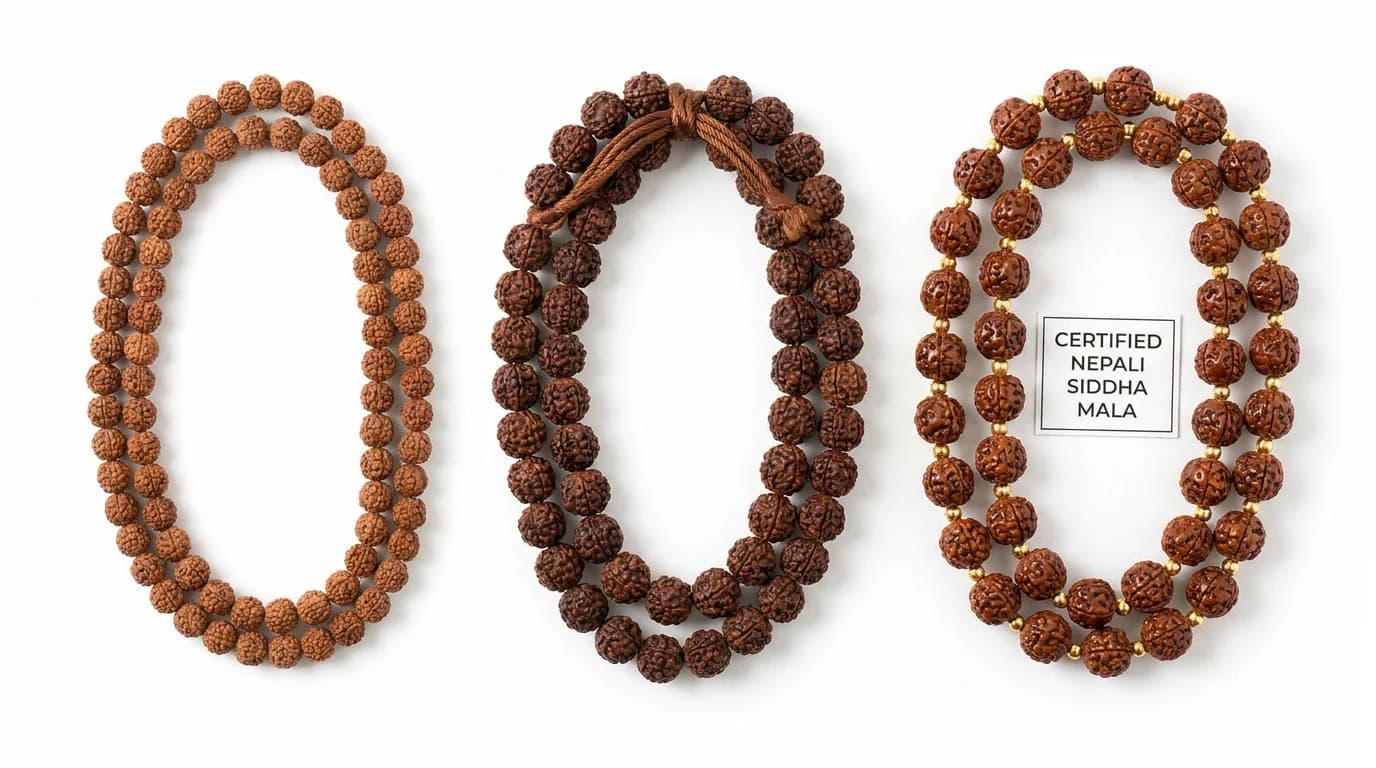
Rudraksha Mala Price Tiers in India (2026)
The price of a 108-bead Rudraksha Mala in India varies by an order of magnitude — ₹200 to ₹50,000+ — and the variation is not random. It tracks specific, verifiable quality factors. Here is what each tier delivers.
| Price Range | Type | Bead Size | Origin | Cert? | Energisation |
|---|---|---|---|---|---|
| ₹200–₹500 | Indonesian Panchmukhi, basic string | 4–5mm | Indonesia (Java) | No | None |
| ₹500–₹900 | Indonesian or low-grade Nepali mix | 5–6mm | Mixed | Rarely | None |
| ₹999–₹2,000 | Lab-certified Nepali Panchmukhi, silk strung | 7–8mm | Nepal | Yes | Siddha (Pran Pratishta) |
| ₹2,000–₹8,000 | Premium Nepali, silver spacers | 8–10mm | Nepal | Yes | Siddha + silver spacers |
| ₹8,000–₹20,000 | AAA Nepali, gold-coated spacers, premium string | 10–12mm | Nepal | Yes | Full Pran Pratishta ceremony |
| ₹20,000–₹50,000+ | Collector-grade Nepali, pure gold spacers | 12–14mm | Nepal | Yes | Full ceremony + documentation |
What Actually Drives the Price of a Rudraksha Mala
- 1Bead size
This is the single biggest price driver in Nepali rudraksha. A 6mm bead and a 10mm bead are both Panchmukhi, but the 10mm is significantly rarer — the tree produces fewer large seeds per harvest, and finding 108 matching large beads in a single harvest is genuinely difficult. Price roughly doubles with every 2mm increment for Nepali grades.
- 2Origin: Nepali vs Indonesian
Nepali rudraksha from the Himalayan foothills consistently commands a premium over Indonesian (Java) rudraksha. Both are genuine Elaeocarpus ganitrus. Nepali beads are larger, denser, and have more clearly defined mukhis. Indonesian is not inferior in species — just different in size and texture.
- 3Mukhi clarity
Within any size grade, beads with sharper, more clearly defined mukhis are rarer and command a premium. A bead with 5 crystal-clear mukhis running tip to tail costs more than an average bead with slightly indistinct faces.
- 4String material
Nylon string (cheapest), silk thread (mid-range), and gold-coated or silver wire (premium) each add to the price. Silk and metal strings last longer and look better.
- 5Energisation / Pran Pratishta
A proper Pran Pratishta ceremony adds priest fees and time — reputable sellers include this in the price. 'Energised' claims from sellers who offer no description of the ceremony should be questioned.
- 6Lab certification
A genuine third-party lab certificate from a recognised laboratory adds cost (₹200–₹500 per mala) but is the only way to confirm species authenticity. Budget sellers skip this.
Nepali vs Indonesian Rudraksha: Is the Price Difference Worth It?
| Factor | Nepali Rudraksha | Indonesian Rudraksha |
|---|---|---|
| Species | Elaeocarpus ganitrus — identical | Elaeocarpus ganitrus — identical |
| Typical size | 7–14mm per bead | 4–6mm per bead |
| Mukhi definition | Clear, well-defined natural lines | Less defined, smaller faces |
| Density / weight | Heavier and denser per bead | Lighter and smaller |
| Price per 108-bead mala | ₹999–₹50,000+ | ₹200–₹700 |
| Lab cert availability | Common at certified sellers | Rarely available |
| Traditional preference | Highest — scriptural references describe large Himalayan rudraksha | Lower — Indonesian is accepted as genuine but considered lesser grade in Indian tradition |
| Best for | Serious sadhana mala, heirloom quality | Budget introduction or children's mala |
Our honest view: Indonesian rudraksha is genuine and beneficial. If your budget is ₹200–₹700, an Indonesian Panchmukhi mala is far better than a fake Nepali. If you can invest ₹999+, the Nepali grade offers noticeably larger, more beautiful beads with better mukhi clarity and lab certification.
Red Flags: When the Price Is Lying to You
- 1Ek Mukhi (1-faced) rudraksha for under ₹2,000
Genuine crescent-shaped Ek Mukhi rudraksha costs ₹10,000–₹50,000 minimum because they are extremely rare. Any 'Ek Mukhi' sold for ₹200–₹500 is almost certainly a half-moon-shaped Elaeocarpus seed (not the same) or a carved fake.
- 2Nepali 108-bead mala with certificate for under ₹400
Lab testing costs money. Stringing 108 beads on silk costs money. A Nepali mala at this price cannot be both genuine Nepali and lab-certified — something is false.
- 3No return policy or no certificate offer
Reputable sellers offer a return window and provide or offer lab certificates. Sellers with no return policy on rudraksha are often not confident in their product's authenticity.
- 4Vague 'energised' claims with no description
If a seller says 'energised' but cannot describe the ceremony (what mantra, how many recitations, by whom), the claim is likely marketing language, not a genuine Pran Pratishta.
- 5Price too consistent across all mukhi types
If a seller sells 1 mukhi, 5 mukhi, and 14 mukhi 108-bead malas for the same price, that is a strong signal that all beads are the same material regardless of claimed mukhi count.
DivineTatva's ₹999 Rudraksha Mala: What You Get
DivineTatva's Panchmukhi Siddha Rudraksha Mala is priced at ₹999 (MRP ₹1,999). Here is the exact breakdown of what that includes.
| Beads | 108 Nepali Panchmukhi rudraksha, 7–8mm, + 1 Sumeru bead = 109 total |
| Species confirmed | Elaeocarpus ganitrus — third-party lab certificate included |
| Mukhi count confirmed | 5-faced — verified in lab certificate |
| String | Silk or gold-coated wire (listed on product page) |
| Energisation | Full Pran Pratishta — 108 Aum Namah Shivaya recitations by trained priest |
| Packaging | Red/yellow cotton pouch + lab certificate + care card |
| Payment | COD available across India + UPI, card, net banking |
| MRP / Price | ₹999 (MRP ₹1,999) — 50% off |
Where to Buy Genuine Rudraksha Mala in India
| Channel | Pros | Cons | Cert Available? |
|---|---|---|---|
| Certified online sellers (DivineTatva, Japam.in) | Lab cert, clear sourcing, COD, return policy | Cannot physically handle before buying | Yes |
| Temple shops / Haridwar, Varanasi | Reputable local sellers; can handle beads | No lab cert; price varies; tourist-area fakes common | Rarely |
| Amazon/Flipkart generic sellers | Convenience, reviews | No cert; mixed quality; fakes common in low-price segment | Rare |
| Local jewellers / puja stores | Personal relationship; can inspect | Limited knowledge of testing; may sell Indonesian as Nepali | Rare |
| Collector auctions / specialist dealers | High quality; transparent grading | High price; minimum ₹5,000+ | Yes |
Frequently asked
Last reviewed: 17 May 2026 · Verified by the DivineTatva expert panel
What is a fair price for a genuine Nepali Panchmukhi Rudraksha Mala in India in 2026?
For a 7–8mm Nepali Panchmukhi 108-bead mala with lab certificate and Siddha energisation, ₹999–₹2,000 is a fair market price. Below ₹700 for Nepali with lab cert should raise questions. Above ₹2,000 at 7–8mm suggests a premium string or spacer add-on.
Is a ₹200 Rudraksha Mala genuine?
At ₹200, you are almost certainly getting an Indonesian rudraksha mala (4–5mm beads, no cert) — which is genuinely Elaeocarpus ganitrus but smaller and lower grade. It is not a fake, but it is not Nepali either. If the seller claims Nepali at ₹200, that is a red flag.
Why is Ek Mukhi (1-faced) rudraksha so expensive?
Genuine crescent-shaped Ek Mukhi rudraksha (the type described in Shiva Purana) is one of the rarest natural objects in rudraksha taxonomy. Trees produce very few per harvest. Authentic ones cost ₹10,000–₹50,000+. Round 'Ek Mukhi' beads sold for ₹200–₹500 are Elaeocarpus sphaericus (a different species) — not the same as true crescent-shaped Ek Mukhi.
Does DivineTatva offer Cash on Delivery for the Rudraksha Mala?
Yes — DivineTatva offers COD across India for the ₹999 Panchmukhi Siddha Mala. Every order includes a third-party lab certificate, red/yellow pouch, and care card.
Is it worth buying a more expensive Rudraksha Mala for better benefits?
Per Vedic tradition, benefit comes from the mantra practice and the energisation — not purely from bead size. A ₹999 Nepali Panchmukhi Siddha Mala with lab cert and Pran Pratishta is fully sufficient for serious daily jaap. Larger, rarer beads are an aesthetic and devotional upgrade, not a benefit multiplier per scripture.
Reviewed by the DivineTatva expert panel
Written and reviewed by DivineTatva's consulting Vedic astrologer. Every piece is lab-certified and energised in our Jaipur atelier. Last updated 15 June 2026.