Real vs Fake Rudraksha Mala: Float Test, X-Ray & Needle Tests Explained
The Indian rudraksha market is flooded with wood carvings, plastic beads, and low-grade imitations sold as genuine Elaeocarpus ganitrus. Five tests — from the simple float test to a definitive X-ray lab certificate — let you separate real from fake. No single test is conclusive alone; use all five for confidence.
Why the Rudraksha Market Is Full of Fakes
Genuine Elaeocarpus ganitrus seeds — especially large Nepali Panchmukhi beads — are in limited supply relative to demand. The tree grows specifically in the Himalayan foothills of Nepal, Uttarakhand, and parts of Indonesia. High-margin imitations using carved Berberis wood, compressed sawdust, and moulded plastic flood the market at ₹100–₹300 per mala, compared to ₹999–₹2,000 for genuinely certified Nepali product. Without knowing the tests, even experienced buyers have been deceived.
| Most common fake | Carved Berberis or similar hardwood — visual mukhis cut with a blade |
| Second common | Plastic/resin moulded with artificial face lines |
| Partial fake | Indonesian rudraksha sold as Nepali — both are genuine Elaeocarpus ganitrus but Indonesian is smaller and cheaper |
| Ek Mukhi fraud | Most ₹200–₹500 'Ek Mukhi' rudraksha are half-moon shaped Elaeocarpus — not the true crescent-shaped one-faced variety worth ₹10,000+ |
The Float Test: A Good First Filter — but Not Conclusive
Fill a glass with plain water and drop the rudraksha bead in. Genuine Nepali rudraksha is dense (Elaeocarpus ganitrus seed + hard outer shell) and sinks. Clear plastic and very light wood fakes float immediately. This filters out the most obvious imitations.
The important caveat: some genuine rudraksha beads also float — especially older, dried beads with a hollow or cracked centre, or Indonesian rudraksha which is slightly less dense. A floating result does NOT confirm a bead is fake. A sinking result is a good sign, but still not final confirmation. Use the float test as elimination only.
| Sinks | Likely genuine — or genuine but with a denser wood fake |
| Floats | Possibly fake — or possibly genuine with hollow centre; proceed to other tests |
| Reliability | Filters ~60% of obvious fakes; not sufficient alone |
The Needle Test: Checking the Natural Hole
Insert a thin sewing needle through the natural hole (the channel running from top crown to base) of the rudraksha bead. Rotate the needle gently inside the channel as you push through. In genuine rudraksha, the internal channel is organically formed — it has irregular sides, slight variations in diameter, and may have small fibrous edges you can feel the needle catch on. In a fake bead drilled with a tool, the bore is smooth, uniform, and the needle slides through with no resistance or texture.
| Genuine feel | Irregular sides, slight resistance, occasional fibrous catch — natural organic channel |
| Fake feel | Smooth, uniform, easy glide — machine-drilled hole |
| Reliability | High — one of the most reliable home tests |
Mukhi Clarity Under Magnification
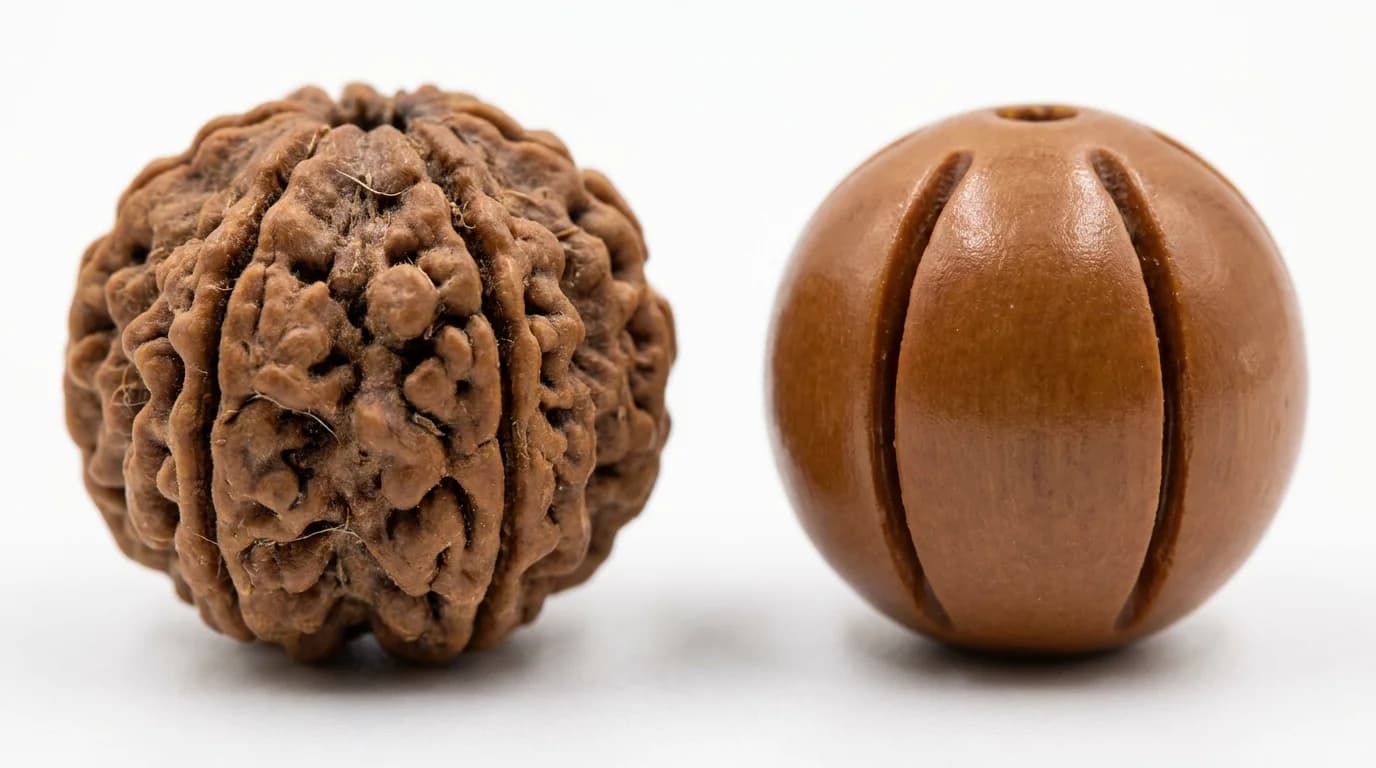
Examine the bead under a 10x jeweller's loupe or phone macro lens. The mukhis (face lines / clefts) of genuine rudraksha run naturally from the crown (top hole) to the base (bottom hole) with organic, slightly irregular paths. The depth of each cleft varies naturally — some deeper, some shallower — and the ridges between faces are naturally rounded. On carved fake beads, the cleft lines are cut with a blade or CNC tool: they are straight, uniformly deep, and the ridges show flat machining marks rather than natural rounded wood grain.
| Genuine mukhi | Organic, irregular path from crown to base; natural depth variation; rounded ridges |
| Fake mukhi | Straight cuts; uniform depth; machining marks on ridge surfaces |
| Easy home method | Macro camera on smartphone — zoom in 5–10x on surface |
Weight, Texture & Smell: The Feel Test
Roll a single rudraksha bead between your fingers. Genuine Nepali Panchmukhi is noticeably hard (harder than most wood), dense enough to feel substantial for its size, and slightly rough to the touch at the ridges. The base colour is a warm brown, often darker in the clefts. Genuine rudraksha has a mild, natural woody-earthy scent. Plastic fakes feel light and smooth; painted wood fakes may smell of varnish, paint, or chemical coating. Dyed beads that have been colour-treated to look darker often have a slight chemical smell and colour that transfers to a wet finger rubbed across the surface.
| Genuine feel | Hard, dense, slightly rough — warm brown with natural variation |
| Plastic fake | Light, smooth, uniform surface, faint chemical or odourless |
| Dyed wood fake | Colour rubs off on wet finger; may smell of stain or varnish |
| Compressed sawdust | Slightly lighter, surface may show press-moulded pattern under loupe |
X-Ray & Lab Certificate: The Only Definitive Test
An X-ray of a genuine rudraksha reveals its internal seed chamber structure. Genuine Elaeocarpus ganitrus has a compartmentalised interior — the number of internal chambers matches the external mukhi count. A 5-mukhi bead has 5 internal chambers; a 7-mukhi has 7. Fake beads (wood or plastic) show a solid or randomly hollow interior with no chamber structure. A third-party laboratory can also identify the species definitively using microscopic seed coat analysis, confirming Elaeocarpus ganitrus vs imitation material.
DivineTatva provides a lab certificate with every Rudraksha Mala confirming: (1) species as Elaeocarpus ganitrus, (2) mukhi count, (3) origin (Nepali Himalayan). This is the gold standard — no home test replaces it.
Genuine Nepali vs Indonesian vs Fake: What You're Actually Getting
| Type | Species | Size | Float? | Mukhi | Lab Cert? | Price (108-bead mala) |
|---|---|---|---|---|---|---|
| Genuine Nepali | Elaeocarpus ganitrus | 7–14mm | Sinks (mostly) | Clear, natural | Yes (DivineTatva) | ₹999–₹50,000+ |
| Genuine Indonesian | Elaeocarpus ganitrus | 4–6mm | May float (lighter) | Less defined | Rarely | ₹200–₹700 |
| Carved wood fake | Berberis or similar | Variable | Sinks (dense wood) | Machined cuts | No | ₹100–₹400 |
| Plastic / resin fake | None | Variable | Floats | Moulded lines | No | ₹50–₹250 |
| Dyed/painted bead | Often wood | Variable | Sinks or floats | May look real | No | ₹150–₹500 |
Frequently asked
Last reviewed: 17 May 2026 · Verified by the DivineTatva expert panel
Is the float test alone enough to confirm rudraksha is genuine?
No. The float test filters obvious plastic fakes but some genuine rudraksha floats too (hollow or dried centres). Use needle test + mukhi clarity + lab certificate for reliable confirmation. Never rely on float test alone when buying a high-value mala.
Is Indonesian rudraksha fake?
No — Indonesian rudraksha is genuine Elaeocarpus ganitrus, the same species as Nepali. It is simply smaller (4–6mm vs 8–12mm for Nepali) and lighter, which is why it commands a lower price. It is a different grade, not a fraud — but it should not be sold as Nepali.
Can a seller's X-ray photo prove the rudraksha is real?
A photo is evidence but not definitive — images can be copied or faked. The most reliable approach is a certificate from a third-party certified laboratory that you can verify independently. DivineTatva provides lab certificates traceable to the testing laboratory.
Why does my rudraksha float even though the seller says it's genuine?
Older or dried rudraksha beads, or those with a slightly hollow or cracked internal chamber, can float despite being genuine Elaeocarpus ganitrus. Conduct the needle and mukhi clarity tests. If both pass, it is likely genuine. A lab cert confirms it definitively.
What is the most reliable home test for rudraksha authenticity?
The needle test (irregular organic bore vs smooth machine-drilled hole) combined with mukhi clarity under a 10x loupe is the most reliable two-test combination for home use. The float test is supplementary only.
Reviewed by the DivineTatva expert panel
Written and reviewed by DivineTatva's consulting Vedic astrologer. Every piece is lab-certified and energised in our Jaipur atelier. Last updated 15 June 2026.