Real vs Fake Shri Yantra: The Geometry Test Most Buyers Never Run
Almost every authenticity guide for Shri Yantra talks about metal and energisation. Both matter, but neither is the real test. The Shri Yantra is a precise mathematical construction — nine interlocking triangles that must meet at exact points to generate 43 smaller triangles — and the majority of mass-produced plates get the intersections wrong. A yantra with incorrect geometry is, in the tradition's own terms, not a Shri Yantra at all, whatever metal it is stamped on.
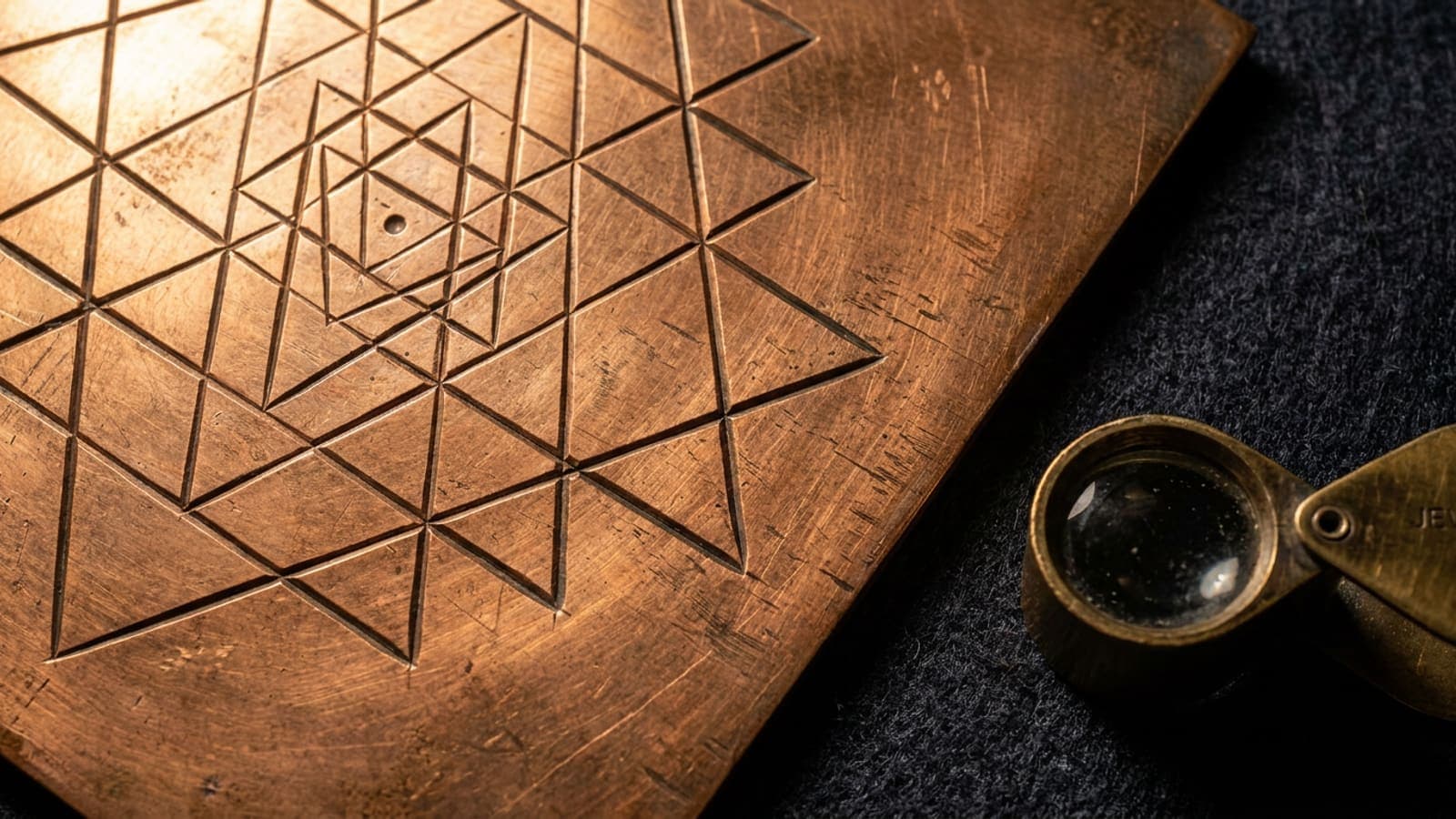
How to identify an original Shri Yantra — in order of importance.
Check in this order: geometry first, engraving depth second, metal third, energisation last. Most buyers do it backwards — they ask 'is it real copper' and 'is it energised' while never looking at whether the nine triangles actually intersect correctly. The geometry is the yantra. A mathematically wrong diagram in solid copper, consecrated by a pandit, is still a wrong diagram.
| Test 1 — geometry | 9 interlocking triangles generating exactly 43 smaller triangles + central bindu |
| Test 2 — engraving | Lines must have physical depth; run a fingernail across them |
| Test 3 — metal | Copper is standard; check weight and check for plating wear at edges |
| Test 4 — energisation | Ask who, when, with which mantra — a vague answer means none |
| Triangle split | 4 upward (Shiva) + 5 downward (Shakti) |
| Surrounding structure | 8-petal lotus, 16-petal lotus, three circles, square bhupura with 4 gates |
| Honest price | ₹800–₹3,500 hand-engraved copper 4-inch; ₹2,500–₹15,000 Meru |
| Red flag | ₹99–₹250 'original Shri Yantra' — printed foil or stamped alloy |
The geometry test — what a correct Shri Yantra must contain.
The Shri Yantra is built from nine primary triangles overlaid on a common centre: four pointing upward (Shiva, the masculine principle) and five pointing downward (Shakti, the feminine). Their intersections generate 43 smaller triangles arranged in five concentric enclosures, with a single point — the bindu — at the exact centre. Constructing this correctly is a genuinely difficult geometry problem; mathematicians have published papers on it, because the nine triangles must be sized and positioned so that their edges meet at shared points rather than crossing at slightly wrong places.
Mass-produced plates are usually copied from other copies, and the errors compound. The result looks right at arm's length and falls apart under inspection: triangle vertices that miss the line they should touch, a bindu that is not at the true centre, or an outer enclosure with the wrong triangle count.
- 1Count the enclosures from outside in
A correct Shri Yantra has, working inward: the square bhupura with four T-shaped gates, three concentric circles, a 16-petal lotus, an 8-petal lotus, then the triangle field, then the bindu. A plate missing the 16-petal lotus or with the lotuses swapped in order is wrong.
- 2Check the two triangle counts
In the triangle field you should be able to trace 4 upward and 5 downward primary triangles. Many cheap plates have 8 or 10 primaries because the copyist lost count. This is the fastest disqualifying check.
- 3Look at the intersections under raking light
Tilt the plate so light rakes across the surface. On a correct yantra the triangle corners MEET — vertex touches line. On a bad copy you will see near-misses: a corner floating just short of, or crossing just past, the line it should touch. Once you have seen it you cannot unsee it.
- 4Find the bindu and check it is central
The central point should sit at the exact geometric centre of the innermost triangle. On poor copies it is visibly offset. Measure with a ruler across the bhupura if you want certainty.
- 5Symmetry check
Fold-test it visually along the vertical axis — a correct Shri Yantra is bilaterally symmetric. Asymmetry between left and right halves means the construction is off.
Engraved vs printed vs stamped — how to tell in five seconds.
| Type | How to identify | Traditional standing | Price band |
|---|---|---|---|
| Hand-engraved | Lines have depth and slight tool variation; back is plain | ✅ The prescribed form | ₹800–₹3,500 (4-inch copper) |
| Machine-engraved | Depth present but perfectly uniform lines | ✅ Acceptable | ₹500–₹1,500 |
| Die-stamped / embossed | Raised rather than cut; reverse shows mirror impression | ⚠️ Common; geometry often inaccurate | ₹200–₹700 |
| Screen-printed on metal | No depth at all; ink sits on surface, scratches off | ❌ Not for installation | ₹100–₹300 |
| Printed paper / foil / laminated | Paper or plastic | ❌ Temporary ritual use only, not installation | ₹20–₹150 |
The five-second test: run a fingernail slowly across the triangle lines. Engraving catches the nail. Printing does not. Then turn the plate over — a die-stamped plate shows the mirror impression of the design pushed through from the front, while an engraved plate has a plain reverse. Neither test requires any expertise, and between them they eliminate most of what is sold as 'original Shri Yantra' online.
Copper, plated or brass — and how to catch plating.
Copper is the prescribed metal for engraved yantras across the tradition. Brass is acceptable and more tarnish-resistant. Silver and gold are used for small pendant yantras. The problem in the market is not brass sold as brass — it is brass or zinc alloy copper-plated and sold as solid copper, at solid-copper prices.
- 1Weight for size
Solid copper is dense. A 4-inch copper plate of normal thickness should feel substantial — noticeably heavier than it looks. A light 4-inch 'copper' plate is thin plated alloy.
- 2Check the edges and the reverse
Plating wears first at the rim and on the back where handling is heaviest. Look for a yellowish or silvery tone showing through the copper colour at any edge. Solid copper is the same colour all the way through, including any scratch.
- 3The tarnish test (over time)
Real copper darkens and develops patina with exposure — it is supposed to. A 'copper' yantra that looks identically bright after a year in a puja room is lacquered or plated. Darkening is a sign of authenticity, not damage; clean it with tamarind or lemon-and-salt and dry it fully.
- 4Magnet test
Neither copper nor brass is magnetic. If a magnet sticks, there is iron or steel in the core — the plate is plated steel, not copper.
Flat plate vs Meru — both real, different purposes.
| Parameter | Flat plate | Meru (3D pyramidal) |
|---|---|---|
| Form | Engraved on a flat sheet | Triangles rise in tiers to the bindu at the apex |
| Traditional use | Wall, altar, framed installation | Dedicated Sri Vidya puja, daily abhishek |
| Geometry verification | Easier — all lines visible at once | Harder — must inspect tier by tier |
| Price (4-inch copper) | ₹800–₹3,500 | ₹2,500–₹15,000 |
| Best for | Most households | Serious daily practitioners |
| Ardha-Meru variant | — | Partially raised; a middle option, ₹1,500–₹5,000 |
Both are legitimate. The Meru's higher price reflects genuine additional craftsmanship, not superior 'power' — the tradition prescribes Meru for the specific context of dedicated Sri Vidya sadhana with regular abhishek, where a flat plate is impractical. If you are installing a yantra on a puja shelf or wall and offering incense and a diya, the flat plate is the correct and standard choice. Treat 'only Meru works' as a sales line.
Energisation — the four questions that separate real from marketing.
'Energised' is the least verifiable claim in this category and therefore the most abused. Pran Pratishtha is a specific procedure, not an adjective. A seller who has actually performed it can answer four questions immediately:
- 1By whom?
A named pandit or a stated in-house ritual. 'Energised by our team of experts' is not an answer.
- 2When, and on what tithi?
Consecration is done on a specific auspicious day — Purnima, Amavasya for certain deities, Navratri, Diwali, Akshaya Tritiya. A real answer names the occasion. DivineTatva energises on Purnima and states the date.
- 3With which mantra, and how many repetitions?
For Shri Yantra the standard is Om Shreem Hreem Shreem Kamale Kamalalaye Praseed Praseed, typically 108 repetitions minimum. A seller who cannot state the mantra did not use one.
- 4What was offered?
Panchamrit cleaning, flowers, incense, diya, and the invocation. The procedure is standard enough that any genuine practitioner describes it the same way.
- 5And the honest note
You can energise a yantra yourself. It is not restricted to professionals — clean it with panchamrit, place it in its correct direction, light a diya, recite the mantra 108 times and state your sankalp. A geometrically correct, well-engraved copper plate that you consecrate yourself is a better buy than a geometrically wrong plate someone else says they energised.
Shri Yantra price in India 2026.
| Printed paper / foil yantra | ₹20–₹150 — ritual use only, not for installation |
| Screen-printed or stamped alloy plate | ₹100–₹300 — geometry usually wrong |
| Machine-engraved copper, 3–4 inch | ₹500–₹1,500 |
| Hand-engraved copper, 4 inch | ₹800–₹3,500 |
| Hand-engraved copper, 6 inch+ | ₹2,000–₹8,000 |
| Ardha-Meru (partially raised) | ₹1,500–₹5,000 |
| Full Meru, copper | ₹2,500–₹15,000 |
| Silver Shri Yantra pendant | ₹1,500–₹6,000 |
| DivineTatva hand-engraved copper 4-inch | ₹1,299, Purnima-energised |
Buying summary: hold the plate under raking light and count the triangles before you look at anything else. Run a nail across the lines. Check the rim for plating. Then ask the four energisation questions. If a seller passes all four checks, the price band above tells you whether you are being charged fairly — and if they fail the first one, no amount of copper or consecration fixes it.
Frequently asked
Last reviewed: 17 May 2026 · Verified by the DivineTatva expert panel
How do I identify an original Shri Yantra?
Check geometry first, not metal. A correct Shri Yantra has nine interlocking primary triangles — 4 upward, 5 downward — generating 43 smaller triangles, with a bindu at the exact centre, enclosed by an 8-petal lotus, a 16-petal lotus, three circles and a square bhupura with four gates. Tilt it under raking light: triangle corners must MEET the lines they touch, not fall short or cross past them.
Why is the geometry more important than the metal?
Because the geometry is the yantra. The Shri Yantra is a precise mathematical construction that mass-produced plates, copied from other copies, frequently get wrong — misaligned vertices, an off-centre bindu, the wrong number of primary triangles. A mathematically incorrect diagram in solid copper, consecrated by a pandit, is still an incorrect diagram in the tradition's own terms.
Engraved or printed Shri Yantra — how do I tell?
Run a fingernail slowly across the triangle lines: engraving catches the nail, printing does not. Then turn it over — a die-stamped plate shows the mirror impression pushed through from the front, an engraved plate has a plain reverse. Printed paper and foil yantras are for temporary ritual use, not for installation.
Is a copper-plated Shri Yantra acceptable?
Not at solid-copper prices. Check three things: weight (solid copper feels substantially heavier than it looks), the rim and reverse (plating wears first at edges, showing yellow or silver beneath), and a magnet (neither copper nor brass is magnetic — if it sticks, the core is steel). Also note that real copper is supposed to darken over time; a plate that stays identically bright is lacquered or plated.
Should I buy a flat Shri Yantra or a Meru?
Both are legitimate. The flat engraved plate is correct and standard for a puja shelf or wall — which is most households. The Meru (3D pyramidal) is prescribed for dedicated Sri Vidya sadhana with regular abhishek, where a flat plate is impractical. Its higher price reflects real extra craftsmanship, not superior power. 'Only Meru works' is a sales line.
How do I know if a Shri Yantra is really energised?
Ask four questions: by whom, on what tithi, with which mantra and how many repetitions, and what was offered. A genuine seller answers all four immediately — for Shri Yantra the mantra is Om Shreem Hreem Shreem Kamale Kamalalaye Praseed Praseed, minimum 108 repetitions. Also worth knowing: you can energise it yourself, and a geometrically correct plate you consecrate is a better buy than a wrong plate someone else claims to have energised.
What is the price of an original Shri Yantra?
Hand-engraved copper 4-inch: ₹800–₹3,500. Machine-engraved copper: ₹500–₹1,500. Full Meru in copper: ₹2,500–₹15,000. Anything sold as 'original Shri Yantra' at ₹99–₹250 is printed foil or a stamped alloy plate whose geometry is almost certainly incorrect.
Reviewed by the DivineTatva expert panel
Written and reviewed by DivineTatva's consulting Vedic astrologer. Every piece is lab-certified and energised in our Jaipur atelier. Last updated 23 July 2026.