Which Yantra for Which Purpose: Shri, Kuber, Lakshmi, Gayatri & Navdurga Compared
Six yantras, six different jobs — and the commonest mistake in Indian homes is keeping several without knowing what any of them is for. Shri Yantra is for overall abundance and is the only one traditionally described as containing all others. Kuber is specifically for retained wealth. Lakshmi is for incoming prosperity. Gayatri is for knowledge and clarity. Navdurga is for protection. Sampoorna combines the set. This guide tells you which one your situation actually calls for.
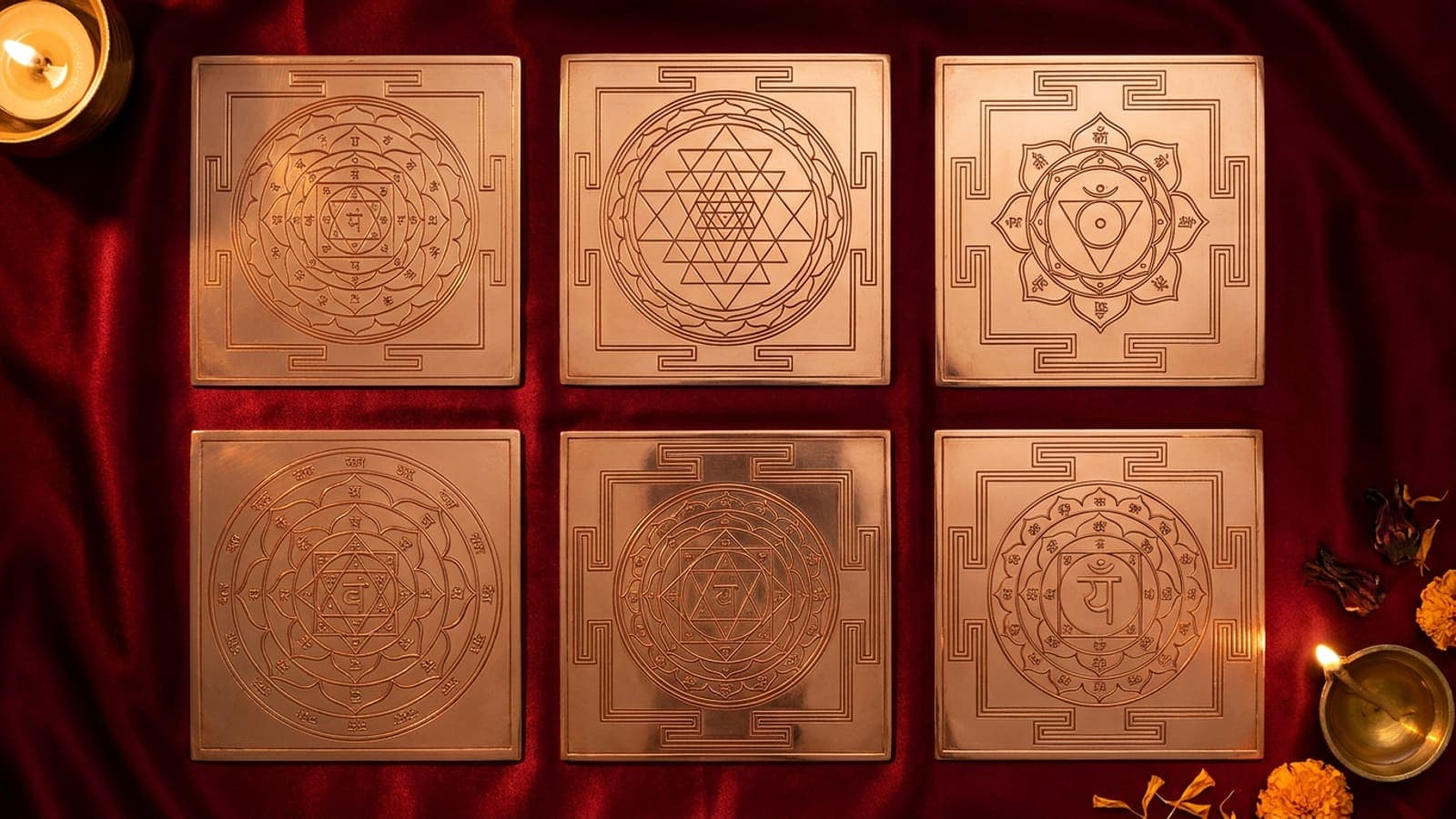
Which yantra for which purpose — the decision table.
A yantra is a geometric diagram that functions as the visual form of a deity or principle — the same way a mantra is its sound form. Each one is a specific instrument for a specific purpose, and the tradition treats keeping the wrong one, or several without understanding, as clutter rather than practice. Start with what you actually need:
| Your situation | Yantra | Deity | Direction to face |
|---|---|---|---|
| General prosperity, no one specific problem | Shri Yantra | Tripura Sundari / Lakshmi | East (yantra faces west) |
| Money comes but does not stay; savings leak | Kuber Yantra | Kubera, treasurer of the gods | North (Kubera's direction) |
| Income itself is short; want new inflow | Lakshmi Yantra | Mahalakshmi | East or North |
| Studies, exams, mental clarity, teaching | Gayatri Yantra | Gayatri / Savitri | East |
| Protection, obstacles, fear, ill-will | Navdurga Yantra | Nine forms of Durga | North-East or East |
| Want the combined set in one plate | Sampoorna Yantra | Multiple | North-East |
| Business premises specifically | Kuber + Shri together | — | North wall / cash counter |
Shri Yantra — the default, and why.
Shri Yantra (also Sri Chakra) is the geometric form of Tripura Sundari and is described in the Saundarya Lahari and Tantric literature as the king of yantras — the one said to contain the others within it. Its structure is nine interlocking triangles: four pointing upward for Shiva, five downward for Shakti, generating 43 smaller triangles around a central bindu. If you are buying one yantra and have no single specific problem, this is the one the tradition points to.
| Purpose | Overall abundance, spiritual growth, removal of general stagnation |
| Deity | Tripura Sundari (Lalita); associated with Mahalakshmi |
| Mantra | Om Shreem Hreem Shreem Kamale Kamalalaye Praseed Praseed |
| Placement | Puja room, living room, or office — at eye level or above |
| Facing | Keep it so the yantra faces west, i.e. you face east while praying to it |
| Best day to install | Friday, Diwali, Navratri, or Akshaya Tritiya |
| Flat vs Meru (3D) | Both valid; Meru (raised pyramidal) is prescribed for dedicated puja, flat plate for wall or altar |
| Who should keep it | Anyone — no lagna or rashi restriction |
One genuine point of debate worth knowing: flat plate versus Meru. The Meru form is three-dimensional, with the triangles rising to the bindu as a small pyramid — the more elaborate and more expensive version, prescribed in Sri Vidya practice for dedicated daily puja. The flat engraved plate is entirely valid for a home altar or wall and is what most households keep. Sellers who insist only Meru 'works' are upselling; sellers who cannot explain the difference do not know the tradition.
Kuber vs Lakshmi Yantra — the distinction almost nobody explains.
These two get treated as interchangeable 'money yantras' and they are not. Lakshmi is the goddess of prosperity — of wealth arriving. Kubera is the treasurer of the gods — the custodian of wealth already accumulated. The tradition's distinction maps almost exactly onto a modern financial one: Lakshmi is income, Kubera is retention.
| Parameter | Kuber Yantra | Lakshmi Yantra |
|---|---|---|
| Governs | Retention, savings, storage of wealth | Inflow, new income, prosperity arriving |
| Buy it when | Money comes but leaks away; no savings accumulate | Income itself is insufficient; seeking new sources |
| Direction | North — Kubera is the dikpala (guardian) of the north | East or North |
| Where in the home | Inside or on the locker, cash box, almirah | Puja room, entrance-facing wall |
| Mantra | Om Yakshaya Kuberaya Vaishravanaya Dhanadhanyadhipataye… | Om Shreem Hreem Shreem Mahalakshmyai Namah |
| Best install day | Dhanteras, Friday | Friday, Diwali, Akshaya Tritiya |
| Business use | Cash counter, safe — the standard shop placement | Entrance or reception area |
The practical answer for most households and shops: keep both, but place them differently — Lakshmi in the puja space or near the entrance where wealth enters, Kuber inside the locker or at the cash counter where wealth is held. Placing a Kuber yantra in the puja room and expecting it to work on savings is the most common misplacement in this category.
Sampoorna Yantra — when the set makes sense.
A Sampoorna ('complete') Yantra engraves several yantras onto one plate — typically Shri, Kuber, Lakshmi, Ganesh, Vastu and a Navagraha section. It exists for the practical situation of a household that wants comprehensive coverage in a single consecrated object rather than a shelf of separate plates.
| Consider Sampoorna if… | Consider separate yantras if… |
|---|---|
| You have one small puja space | You want each yantra placed in its correct direction and room |
| You want general coverage, no specific problem | You have one clear specific need (savings, studies, protection) |
| Budget for one good plate, not five | You are building a practice around one deity over time |
| You are setting up a new home broadly | You run a business and need Kuber at the counter specifically |
The honest limitation: a combined plate cannot be placed in six correct directions at once. Direction is a real part of yantra practice — Kubera is specifically northern, Gayatri specifically eastern. A Sampoorna plate is a reasonable compromise for a small home, and a compromise is what it is. If you have the space and the need, separate yantras placed correctly is the more faithful practice.
How many yantras can you keep at home?
There is no scriptural limit on the number, but there is a strong tradition-wide principle: a yantra that is not maintained is worse than no yantra. Each one is treated as a consecrated object requiring regular cleaning, periodic re-energisation and its own mantra. Five yantras nobody has dusted in a year is, in the tradition's own terms, five neglected deities.
| Practical maximum for a home | 2–3, each with a clear purpose and correct direction |
| Typical household set | Shri Yantra (puja room) + Kuber (locker) |
| Typical shop set | Kuber (cash counter, north) + Lakshmi (entrance) |
| Student's room | Gayatri Yantra alone |
| Never do | Keep yantras in a bedroom, bathroom-adjacent wall, or on the floor |
| Never do | Keep a cracked, bent or blackened-and-unmaintained yantra — replace or immerse it |
| Maintenance | Dust weekly, clean monthly (tamarind/lemon-salt for copper, then dry fully), re-energise annually |
Rules that apply to every yantra.
- 1Metal matters — copper is the standard
Copper is the prescribed metal for engraved yantras and what nearly all traditional plates use. Silver and gold are used for smaller pendant yantras. Avoid printed paper yantras (they are for temporary ritual use, not installation) and avoid plastic or laminated versions entirely.
- 2Engraved, not printed
The geometry should be physically engraved into the metal, and the lines should be accurate — the Shri Yantra's nine triangles must actually intersect correctly, which cheap stamped plates often get wrong. Run a finger over it: engraving has depth, printing does not.
- 3Direction is not optional
Each yantra has a prescribed direction and it is part of the practice, not decoration. Use a compass rather than assuming. A correctly-chosen yantra placed in the wrong direction is the second most common mistake after choosing the wrong yantra.
- 4Pran Pratishtha before use
A yantra is inert until energised. The consecration involves cleaning with panchamrit, invoking the deity with the yantra's specific mantra (typically 108 repetitions), and offering flowers, incense and a diya. DivineTatva performs this on Purnima before dispatch; you can also have a pandit do it, or do it yourself with the mantra.
- 5Placement height and cleanliness
Eye level or above, never on the floor, never in a bedroom or against a bathroom wall. Keep the surrounding space clean — in this tradition an unclean placement is treated as cancelling the installation.
Frequently asked
Last reviewed: 17 May 2026 · Verified by the DivineTatva expert panel
Which yantra is best for home?
Shri Yantra, if you have no single specific problem — it is described in the Saundarya Lahari as containing all other yantras and has no lagna or rashi restriction. Choose differently for specific needs: Kuber for money that leaks away, Lakshmi for insufficient income, Gayatri for studies and clarity, Navdurga for protection and obstacles.
What is the difference between Kuber Yantra and Lakshmi Yantra?
Lakshmi governs wealth arriving; Kubera governs wealth retained. Buy Lakshmi when income itself is short and you want new inflow — place it in the puja room or near the entrance. Buy Kuber when money comes but does not stay — place it inside the locker, cash box or at the shop's cash counter, facing north, since Kubera is the guardian of the north.
How many yantras can we keep at home?
There is no scriptural limit, but the practical maximum is 2–3, each with a clear purpose and correct direction. The tradition holds that an unmaintained yantra is worse than none — each is a consecrated object needing weekly dusting, monthly cleaning and annual re-energisation. A common household set is Shri Yantra in the puja room plus Kuber in the locker.
Which direction should a yantra face?
It depends on the yantra. Shri Yantra: placed so it faces west and you face east while praying. Kuber: north, Kubera's own direction. Lakshmi: east or north. Gayatri: east. Navdurga and Sampoorna: north-east. Use a compass rather than assuming — wrong direction is the second most common mistake after choosing the wrong yantra.
Should I buy a flat Shri Yantra or a 3D Meru?
Both are valid. The Meru is the three-dimensional pyramidal form prescribed in Sri Vidya practice for dedicated daily puja; the flat engraved plate is entirely appropriate for a home altar or wall and is what most households keep. Sellers who insist only Meru works are upselling; sellers who cannot explain the difference do not know the tradition.
Is a Sampoorna Yantra better than separate yantras?
It is a reasonable compromise, not an upgrade. A combined plate suits a small puja space and a general need. Its real limitation is that direction is part of yantra practice — Kubera is specifically northern, Gayatri specifically eastern — and one plate cannot face six directions. With space and a specific need, separate yantras placed correctly is the more faithful practice.
Does a yantra need to be energised before use?
Yes — a yantra is treated as inert until Pran Pratishtha is performed. The consecration involves cleaning with panchamrit, invoking the deity with that yantra's specific mantra (typically 108 repetitions), and offering flowers, incense and a diya. DivineTatva performs this on Purnima before dispatch; you can also have a pandit do it or perform it yourself.
Reviewed by the DivineTatva expert panel
Written and reviewed by DivineTatva's consulting Vedic astrologer. Every piece is lab-certified and energised in our Jaipur atelier. Last updated 23 July 2026.