7 Chakra Bracelet Price in India & How to Buy an Original One
A 7 chakra bracelet in India typically costs Rs 150-400 for mass-market dyed beads, Rs 500-900 for genuine AA-grade natural stone, and Rs 1,000-plus for certified, energised pieces. Price tracks bead quality, certification and sourcing, not packaging. An original uses seven real stones in fixed root-to-crown colour order, comes lab-certified, and is honestly described as a tradition that supports intention, not a medical cure.
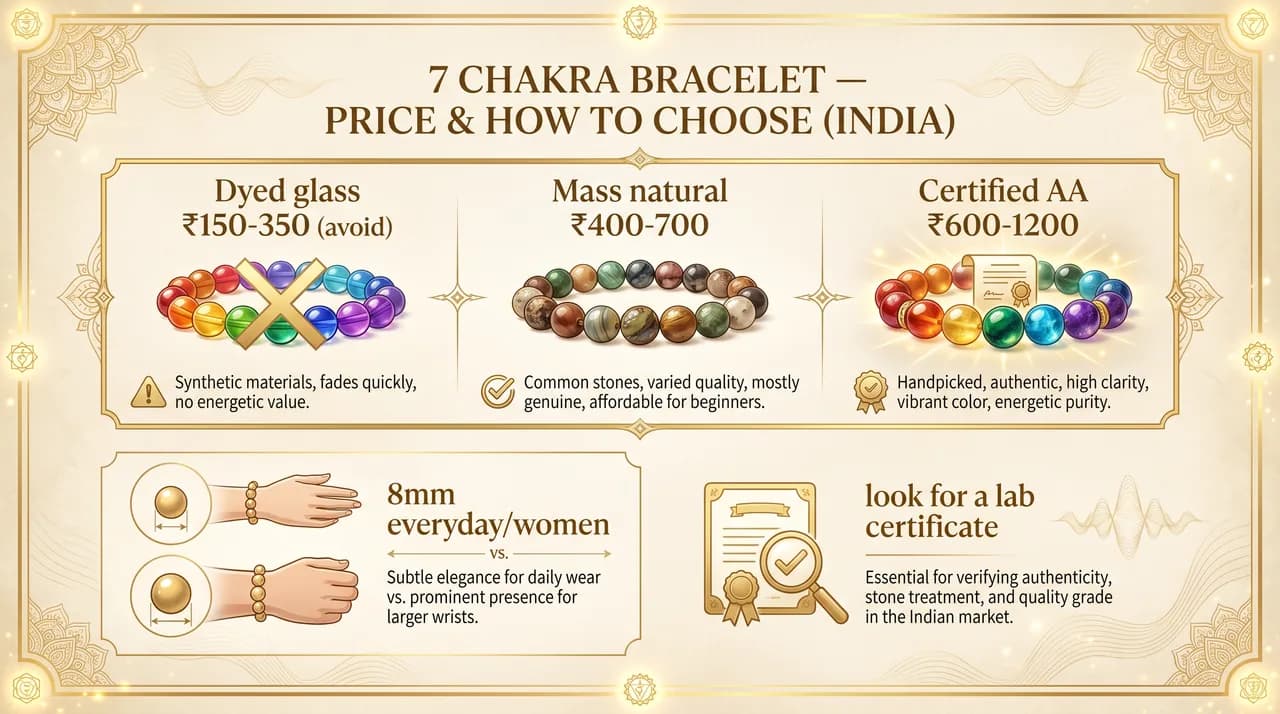
7 Chakra Bracelet Price in India by Quality Tier
Search "7 chakra bracelet price in india" and you will see anything from Rs 99 to Rs 2,500 for what looks like the same product. The spread is real, and it maps to three things: the stones (dyed glass and reconstituted powder versus genuine natural stone), whether the piece is independently certified, and whether it has been cleansed and energised before dispatch. The bracelet itself is simple, seven 8mm or 10mm beads on elastic, so the price is almost entirely a quality and trust signal, not a manufacturing one.
Use the tiers below as honest benchmarks. If a listing is far under the natural-stone band but claims AA-grade certified stone, treat the claim with caution. Genuine Red Jasper, Carnelian, Citrine, Green Aventurine, Sodalite, Lapis Lazuli and Amethyst, cut and drilled to a matched 8mm size, cannot reach Rs 99 once you account for sourcing, wastage and certification.
| Tier | Typical price (India) | What you actually get |
|---|---|---|
| Mass-market / fashion | Rs 99-Rs 400 | Dyed glass, resin or reconstituted stone powder. Bright but uneven colour, no certificate, fades fast. Fine as decor, not as a genuine chakra set. |
| Genuine natural stone | Rs 500-Rs 900 | Real AA-grade stones in correct colour order, natural tone variation, no certificate or a basic one. Good everyday quality. |
| Certified & energised | Rs 800-Rs 1,500 | Lab-certified natural stone, matched beads, cleansed and energised (Pran Pratishta). Comes with documentation and clear return terms. |
| Premium / designer | Rs 1,500-Rs 2,500+ | Hand-matched high-grade stones, silver charms or spacers, gift packaging. Premium for finish and presentation, not extra healing. |
| DivineTatva 8mm | Rs 599 for a certified, energised natural-stone bracelet |
| DivineTatva 10mm | Rs 799 for the larger-bead version, same certification |
| Price driver | Stone authenticity and certification, not bead count or packaging |
| Red flag | Certified AA-grade claim priced below Rs 300 |
One honest note before you spend: no crystal has clinical proof of healing. Across every tier you are buying a beautiful natural-stone tradition that supports your own intention and mindfulness, not a medical treatment. Pay for real stone and honest certification, not for promises that a bracelet will cure anything.
8mm vs 10mm Beads and How to Size Your Wrist
Bead size is the most common buying mistake. 8mm is the everyday default: lighter, slimmer, and easy to stack or wear under a sleeve, which suits most women, teens and slimmer wrists. 10mm beads are chunkier and more visible, which most men and anyone with a broader wrist prefer. Neither size changes the meaning or the stones, only the look and weight, so choose for comfort and wrist proportion.
| Factor | 8mm bracelet | 10mm bracelet |
|---|---|---|
| Best for | Women, teens, slim wrists, stacking | Men, broad wrists, a bolder solo look |
| Feel on wrist | Light, low-profile, daily wear | Heavier, more presence |
| DivineTatva price | Rs 599 | Rs 799 |
| Beads on a 7-inch strand | About 22-23 beads | About 17-18 beads |
- 1Measure your wrist
Wrap a soft tape or a strip of paper snugly around the wrist just below the bone and note the number in centimetres.
- 2Add ease for comfort
Add about 1.5 to 2 cm to your bare measurement so the elastic sits comfortably without pinching.
- 3Pick your size band
Roughly: under 15 cm is small, 15-17 cm is medium (most people), and over 17 cm is large. Most men land in medium-large.
- 4Match bead to wrist
On very slim wrists, 10mm beads can look oversized; on broad wrists, 8mm can disappear. When unsure, 8mm flatters more people.
- 5Mind the elastic
A correctly sized stretch bracelet slips over the hand with light tension. Too tight strains the elastic; too loose lets beads rub and chip.
For children, choose 8mm on a shorter strand and supervise wear, since elastic and small beads are not suited to unsupervised young kids. If you are buying as a gift and cannot measure, a medium 8mm is the safest default for women and a medium-large 10mm for men.
What a Real 7 Chakra Bracelet Certificate Actually Shows
A certificate is what separates an original from a lookalike, but only if it carries real, checkable detail. A vague card that simply says "100% genuine" with a logo is marketing, not certification. A genuine lab report or authenticity certificate names the stones, confirms they are natural, and ties the document to a real testing body or the brand's verifiable guarantee.
- 1Named stones
Each of the seven stones identified individually (Red Jasper, Carnelian, Citrine, Green Aventurine, Sodalite, Lapis Lazuli, Amethyst), not just "assorted crystals".
- 2Natural vs treated
A clear statement that stones are natural, with any standard treatment (such as dyeing of howlite) disclosed honestly rather than hidden.
- 3Specifications
Bead size (8mm or 10mm), count (7), and material so the document matches what arrives in the box.
- 4Issuing authority
A named lab or brand authenticity guarantee with a way to verify, not an anonymous clip-art seal.
- 5Energisation note
If sold as energised, a clear statement of the Pran Pratishta or cleansing done, kept separate from any health claim.
Be wary of certificates that promise medical outcomes. A credible document certifies what the stones ARE (natural, identified, correctly sized); it does not certify what they will DO to your body. DivineTatva pieces are lab-certified natural stone and energised in Jaipur, and we describe benefits as traditional and intention-based, supporting your effort rather than replacing medical care.
| Certifies | Stone identity, natural origin, bead size and count |
| Does not certify | Any cure, diagnosis or guaranteed health effect |
| Green flag | Stones named one by one and matched to the product |
| Red flag | A generic seal plus a medical-sounding promise |
How to Vet a Seller Before You Pay
Most disappointment comes from the seller, not the stone. Before checkout, run a quick trust check. Honest sellers show real photos, state the stones plainly, price within the natural-stone band, and frame benefits as tradition plus intention rather than guaranteed healing.
- 1Check the colour order
A real set runs root-to-crown: red, orange, yellow, green, blue, indigo, violet. Random or repeated colours signal a fashion piece, not a true chakra bracelet.
- 2Read the stone list
The listing should name all seven stones. "Multicolour crystal" with no names usually means dyed glass.
- 3Inspect real photos
Look for natural tone variation and tiny inclusions. Flawless, candy-bright, identical beads often mean dyed or synthetic.
- 4Match price to tier
Compare against the tiers above. A certified-AA claim at fashion-tier pricing is a contradiction.
- 5Confirm certificate and returns
Look for a real certificate, a stated authenticity guarantee, and a clear return or exchange window.
- 6Judge the claims
Sellers promising guaranteed cures are overselling. Trust those who say the bracelet supports your effort, not a medical treatment.
Care matters after the sale too, and good sellers tell you how. Cleanse a real natural-stone bracelet with dry methods, dry rice, a selenite plate, or a sage or incense smudge, or brief moonlight. Avoid prolonged sunlight, which fades amethyst and citrine, and avoid salt water, which can damage softer beads and the elastic. A seller who shares this care guidance is usually one who sells real stone.
7-Chakra vs Single-Chakra vs Lava-Stone Bracelets
If you are choosing between styles, the difference is purpose. A 7-chakra bracelet is the all-rounder, covering every energy centre for general balance. A single-chakra bracelet concentrates on one intention. A lava-stone bracelet is mainly a diffuser you can scent with essential oil, often combined with chakra beads.
| Type | Stones | Best for | Typical price |
|---|---|---|---|
| 7-chakra | Seven stones, one per chakra in colour order | Overall balance, beginners, gifting | Rs 599-Rs 1,500 certified |
| Single-chakra | One stone type (e.g. Amethyst for crown) | A focused intention like calm or confidence | Rs 400-Rs 900 |
| Lava-stone | Porous black lava, sometimes with chakra beads | Aromatherapy diffusing, a rugged unisex look | Rs 300-Rs 800 |
There is no "best" type, only the right fit for your goal. Choose the 7-chakra set if you want a complete, balanced piece and a clear colour story on the wrist. Choose single-chakra if one area matters most to you right now. Choose lava-stone if scent and texture appeal more than a full stone spectrum. Across all three, the honest framing is the same: these are supportive traditions, not medical devices.
Choosing for Men, Women and Kids
The stones and meaning are the same for everyone; only size, bead choice and styling change. The 7-chakra bracelet is naturally unisex because its design is the colour sequence, not a gendered shape.
| For men | 10mm beads on a medium-large strand for a bolder, balanced look on broader wrists |
| For women | 8mm beads suit most wrists, sit well under sleeves and stack easily with other bracelets |
| For teens | 8mm on a medium-small strand; a popular first mindful-jewellery piece |
| For kids | 8mm on a short strand, worn with supervision; not for unsupervised young children |
Wrist choice applies to all wearers. Many traditions favour the left wrist, the receiving hand, for calm and balance, while the right projects energy outward. Pick the wrist that matches your intention. Whoever wears it, treat the bracelet as a daily reminder of an intention you are already working toward, a support for your effort rather than a substitute for medical advice.
DivineTatva offers both sizes (8mm at Rs 599, 10mm at Rs 799) in AA-grade natural stone, lab-certified and energised in Jaipur, so the same certified quality fits men, women and teens. If you are unsure which size or style suits the wearer, the bracelet quiz can point you to the right fit before you buy.
Frequently asked
Last reviewed: 17 May 2026 · Verified by the DivineTatva expert panel
How much does a 7 chakra bracelet cost in India?
Expect roughly Rs 99-Rs 400 for mass-market dyed beads, Rs 500-Rs 900 for genuine natural stone, and Rs 1,000-plus for certified, energised pieces. DivineTatva's certified natural-stone bracelet is Rs 599 for 8mm and Rs 799 for 10mm. Price tracks stone authenticity and certification, not bead count or packaging.
How do I know if my 7 chakra bracelet is original?
An original uses seven real stones in fixed root-to-crown colour order (red, orange, yellow, green, blue, indigo, violet), shows natural tone variation and tiny inclusions, and comes with a certificate that names each stone. Flawless, candy-bright, identical beads with no certificate usually mean dyed glass or resin.
Is 8mm or 10mm better for a 7 chakra bracelet?
Neither is better; they differ in look and weight. 8mm is lighter and slimmer, suiting most women, teens and slim wrists, and stacks easily. 10mm is chunkier and bolder, which most men and broader wrists prefer. The stones and meaning are identical in both sizes.
Why are some 7 chakra bracelets so cheap?
Very low prices usually mean dyed glass, resin or reconstituted stone powder rather than genuine natural stone, plus no certification and no energisation. Real AA-grade stones, cut and matched to size and independently certified, cannot reach fashion-tier prices once sourcing and testing are accounted for.
What should a real 7 chakra certificate include?
It should name all seven stones individually, confirm they are natural (disclosing any standard treatment), state bead size and count, and come from a named lab or a verifiable brand authenticity guarantee. A credible certificate certifies what the stones are, not any medical cure or guaranteed health effect.
Can men wear a 7 chakra bracelet?
Yes. The 7-chakra bracelet is unisex because the design is the colour sequence, not a gendered shape. Men often prefer 10mm beads on a medium-large strand for a bolder look on broader wrists, while the stones and meaning stay the same as any other size.
How do I care for a natural-stone chakra bracelet?
Cleanse with dry methods such as dry rice, a selenite plate, or a sage or incense smudge, or brief moonlight. Avoid prolonged sunlight, which fades amethyst and citrine, and avoid salt water, which can damage softer beads and the elastic. Gentle dry care keeps both stones and elastic in good condition.
Do 7 chakra bracelets actually heal you?
There is no clinical proof that crystals heal. The 7 chakra bracelet is best understood as a tradition that supports your own intention and mindfulness, a daily reminder of a goal you are working toward. It supports your effort and is not a medical treatment or a substitute for professional care.
Which wrist should I wear a 7 chakra bracelet on?
Many traditions favour the left wrist, the receiving hand, for calm and balance, while the right wrist projects energy outward. There is no fixed rule, so choose the wrist that matches your intention. The stones and benefits are the same whichever wrist you pick.
Reviewed by the DivineTatva expert panel
Written and reviewed by DivineTatva's consulting Vedic astrologer. Every piece is lab-certified and energised in our Jaipur atelier. Last updated 21 April 2026.