Citrine Bracelet Price in India 2026: Natural vs Treated Cost, 8mm vs 10mm & Sizing
A citrine bracelet is a stretch or beaded wrist band of citrine — a yellow-to-golden quartz called the "merchant's stone" of abundance. Price in India swings widely because most market "citrine" is heat-treated amethyst (real quartz, kiln-coloured), while naturally yellow citrine is rarer and dearer. This guide explains the gap, bead-size value and sizing.
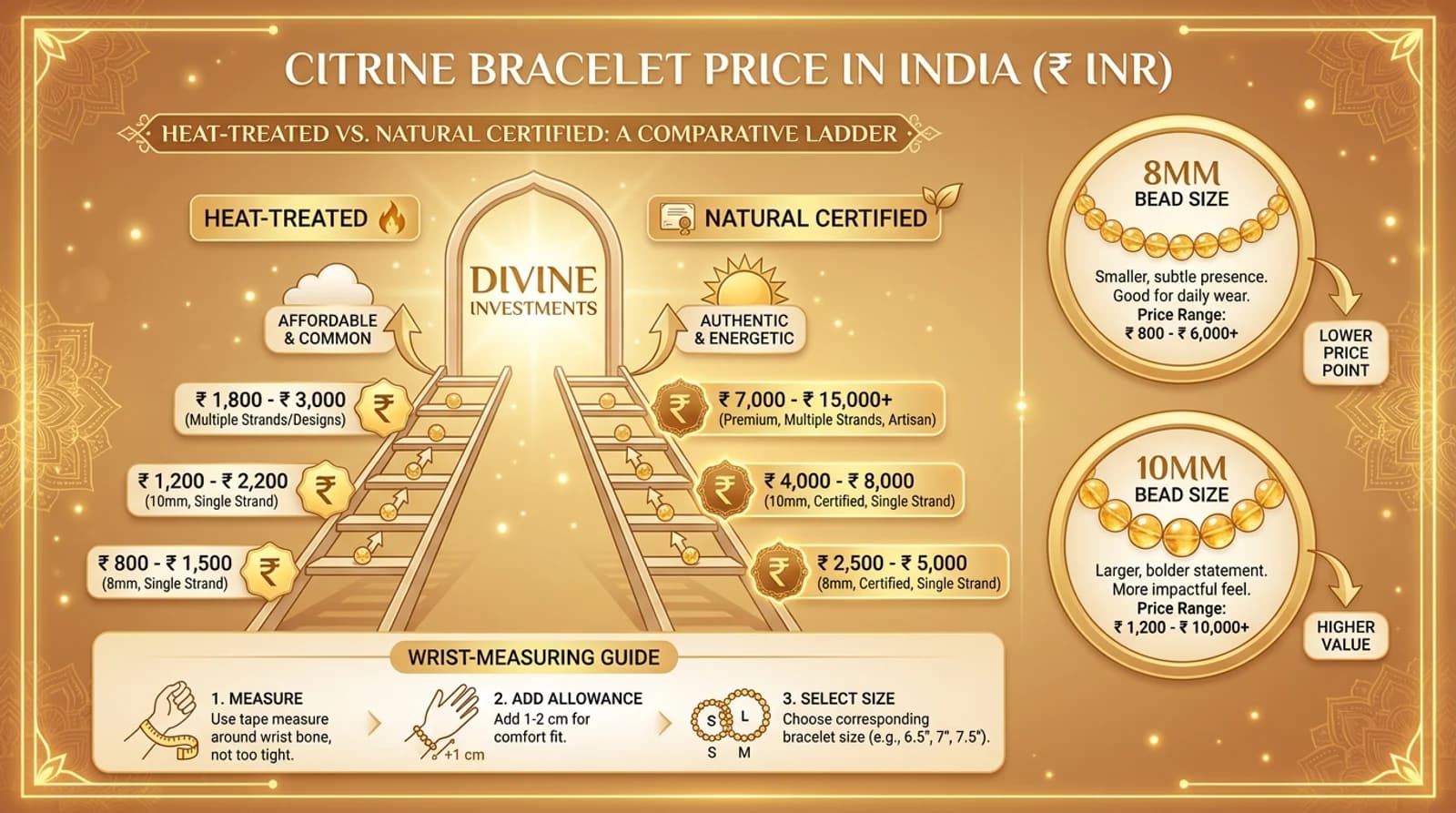
What a Citrine Bracelet Actually Costs in India
A genuine citrine bracelet in India typically costs between ₹450 and ₹3,500 in 2026, depending on whether the stone is naturally yellow or heat-treated quartz, the bead size, the cut quality and — crucially — whether it comes with a real lab certificate. Anything advertised below roughly ₹300 is almost always dyed glass or uncertified treated stock, not a tested gemstone.
Price is driven by four things: origin (natural vs treated), bead diameter, clarity and finish, and certification. Two bracelets that look identical online can differ 5x in price once you account for those factors. The table below shows realistic INR bands so you can sanity-check any listing before you pay.
| Treated citrine, 8mm, uncertified | ₹300–₹700 |
| Treated citrine, 8mm, lab-certified | ₹700–₹1,400 |
| Treated citrine, 10mm, lab-certified | ₹1,100–₹1,900 |
| Natural yellow citrine, certified | ₹2,000–₹3,500+ |
| Dyed glass / fake (avoid) | ₹99–₹299 |
| Typical COD + free-shipping range | ₹700–₹2,500 |
These bands reflect honest 2026 pricing for tested stones with a downloadable Jaipur lab report. Belief in citrine's prosperity and confidence benefits comes from Vedic and metaphysical tradition; it is culturally meaningful, not medically or financially proven, and price has nothing to do with how 'powerful' a stone is.
Natural vs Heat-Treated Citrine: Why the Price Gap
Here is the disclosure most sellers skip: the large majority of commercial 'citrine' is heat-treated amethyst. It is still real quartz and still genuinely citrine — but its golden colour was produced in a kiln, not by the earth. Naturally yellow citrine is geologically rare, which is exactly why it costs several times more. Neither is 'fake'; the honest question is which one you are paying for.
| Factor | Natural Citrine | Heat-Treated Citrine |
|---|---|---|
| Colour origin | Formed yellow in the earth | Amethyst baked golden in a kiln |
| Real quartz? | Yes | Yes |
| Typical hue | Pale lemon to smoky honey | Bright golden to orange-amber |
| Rarity | Rare | Very common (most of the market) |
| Certified price (8mm) | ₹2,000–₹3,500+ | ₹700–₹1,400 |
| Honest to sell as 'citrine'? | Yes | Yes, IF treatment is disclosed |
We state on every product page whether a bracelet is natural or heat-treated citrine — something most marketplace listings never tell you. A deep, perfectly uniform orange almost always signals treatment; uneven, subtle lemon zoning leans natural. Pay the natural premium only if you specifically want it, not because a listing implies rarity it can't prove.
Why ₹399 Citrine Beads Are Never Truly Certified
A real gemmological test costs money: a lab examines the stone, records refractive index and inclusions, and issues a numbered report. That cost alone makes a genuinely certified bracelet hard to sell at ₹399 without losing money. So when a ₹399 listing claims '100% certified', it usually means a printed authenticity card with no lab name, no report number and nothing to verify.
Look for what the certificate actually contains, not the word 'certified'. A real report names the issuing lab, carries a unique report number you can cross-check, and is downloadable. Vague badges like 'AAA-quality' or 'lab-tested' with no body named are marketing, not proof.
| Names a real lab | Genuine certificate |
| Unique report number you can verify | Genuine certificate |
| Downloadable copy per piece | Genuine certificate |
| '100% Certified' with no lab named | Marketing claim |
| 'AAA-quality' / authenticity badge only | Marketing claim |
| Bracelet under ~₹300 sold as certified | Almost certainly not tested |
Our Jaipur bracelets ship with a real lab certificate carrying a report number and a downloadable copy, so you are verifying the stone — not trusting a slogan. Certification confirms the material is genuine quartz; it does not, and cannot, certify any spiritual or wealth outcome.
Bead Size and What You Actually Pay For
Bead diameter is the single biggest driver of price between two otherwise identical bracelets. Larger beads use more material and weigh more, so a 10mm bracelet costs noticeably more than an 8mm of the same quality. Bigger is not 'stronger' — it is simply more stone and a bolder look. Choose by wrist size and style, not by any belief that size increases benefit.
| Bead size | Look & feel | Best for | Certified price feel |
|---|---|---|---|
| 6mm | Delicate, dainty | Slim wrists, layering, daily wear | Lowest |
| 8mm | Balanced, everyday | Most adults, unisex, gifting | Mid (best value) |
| 10mm | Bold, statement | Larger wrists, men, strong visual | Higher |
| 12mm | Chunky | Statement-only wear | Highest |
For most buyers, 8mm is the value sweet spot: enough presence to read as a proper bracelet, without the material premium of 10mm. Pick 6mm for a subtle daily piece or 10mm if you want it seen. The bead count adjusts to your wrist, so a larger wrist in 8mm and a slimmer wrist in 10mm can cost similar amounts.
Wrist Measurement and Sizing Chart
A citrine bracelet should sit snug but not tight, with room to slide about a finger underneath. To measure, wrap a soft tape or a strip of paper around your wrist just below the wrist bone, mark where it overlaps, and read the length in centimetres. Add roughly 1–1.5cm to that figure for a comfortable stretch-bracelet fit.
- 1Wrap
Loop a soft tape or paper strip around your wrist below the wrist bone.
- 2Mark
Note exactly where the strip overlaps itself.
- 3Measure
Lay the strip flat against a ruler and read the centimetres.
- 4Add ease
Add about 1–1.5cm for a comfortable, non-pinching fit.
- 5Match
Use the chart below to pick your bracelet size.
| 14–15 cm wrist | Small (XS/S) |
| 15–16.5 cm wrist | Medium (most women) |
| 16.5–18 cm wrist | Large (most men / broad wrists) |
| 18–19.5 cm wrist | Extra Large |
| Finger-gap test | One finger fits under a correct fit |
| Stretch ease to add | ≈1–1.5 cm over raw measurement |
If you are between sizes, size up for stretch bracelets — a slightly loose band wears better than one that strains the elastic. By tradition citrine is worn on the left wrist, the receiving side, for drawing in abundance, though either wrist is fine and the choice is personal preference, not a rule.
Spotting a Fake Citrine Bracelet
The most common fakes are dyed glass and dyed quartz sold as 'natural citrine'. A few quick tells help you judge a listing's photos and the bracelet in hand. None are foolproof on their own — but together with a real lab certificate, they protect you from overpaying for glass.
| Tiny round air bubbles inside beads | Likely glass — fake |
| Perfectly even, intense orange throughout | Often dyed or aggressively treated |
| Subtle colour zoning, pale-to-deeper patches | Consistent with genuine citrine |
| Colour rubs off on a damp cloth | Dyed — fake |
| Warms slowly, feels cool at first touch | Consistent with real quartz |
| No lab report or report number | Treat as unverified |
Genuine citrine is real quartz at about Mohs 7, so it resists casual scratching. Its colour can fade with prolonged direct sunlight, so test gently and never leave a bracelet baking on a windowsill. When photos and feel agree and a verifiable certificate backs them, you can buy with confidence.
Your Citrine Bracelet Buying Checklist
Use this before checkout to make sure you are paying a fair INR price for a tested stone — and to keep your bracelet looking golden for years. Care matters: citrine is durable but its golden colour can fade with prolonged sun exposure, so cleanse it briefly under moonlight, selenite or a quick water rinse and avoid leaving it in direct sunlight; keep it away from harsh chemicals, perfume and water while bathing.
- 1Confirm natural vs treated
The listing should clearly state which — most don't.
- 2Verify the certificate
Real lab name, a report number, downloadable copy.
- 3Match the price band
Cross-check against the INR ranges in this guide.
- 4Choose bead size by wrist
8mm for value; 6mm subtle; 10mm bold.
- 5Get your size right
Measure, add ease, size up if between.
- 6Check trust terms
COD, free shipping and a stated return window.
Citrine's links to the solar plexus chakra, to Jupiter (Guru) and Thursday wear, and to prosperity and confidence come from Vedic and metaphysical tradition. Many wearers report feeling calmer, clearer and more motivated — experiences consistent with intention and ritual. Treat the bracelet as supportive practice, not a substitute for medical, financial or professional advice.
Frequently asked
Last reviewed: 17 May 2026 · Verified by the DivineTatva expert panel
What is the price of a citrine bracelet in India in 2026?
A genuine, lab-certified citrine bracelet typically costs ₹700–₹1,900 for heat-treated stone at 8–10mm, and ₹2,000–₹3,500+ for naturally yellow citrine. Uncertified treated beads run ₹300–₹700. Anything under roughly ₹300 sold as 'certified' is almost always dyed glass, not a tested gemstone.
Why is natural citrine so much more expensive than treated?
Most market 'citrine' is heat-treated amethyst — real quartz baked golden in a kiln. Naturally yellow citrine forms that colour in the earth and is geologically rare, so it costs several times more. Neither is fake; you are paying for rarity. A reputable seller states clearly which one a bracelet is.
Is 8mm or 10mm citrine better value?
8mm is usually the value sweet spot: enough presence to look like a proper bracelet without 10mm's extra material cost. 10mm is bolder and suits larger wrists or a statement look. Bead size is about style and fit, not strength — a bigger bead does not deliver more benefit.
How do I know my citrine bracelet is real?
Look for a verifiable lab certificate with a named lab and a unique report number, not just the words '100% certified'. Genuine citrine is quartz (≈Mohs 7), shows subtle colour zoning rather than a flat dyed orange, has no internal air bubbles, and won't lose colour on a damp cloth.
How do I measure my wrist for a citrine bracelet?
Wrap a soft tape or paper strip around your wrist just below the wrist bone, mark the overlap, and measure it flat in centimetres. Add about 1–1.5cm for comfortable stretch. Roughly: 15–16.5cm is Medium, 16.5–18cm is Large. If between sizes, size up for stretch bracelets.
Does a citrine bracelet really attract money?
Citrine is the traditional 'merchant's stone' of abundance and confidence in Vedic and metaphysical belief. Many wearers report feeling more focused and motivated, consistent with intention and ritual. There is no clinical or financial proof it attracts wealth; treat it as supportive practice, not a substitute for professional advice.
Will my citrine bracelet fade?
Citrine is durable at about Mohs 7, but its golden colour can fade with prolonged direct sunlight. Cleanse it briefly under moonlight, selenite or a quick water rinse and avoid leaving it in the sun; keep it away from harsh chemicals, perfume and water while bathing to protect both colour and elastic.
Reviewed by the DivineTatva expert panel
Written and reviewed by DivineTatva's consulting Vedic astrologer. Every piece is lab-certified and energised in our Jaipur atelier. Last updated 26 March 2026.