Dhan Yog Bracelet Price in India 2026: Fair Cost, Cheap Fakes & Lab-Certified Value
A genuine Dhan Yog bracelet — a 6-stone prosperity combo of Pyrite, Citrine, Green Aventurine, Tiger Eye, Green Jade and Clear Quartz — typically costs ₹399–₹1,500 in India in 2026. Listings under ₹250 are almost always uncertified glass or dyed quartz. A per-piece lab-certified bracelet usually sits around ₹699–₹1,299 with COD and returns.
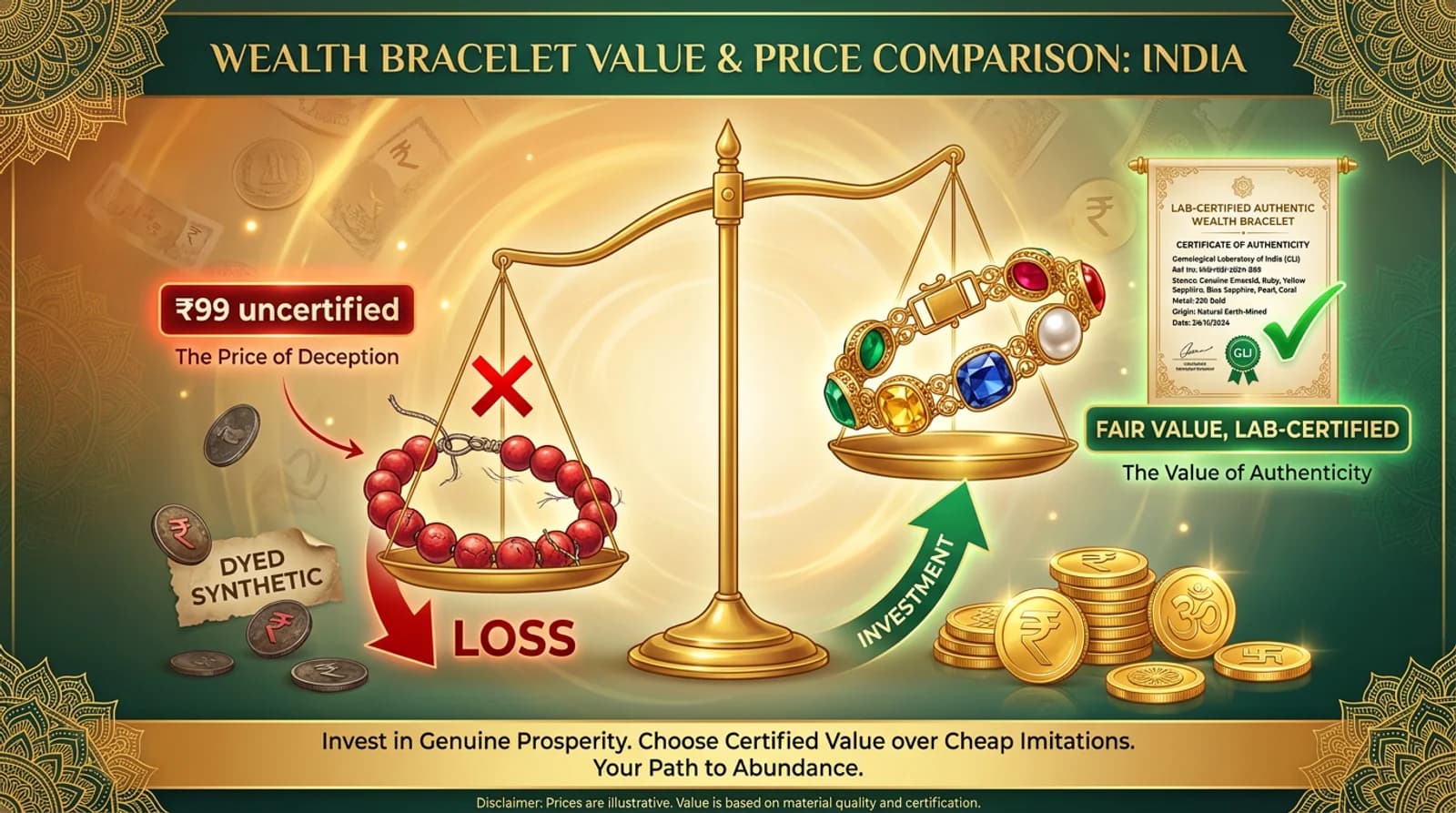
What Does a Dhan Yog Bracelet Cost in India?
In 2026, a genuine Dhan Yog bracelet (the 6-stone wealth combo of Pyrite, Citrine, Green Aventurine, Tiger Eye, Green Jade and Clear Quartz/Sphatik) typically costs ₹399 to ₹1,500 in India. A per-piece lab-certified version with a verifiable certificate number usually sits at ₹699–₹1,299. Anything priced below ₹250 is almost always uncertified glass, plastic or dyed quartz pretending to be natural stone.
Price depends on three honest things: whether the stones are genuine natural crystal, whether each bracelet ships with its own lab certificate, and the quality of the bead cut and elastic. The 'Dhan Yog' name itself adds no value — it is the verifiable stones and certification you are actually paying for.
| Typical fair price range (2026) | ₹399 – ₹1,500 |
| Lab-certified sweet spot | ₹699 – ₹1,299 |
| Stone count | 6-stone combo |
| Suspiciously cheap (likely fake) | Under ₹250 |
| Payment options expected | Prepaid + COD |
| Should include | Per-piece lab certificate |
Dhan Yog Bracelet Price Range, Tier by Tier
Not every price tells the same story. Here is what each price band on Indian marketplaces and brand stores usually means, so you can read a listing honestly before you pay.
| Price band | What you usually get | Verdict |
|---|---|---|
| Under ₹250 | Glass, plastic or dyed quartz beads; no certificate; mass imported | Avoid — not real crystal |
| ₹250 – ₹500 | Some natural stones mixed with treated/dyed beads; generic 'Lab Certified' badge with no number | Risky — verify before buying |
| ₹500 – ₹900 | Mostly genuine natural stones; basic certificate; decent bead cut | Fair value if certificate is verifiable |
| ₹900 – ₹1,500 | Genuine natural stones, per-piece lab certificate, transparent sourcing, good elastic and finish | Best trust-to-price ratio |
| Above ₹1,500 | Premium AAA-grade beads or larger sizes; often heavier marketing markup | Pay only if quality is provably higher |
Note on Citrine: most affordable Citrine in any Dhan Yog combo is heat-treated amethyst — this is industry-standard and not a scam, but an honest seller states it up front rather than implying every bead is rare natural Citrine.
Why Are Some Dhan Yog Bracelets So Cheap?
A ₹99 or ₹149 'Dhan Yog bracelet' looks like a bargain, but the maths does not work. Six genuine natural-stone beads, an elastic band, packaging, a real lab test and shipping cannot honestly be sold at that price. Something has been substituted — usually the stones.
- 1Glass and dyed stand-ins
Pyrite is faked with painted glass or hematite; Green Aventurine and Jade are imitated with dyed quartz or plastic that fades.
- 2No real certification
A generic 'Lab Certified' image with no certificate number is decorative, not proof. Real testing costs money, which is why it is skipped on ultra-cheap pieces.
- 3Bulk unbranded imports
Many cheap listings resell the same anonymous bulk stock with no sourcing story, no quality control and no accountability if a bead breaks.
- 4Missing care information
Genuine Pyrite tarnishes with water and sweat. Sellers who do not even know this rarely sell the real mineral.
Cheap is fine if you only want a fashion accessory. But if you are buying for the Dhan Yog tradition and the intention behind it, an uncertified fake defeats the purpose you are paying for.
Lab-Certified vs Uncertified: What You Actually Pay For
The single biggest price difference between two identical-looking Dhan Yog bracelets is certification. A per-piece lab certificate with a number you can verify is the difference between trusting a badge and trusting evidence.
| Feature | Uncertified bracelet | Lab-certified (per-piece) |
|---|---|---|
| Proof of natural stone | A printed badge or none | Certificate with a verifiable number |
| Sourcing transparency | Anonymous bulk | Named Jaipur sourcing story |
| Stone disclosure | Vague or absent | States heat-treated Citrine up front |
| Care guidance | Usually missing | Includes Pyrite DRY-care warning |
| Recourse if wrong | Little to none | Returns / replacement policy |
| Typical price | ₹99 – ₹400 | ₹699 – ₹1,299 |
You are not paying extra for a fancier bead — you are paying for accountability. The certificate ties this specific bracelet to a real test, and a transparent brand stakes its name on it. That is the trust moat a ₹99 listing structurally cannot offer.
What Makes a Dhan Yog Bracelet a Fair Price
A fair price is not the lowest price — it is the lowest price at which everything you need is actually present. Use this checklist to judge whether a listing earns its ₹699–₹1,299 tag.
- 1Per-piece lab certificate
A certificate number tied to your bracelet, not a stock image. This alone justifies most of the price gap over cheap fakes.
- 2Honest stone disclosure
The seller names all six stones and states clearly that Citrine is typically heat-treated. Transparency signals authenticity.
- 3Correct care information
Genuine Pyrite oxidises. The listing should tell you to keep it DRY and never soak it — proof the seller knows the real mineral.
- 4Clear sizing
Bead size and bracelet circumference stated, plus the elastic-stretch fit, so it actually fits your wrist.
- 5COD and returns
Cash on delivery and an easy return window let you inspect before fully committing — a fair seller welcomes this.
| Best trust-to-price band | ₹699 – ₹1,299 |
| Must-have at any price | Verifiable certificate number |
| Red flag | 'Lab Certified' with no number |
| Care must-have | Pyrite DRY-care warning |
| Buyer protection | COD + return window |
COD, Returns and Buying a Dhan Yog Bracelet Safely
Because authenticity is hard to judge from a photo, how you buy matters as much as price. Cash on delivery (COD) lets you receive the bracelet before paying, and a clear return window lets you inspect the stones, weight and certificate in hand.
- 1Choose COD where possible
Pay on delivery so you are not out of pocket if the parcel never matches the listing.
- 2Check the certificate first
On arrival, confirm the certificate number is real and matches your bracelet before wearing it.
- 3Do quick authenticity checks
Real Pyrite is cool, heavy and metallic; dyed stones often have paint pooling in drill holes. See our real-vs-fake guide.
- 4Keep packaging until satisfied
If anything is off, an easy return is far simpler with the original packaging and certificate intact.
- 5Mind the care from day one
Remove before bathing, swimming and workouts; the Pyrite tarnishes with water and sweat, so cleanse it DRY only.
Care note in full, because it protects your purchase: this combo contains Pyrite, which oxidises and tarnishes with water and sweat. Cleanse DRY only (selenite plate, moonlight overnight, smudge/incense, sound); NEVER soak in water or salt-water; remove before bathing, swimming and workouts; wipe with a soft dry cloth.
Does Paying More Make It 'Work' Better?
Here is the honest part most sellers skip. The Dhan Yog bracelet's wealth associations come from Vedic and crystal-healing tradition and from belief, not from peer-reviewed scientific evidence. There is no clinical proof that any crystal changes your finances or energy field. A higher price buys you genuine, certified stones — not a guaranteed outcome.
What many wearers do report is real in its own way: calm, focus and a daily reminder of their financial goals. That is consistent with intention-setting and ritual — the bracelet works as a faith-and-focus aid. Paying for certification ensures you are practising that tradition with real stones rather than dyed glass, which is the actual value of a fair price.
Treat it as a meaningful, beautiful intention tool, not a money machine. It is not a substitute for financial, medical or professional advice, and no bracelet replaces planning, work and sound money habits.
Frequently asked
Last reviewed: 17 May 2026 · Verified by the DivineTatva expert panel
What is the genuine price of a Dhan Yog bracelet in India?
In 2026 a genuine 6-stone Dhan Yog bracelet typically costs ₹399 to ₹1,500, with the lab-certified sweet spot around ₹699–₹1,299. The price reflects genuine natural stones, a per-piece lab certificate and quality finishing — not the 'Dhan Yog' name itself. Listings under ₹250 are almost always uncertified glass or dyed quartz.
Why are some Dhan Yog bracelets only ₹99 or ₹149?
Because something has been substituted to hit that price — usually the stones. Six genuine natural-stone beads, real lab testing, packaging and shipping cannot honestly be sold for ₹99. Such listings typically use dyed quartz, glass or plastic with a decorative 'Lab Certified' image that has no verifiable number. They are fashion accessories, not authentic crystal combos.
Is a lab-certified Dhan Yog bracelet worth the higher price?
If you want genuine stones, yes. The extra cost buys accountability: a certificate number tied to your specific bracelet, transparent Jaipur sourcing, honest stone disclosure and care guidance. It does not buy a guaranteed financial outcome — no crystal does that. It simply ensures you are practising the Dhan Yog tradition with real stones rather than dyed glass.
How do I know I am paying for an original and not a fake?
Look for a per-piece lab certificate with a number you can verify, not just a badge. Real Pyrite is cool, heavy and metallic; dyed stones often show paint pooling in the drill holes. An honest seller also discloses that Citrine is usually heat-treated and warns that Pyrite must be kept dry. COD lets you inspect before fully committing.
Why does the Citrine cost less than I expected?
Most affordable Citrine in any wealth combo is heat-treated amethyst rather than rare natural Citrine. This is an accepted industry-standard treatment, not a scam — but a trustworthy seller states it up front. If a listing implies every bead is rare natural Citrine at a budget price, treat that as a red flag about the rest of the stones too.
Does a more expensive Dhan Yog bracelet work better?
Not in any measurable financial sense. The wealth associations come from Vedic and crystal-healing tradition and belief, with no clinical scientific proof. A higher price buys genuine certified stones and craftsmanship, not a stronger effect. Many wearers report calm, focus and goal-reminding benefits consistent with intention-setting — the bracelet works as a faith-and-focus aid, not a money machine.
Can I buy a Dhan Yog bracelet with cash on delivery?
Yes — most reputable Indian sellers, including DivineTatva, offer COD. This is genuinely useful for an authenticity-sensitive purchase: you receive the bracelet, check the certificate number and inspect the stones before paying. Pair COD with an easy return window and keep the original packaging until you are fully satisfied with what arrived.
Reviewed by the DivineTatva expert panel
Written and reviewed by DivineTatva's consulting Vedic astrologer. Every piece is lab-certified and energised in our Jaipur atelier. Last updated 3 May 2026.