Manik Stone (Ruby): Benefits, Who Should Wear, Glass-Filled Warning & Price
Manik is the gemstone of Surya (the Sun) — authority, vitality, the father, government favour and the soul itself. It is also the navratna where Indian buyers lose the most money, because the market is saturated with lead-glass-filled 'rubies': stones that are 30–50% glass by volume, cost a few hundred rupees to produce, are sold for tens of thousands, and dissolve in ordinary lemon juice. This guide gives the Jyotish rules and then the one authentication test that matters more than any other.
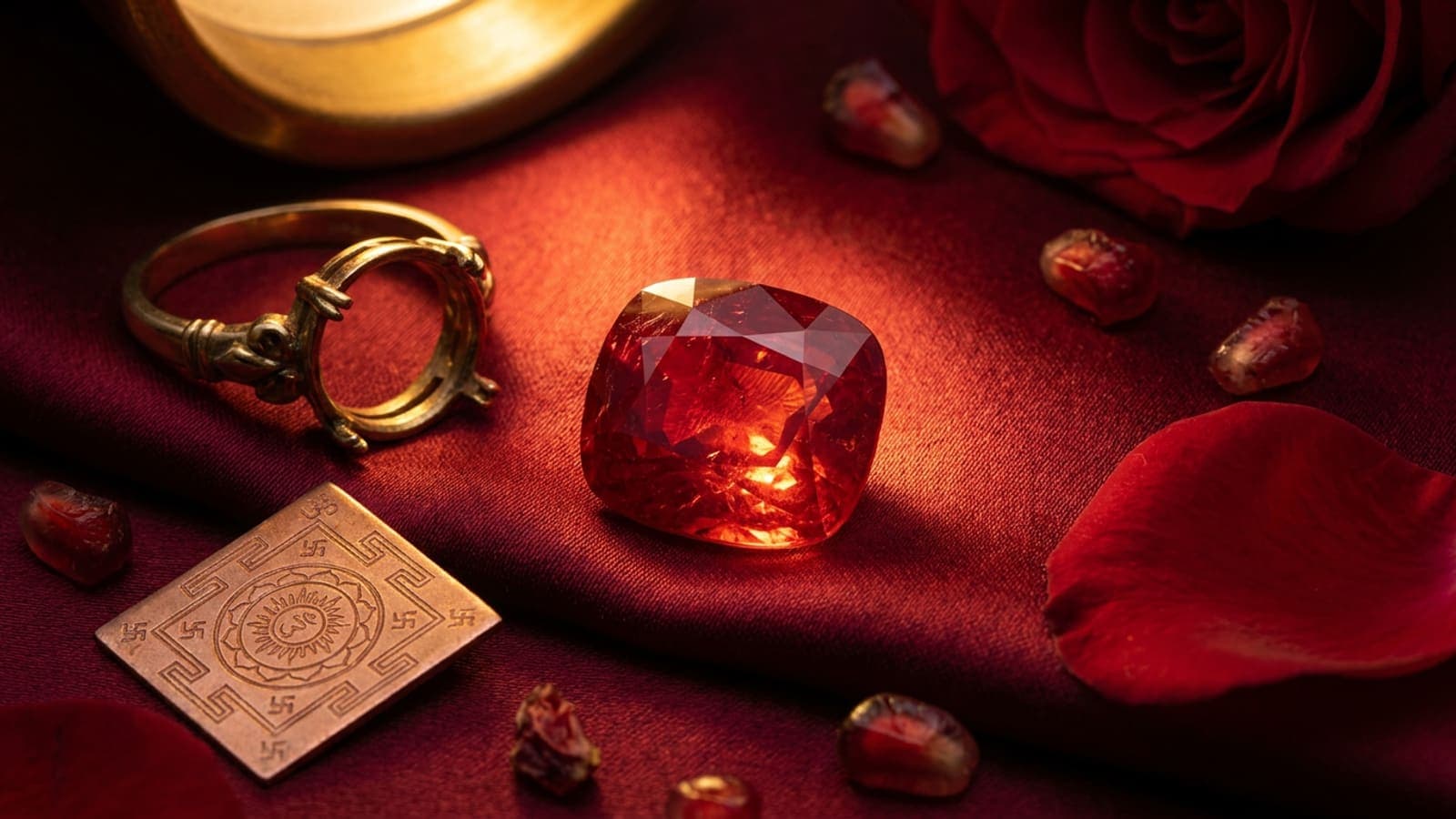
Manik stone — the Sun's gem and its one big buying trap.
Manik (ruby) strengthens Surya — the Sun, karaka of atma (soul), authority, vitality, the father, bones and the government. It is prescribed for leadership roles, government and administrative careers, chronic low vitality, and troubled relations with the father or with authority figures. Worn in gold on the ring finger, first on a Sunday morning at sunrise. The buying trap unique to ruby: lead-glass filling. Unlike heating (accepted) or emerald oiling (accepted), glass filling creates a composite material that is only partly ruby, has almost no resale value, and is sold across Indian retail as natural ruby every day.
| Vedic planet | Surya (Sun) |
| Mineral | Corundum (Al₂O₃) — red from chromium |
| Hardness | 9 Mohs (but glass-filled composites are far softer) |
| Finger | Ring finger (Anamika), right hand |
| Metal | Gold or copper; NOT silver |
| Day to wear first | Sunday (Ravivar) at sunrise, Shukla Paksha |
| Mantra | Om Hram Hreem Hraum Sah Suryaya Namah (108×) |
| Never combine with | Neelam (Saturn), Gomed (Rahu), Lehsunia (Ketu) — all enemies of Surya |
| Biggest risk | Lead-glass filled composite sold as natural ruby |
| Honest price band | ₹3,000–₹30,000/ct certified unfilled; Burmese pigeon blood is lakhs |
Manik benefits — what the Sun governs.
- 1Authority, leadership and command
Surya is the raja-graha. Manik is prescribed for those who hold or seek positions of command — administrators, officers, senior managers, politicians, heads of family businesses — and specifically where the complaint is that the native has the competence but not the standing, or is repeatedly overlooked for the top role.
- 2Government and administrative favour
The Sun rules the state in Jyotish. Classical prescription includes government service, civil-service aspirants, and matters requiring official approval — licences, permissions, litigation involving the state. This is among the most common reasons manik is prescribed in India.
- 3Vitality, bones and eyes (traditional)
Surya is the karaka of the physical constitution, bones and the right eye (left eye for women). Classical texts prescribe manik for chronic low energy, weak constitution and bone-related complaints. This is tradition, not medicine — see a doctor for any of it.
- 4Relationship with the father
Sun is pitru-karaka. Manik is prescribed where the 9th house or Sun is afflicted and the presenting issue is estrangement from the father, or the father's ill health or misfortune affecting the native.
- 5Confidence and self-definition
Sun is atma-karaka — the soul, the sense of 'I'. The traditional claim for manik is not external gain but internal consolidation: knowing one's own mind and holding a position under pressure. Weak Sun in Jyotish shows as dependence on others' approval.
Who should wear manik — the lagna table.
| Lagna | Sun rules | Manik? |
|---|---|---|
| Mesh (Aries) | 5th | ✅ Excellent — 5th lord (trikona), Sun exalts in Mesh |
| Simha (Leo) | 1st | ✅ Lagna lord — the natural fit |
| Dhanu (Sagittarius) | 9th | ✅ Excellent — 9th lord (bhagya) |
| Vrishchik (Scorpio) | 10th | ✅ Recommended — 10th lord, karma sthana |
| Kark (Cancer) | 2nd | ⚠️ Neutral-positive — dhana lord; consult |
| Meen (Pisces) | 6th | ⚠️ Not generally recommended — 6th lordship |
| Mithun (Gemini) | 3rd | ⚠️ Not generally recommended |
| Kanya (Virgo) | 12th | ❌ Generally avoided — 12th lordship |
| Tula (Libra) | 11th | ❌ Generally avoided — Sun debilitates in Tula |
| Vrishabh (Taurus) | 4th | ⚠️ Kendra lordship, neutral; consult |
| Makar (Capricorn) | 8th | ❌ Avoid — 8th lordship |
| Kumbh (Aquarius) | 7th | ❌ Avoid — Sun is at enmity with Saturn-ruled lagna |
The combination rule matters as much as the lagna rule for manik. **Never wear manik with neelam (Saturn), gomed (Rahu) or lehsunia (Ketu)** — all three are enemies of the Sun in Jyotish, and the combination is considered to cancel or actively harm. Manik pairs well with moonga (Mars) and pukhraj (Jupiter), both friends of the Sun. This is one of the most commonly violated rules in Indian gemstone retail, where multi-stone navratna rings are sold to people who should not be wearing half of what is in them.
How to wear manik.
- 1Weight: 3–5 carats for adults
About one ratti (0.91 ct) per 12 kg body weight. Ruby is dense (SG ~4.0), so a 5ct ruby looks smaller than a 5ct emerald — expect that.
- 2Metal: gold or copper; never silver
Gold is the Sun's metal, and copper is the classical alternative. Silver belongs to the Moon and Venus and is not prescribed for manik — a silver-set ruby mixes conflicting planetary metals.
- 3Finger: ring finger (Anamika), right hand
The ring finger is the Sun's finger. Open-back setting so the stone touches skin.
- 4Day: Sunday at sunrise, Shukla Paksha
Ravivar is the Sun's day and sunrise is its hora. This is the one navratna where the timing is emphatically at first light rather than merely 'morning'.
- 5Purification and mantra
Soak overnight in raw milk or Gangajal. At sunrise, wash, offer red flowers and roli, light a diya, face east toward the rising sun, and recite Om Hram Hreem Hraum Sah Suryaya Namah 108 times. Many wearers pair the first wearing with arghya (water offering) to the Sun.
The lead-glass-filled ruby scam — and the test that exposes it.
Since the mid-2000s the market has been flooded with what the trade calls composite or lead-glass-filled ruby. Very poor, heavily fractured corundum — material otherwise worth almost nothing — is heated with lead glass that flows into the fractures and hardens. The result looks like a decent ruby to the naked eye. It can be 30–50% glass by volume. It costs a few hundred rupees per carat to produce. It is routinely sold in Indian retail, including by jewellers who genuinely do not know what they are handling, at natural-ruby prices.
It is not a durability quibble. Lead-glass composites are damaged by ordinary household contact: **lemon juice, vinegar and common jewellery-cleaning solutions etch the glass and leave the stone visibly pitted and cloudy within minutes.** A jeweller's routine repair torch will melt the filler and destroy the stone. Resale value is near zero. And for astrological purposes, a stone that is half glass cannot reasonably be said to carry Surya's imprint by any school's reasoning.
- 1The flash effect under 10× loupe — the decisive test
Tilt the stone under a loupe with strong light. Lead-glass filling shows a distinctive blue or orange FLASH along the healed fractures as the angle changes — an optical effect natural corundum never produces. Any gemmologist can show you this in ten seconds. If a seller cannot or will not put your stone under a loupe, that is your answer.
- 2Gas bubbles in the fractures
Under magnification the filled fissures show trapped spherical gas bubbles — the signature of a molten filler that solidified. Natural fingerprint inclusions in unfilled ruby do not contain round bubbles.
- 3The report must say the treatment
A proper lab report states 'Lead glass filled', 'Composite ruby' or 'Clarity enhanced (glass)'. If a report on a suspiciously cheap ruby says only 'Natural corundum' with no treatment line at all, that omission is the problem. Insist the treatment line be present, even if it says 'heated only'.
- 4Price sanity
An eye-clean 4ct 'Burmese ruby' at ₹6,000 total does not exist. That price buys glass-filled composite. Ruby is rarer than sapphire in fine qualities; the arithmetic is unforgiving.
- 5What IS acceptable
Heat treatment alone (no filler) is standard, stable and accepted for ruby exactly as for sapphire. The line to hold is between heat (fine) and glass filling (not fine).
Burmese vs Mozambique vs Thai manik.
| Origin | Colour character | Price/ct (certified, unfilled) | Note |
|---|---|---|---|
| Burmese (Mogok) | Pure vivid red with slight blue undertone — 'pigeon blood' | ₹50,000–₹15,00,000+ | The benchmark; fluoresces strongly; most-faked origin claim |
| Mozambique | Vivid red, slightly darker; the modern mainstay | ₹5,000–₹80,000 | Best quality-to-price today; DivineTatva's usual source |
| Thai/Siam | Darker, brownish-red, less fluorescence | ₹2,000–₹15,000 | Iron-rich, subdued colour |
| Indian (Mysore, Orissa) | Opaque to translucent, pale to dark | ₹300–₹3,000 | Common in cheap 'manik' rings; often cabochon |
| Madagascar | Variable, often good colour | ₹3,000–₹30,000 | Growing supply |
'Pigeon blood' is a colour grade, not an origin — it describes a specific vivid red with strong fluorescence, and top Mozambique material now earns the term at major labs. As with Kashmir sapphire, treat unverified Burmese origin claims at Indian retail prices as marketing. Buy the colour, the clarity and the treatment line; origin is the last variable, not the first.
Real vs fake manik & the honest substitutes.
- 1Hardness 9
Real unfilled ruby scratches quartz, topaz and glass. Note that heavily glass-filled composites can be scratched far more easily — a 'ruby' that scuffs is either not corundum or is substantially glass.
- 2RI 1.762–1.770, SG 3.99–4.00
On the report. Red garnet reads RI 1.74–1.89 (single refractive, unlike ruby which is doubly refractive), red spinel reads 1.712 and is also singly refractive. Red glass reads around 1.50–1.65. The doubly-refractive check alone separates ruby from garnet and spinel.
- 3Fluorescence under UV
Chromium-rich natural ruby (especially Burmese) glows strong red under longwave UV. Iron-rich Thai material glows weakly. Garnet and most glass do not fluoresce red. Useful as a screen, not proof.
- 4Honest substitutes (upratna)
Classical Sun substitutes are **red garnet (tamra)**, **red spinel**, **rubellite tourmaline** and **red star ruby** of lower grade. Red spinel is historically significant — several famous 'rubies' in royal collections turned out to be spinel. At ₹500–₹5,000/ct these are legitimate prescriptions when ruby is unaffordable; the fraud is a garnet certificate reading 'manik'.
- 5Verify the certificate — with the treatment line
GIA, IGI, GRS, GTL Jaipur, verified on the lab's own site. For ruby specifically, the report is incomplete without an explicit treatment statement. 'Heated' is acceptable; 'lead glass filled' or 'composite' means walk away at astrological prices.
Manik price in India 2026.
| Lead-glass filled composite (avoid) | ₹200–₹1,500 per carat — often SOLD at ₹10,000+ |
| Indian, opaque/pale | ₹300–₹3,000 per carat |
| Thai/Siam, heated, certified | ₹2,000–₹15,000 per carat |
| Mozambique, heated, certified, unfilled | ₹5,000–₹80,000 per carat |
| Burmese Mogok, certified | ₹50,000–₹15,00,000+ per carat |
| Red garnet / spinel substitute | ₹500–₹5,000 per carat |
| A 3ct certified unfilled Mozambique ring in gold | ₹30,000–₹1,50,000 all-in |
| Red flag | Eye-clean 4ct 'Burmese ruby' at ₹6,000 total — that is glass-filled composite |
Ruby is the navratna where the gap between what a stone costs to make and what it sells for is widest, which is exactly why the glass-filling trade thrives. Get two things in writing before payment: the explicit treatment line on a verifiable lab report, and a return window. Then put the stone under a loupe and look for the flash. Ten seconds of looking is worth more than any assurance.
Frequently asked
Last reviewed: 17 May 2026 · Verified by the DivineTatva expert panel
What are the benefits of wearing manik (ruby)?
Manik strengthens Surya — authority and leadership, government and administrative favour, vitality and constitution (traditionally bones and eyes), the relationship with the father, and confidence or self-definition. It is most prescribed for those in or seeking positions of command, civil-service aspirants, and where the 9th house or Sun is afflicted.
Who should wear manik stone?
Best for Mesh (Sun exalts there and rules the 5th), Simha (lagna lord), Dhanu (9th lord) and Vrishchik (10th lord). Generally avoided for Kanya, Tula (Sun debilitates in Tula), Makar and Kumbh. Critically: never wear manik together with neelam, gomed or lehsunia — Saturn, Rahu and Ketu are all enemies of the Sun.
What is a glass-filled ruby and how do I detect it?
Lead-glass filled ruby is heavily fractured low-grade corundum infused with molten lead glass — often 30–50% glass by volume, costing a few hundred rupees per carat to produce and sold at natural-ruby prices. Detect it under a 10× loupe: tilt the stone and look for a distinctive blue or orange flash along the healed fractures, plus round gas bubbles inside them. Natural corundum never shows the flash effect.
Is glass-filled ruby actually a problem, or just cheaper?
It is a real problem. Lemon juice, vinegar and standard jewellery cleaners etch the glass and leave the stone pitted and cloudy within minutes; a jeweller's repair torch melts the filler entirely. Resale value is near zero. For astrological purposes, a stone that is half glass cannot reasonably be said to carry the Sun's imprint under any school's reasoning.
Which finger and metal for ruby?
Ring finger (Anamika) of the right hand, set in gold or copper — never silver, which belongs to Moon and Venus. Wear first on a Sunday at sunrise during Shukla Paksha, facing east, after reciting Om Hram Hreem Hraum Sah Suryaya Namah 108 times.
What is the price of original manik in India?
Certified unfilled Mozambique: ₹5,000–₹80,000 per carat. Thai/Siam heated: ₹2,000–₹15,000. Burmese Mogok: ₹50,000 to several lakhs per carat. A 3-carat certified unfilled Mozambique stone set in gold lands around ₹30,000–₹1,50,000 all-in. An eye-clean 4ct 'Burmese ruby' offered at ₹6,000 total is glass-filled composite, not ruby.
Can I wear red garnet instead of ruby?
Yes, as an acknowledged substitute (upratna). Red garnet (tamra), red spinel and rubellite tourmaline are classical Sun substitutes at ₹500–₹5,000 per carat. Red spinel has real historical standing — several famous 'rubies' in royal collections were later identified as spinel. The fraud is selling them as manik, not selling them as substitutes.
Reviewed by the DivineTatva expert panel
Written and reviewed by DivineTatva's consulting Vedic astrologer. Every piece is lab-certified and energised in our Jaipur atelier. Last updated 23 July 2026.