Pukhraj Stone (Yellow Sapphire): Benefits, Who Should Wear, Price & Real vs Fake
Pukhraj is the Vedic gemstone of Brihaspati (Jupiter) — the planet of wisdom, dharma, wealth-through-knowledge, teachers, children and marriage for women. It is the one navratna most astrologers consider safe to prescribe widely, because Jupiter is a natural benefic. But 'safe' does not mean 'buy anything': the market is full of heated Bangkok sapphire, citrine sold as pukhraj, and lab-grown corundum with real-looking certificates. This guide covers the Jyotish rules and the buying reality with equal honesty.
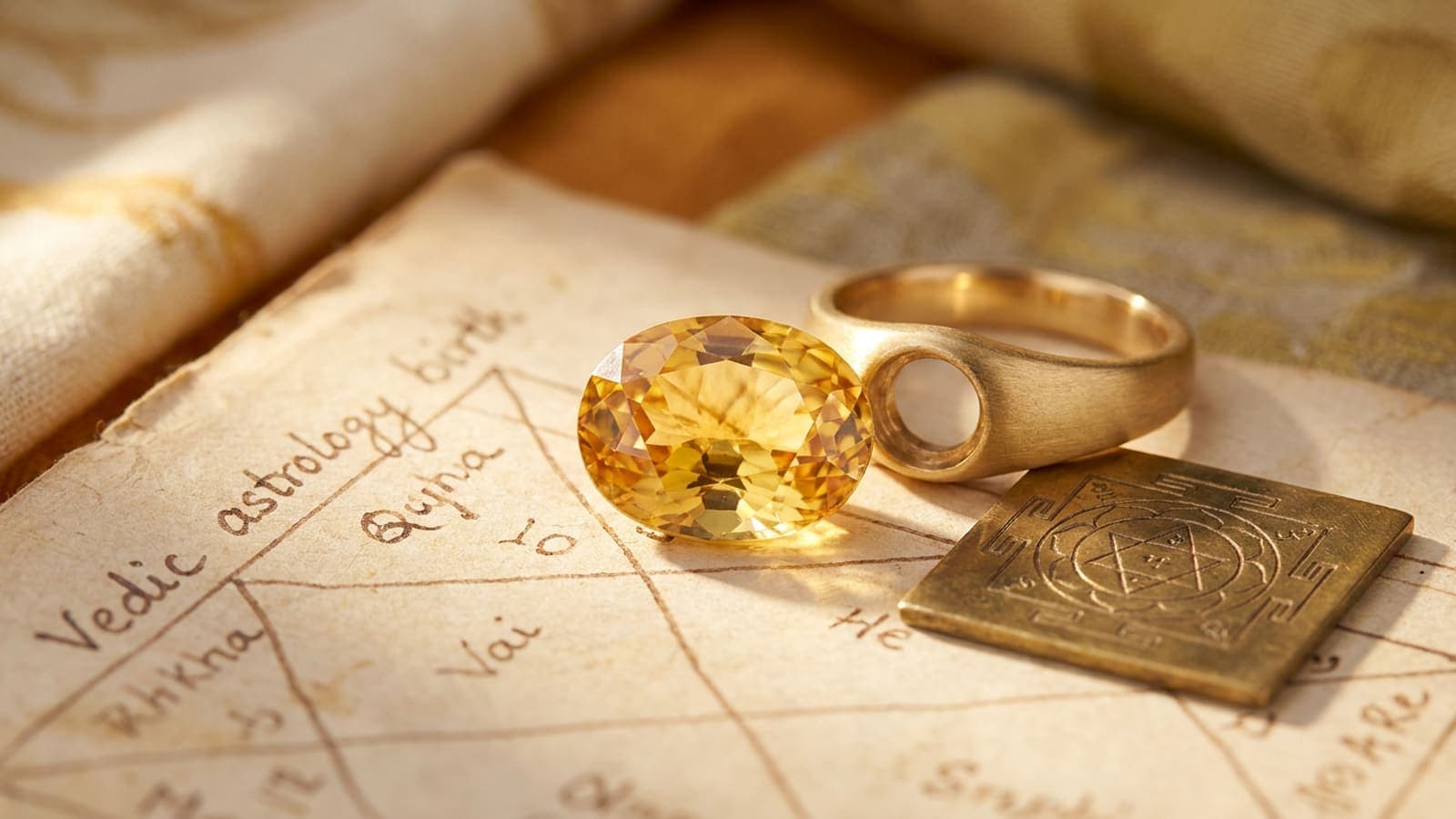
Pukhraj stone — what it does and who it is for.
Pukhraj (yellow sapphire) is the gemstone of Jupiter — Brihaspati, the guru of the gods. In Jyotish it is prescribed to strengthen wisdom, teaching ability, dharmic judgment, wealth that comes through knowledge rather than speculation, the prospects of children, and — specifically in a woman's chart — marriage, because Jupiter is the karaka of the husband. It is worn in gold on the index finger of the right hand, first on a Thursday morning. Because Jupiter is a natural benefic, pukhraj carries less risk than neelam or manik, which is why it is India's most-prescribed navratna.
| Vedic planet | Brihaspati (Jupiter) |
| Mineral | Corundum (Al₂O₃) — same species as ruby and blue sapphire |
| Hardness | 9 Mohs — second only to diamond; excellent for daily wear |
| Finger | Index finger (Tarjani), right hand |
| Metal | Gold (classical); Panchdhatu acceptable |
| Day to wear first | Thursday (Guruvar), Shukla Paksha, morning |
| Mantra | Om Gram Greem Graum Sah Gurave Namah (108×) |
| Minimum weight | 3–5 carats for adults (BPHS-tradition minimum ~1 ratti per 12 kg body weight) |
| Best origin | Ceylon (Sri Lanka) unheated; Bangkok material is usually heated |
| Honest price band | ₹3,000–₹15,000/ct certified Ceylon; ₹25,000+/ct for fine unheated |
What pukhraj is — and what it is not.
Pukhraj is yellow corundum — chemically Al₂O₃, coloured yellow to golden by trace iron. It is the same mineral species as ruby (red corundum) and neelam (blue corundum); only the trace element differs. At 9 on the Mohs scale it is the hardest gemstone after diamond, which is why a pukhraj ring survives decades of daily wear where a coral or pearl would not.
Two things routinely sold as pukhraj are not pukhraj. **Citrine** (yellow quartz, Mohs 7) is often marketed as 'pukhraj substitute' or even plain 'pukhraj' — it is a legitimate, honest *upratna* (semi-precious substitute) when sold as citrine at citrine prices, and fraud when sold as pukhraj at sapphire prices. **Yellow topaz** is a different mineral again (Mohs 8), and in English-language listings the confusion is worsened because 'topaz' is sometimes used loosely for pukhraj. In Jyotish, the prescribed Jupiter stone is yellow *sapphire*; citrine and topaz are accepted substitutes only when a client cannot afford sapphire, and every honest astrologer states that distinction plainly.
| Sold as | Actually is | Mohs | Honest price/ct | Jyotish standing |
|---|---|---|---|---|
| Pukhraj / yellow sapphire | Yellow corundum | 9 | ₹3,000–₹25,000+ | ✅ The prescribed Jupiter gem |
| Sunehla / citrine | Yellow quartz | 7 | ₹100–₹600 | ⚠️ Accepted upratna (substitute) only |
| Yellow topaz | Topaz (Al₂SiO₄(F,OH)₂) | 8 | ₹500–₹3,000 | ⚠️ Substitute; not classical pukhraj |
| Lab-grown 'natural' sapphire | Synthetic corundum | 9 | ₹200–₹800 | ❌ No astrological standing |
| Glass / doublet | Glass, sometimes capped | 5–6 | ₹50–₹300 | ❌ Fake |
Pukhraj benefits — what the classical texts actually claim.
Jupiter is the greatest natural benefic in Parashari Jyotish — the Brihat Parashara Hora Shastra calls it the karaka of dhana (wealth), putra (children), vidya (learning), dharma and, in a female chart, pati (husband). Pukhraj is prescribed to strengthen a Jupiter that is weak by placement, debilitated in Makar (Capricorn), combust, or under affliction. The claimed benefits track Jupiter's domain exactly:
- 1Wisdom, teaching and judgment
Jupiter is guru — the one who guides. Pukhraj is the standard prescription for teachers, lawyers, advisors, doctors and anyone whose profession is dispensing judgment. Traditionally it is credited with improving the ability to see the long-term consequence of a decision rather than the immediate gain.
- 2Marriage prospects in a woman's chart
This is pukhraj's single most common real-world prescription in India. Because Jupiter is pati-karaka (significator of the husband) for women, pukhraj is prescribed for delayed marriage — often more readily than it should be. An honest astrologer checks 7th house, 7th lord and Venus before defaulting to pukhraj.
- 3Children and fertility (5th house)
Jupiter is putra-karaka. Classical texts prescribe pukhraj where the 5th house or Jupiter is afflicted and the concern is progeny. This is tradition, not medicine — fertility concerns need a doctor first, always.
- 4Wealth through knowledge, not speculation
The distinction matters. Jupiter's wealth is the wealth of the advisor, the teacher, the professional — earned through expertise. Pukhraj is not the speculative-gain stone (that is Rahu/Mercury territory); it is prescribed for building durable professional standing.
- 5Dharmic protection and reputation
Jupiter rules the 9th house of dharma and fortune. The traditional claim is protection from reputational damage and a steadying of one's moral compass under pressure — vague by modern standards, but consistently attested across BPHS, Phaladeepika and Mani-Mala.
Who should wear pukhraj — the lagna table.
The Parashari rule: wear a planet's gemstone only when that planet is a functional benefic for your lagna. Jupiter is a natural benefic, but for a few lagnas it owns dusthana houses and becomes a functional malefic — for those, pukhraj is generally avoided.
| Lagna | Jupiter rules | Pukhraj? |
|---|---|---|
| Mesh (Aries) | 9th, 12th | ✅ Strongly recommended — 9th lord, bhagya karaka |
| Kark (Cancer) | 6th, 9th | ✅ Recommended — 9th lordship dominates |
| Vrishchik (Scorpio) | 2nd, 5th | ✅ Strongly recommended — 5th lord (trikona) |
| Dhanu (Sagittarius) | 1st, 4th | ✅ Lagna lord — among the best fits |
| Meen (Pisces) | 1st, 10th | ✅ Lagna + 10th lord — excellent |
| Simha (Leo) | 5th, 8th | ⚠️ Mixed — 5th lordship good, 8th complicates; consult |
| Kumbh (Aquarius) | 2nd, 11th | ⚠️ Neutral — maraka + labha; consult |
| Mithun (Gemini) | 7th, 10th | ⚠️ Kendradhipati dosha — Jupiter loses benefic power |
| Kanya (Virgo) | 4th, 7th | ⚠️ Kendradhipati dosha — same caution |
| Vrishabh (Taurus) | 8th, 11th | ❌ Generally avoided — 8th lordship |
| Tula (Libra) | 3rd, 6th | ❌ Generally avoided — dusthana lordships |
| Makar (Capricorn) | 3rd, 12th | ❌ Generally avoided |
This table is the standard framework, not a verdict. Placement, conjunction, aspect and the running dasha all change the answer — a Vrishabh lagna native in Jupiter mahadasha with a well-placed Jupiter may still be prescribed pukhraj by a competent astrologer. Also note the common Indian shortcut of prescribing pukhraj to every unmarried woman regardless of lagna: that is convention, not Jyotish. Get the chart read before you buy.
How to wear pukhraj — finger, metal, weight, day and mantra.
- 1Weight: 3–5 carats minimum for adults
The traditional rule of thumb is roughly one ratti (0.91 ct) per 12 kg of body weight, so a 60 kg adult lands near 5 ratti / 4.5 ct. Below 3 carats most astrologers consider the effect negligible. Weight matters more for pukhraj than for most stones because Jupiter is a 'large' graha in this tradition.
- 2Metal: gold
Gold is Jupiter's metal and the classical setting. Panchdhatu (five-metal alloy) is an accepted budget alternative. Silver is not prescribed for pukhraj — it belongs to Moon and Venus.
- 3Finger: index (Tarjani), right hand
The index finger is Jupiter's finger in Vedic hand-mapping. Right hand for men and for most traditions; some schools prescribe the left for women. Ensure the stone touches the skin — an open-back setting is standard for astrological rings, unlike ordinary jewellery.
- 4Day: Thursday morning, Shukla Paksha
Guruvar (Thursday) is Jupiter's day. Wear during the waxing fortnight, ideally in the hora (planetary hour) of Jupiter at sunrise. Avoid eclipse periods and the Guru-asta (Jupiter combustion) window if your astrologer flags it.
- 5Purification and mantra
Soak the ring overnight in raw milk or Gangajal with a tulsi leaf. Morning: wash with clean water, apply haldi and a yellow flower, light a ghee diya, and recite Om Gram Greem Graum Sah Gurave Namah 108 times before wearing. Repeat 9 times on subsequent re-wearings.
Heated vs unheated pukhraj — the honest position.
Over 90% of yellow sapphire in the global market is heat-treated. Heating at 1,400–1,800°C dissolves rutile inclusions and deepens colour — it is a permanent, stable, industry-accepted treatment, disclosed on every reputable lab report. Unheated stones of the same visual quality cost 3–10× more, purely because they are rare.
Does Jyotish require unheated? The classical texts predate modern heat treatment and say nothing about it directly — they speak of stones being free from doshas (cracks, milkiness, black spots, dullness). Two honest positions exist in the tradition: the stricter school holds that any human intervention dilutes the stone's natural planetary imprint and insists on unheated; the pragmatic school holds that heat only completes what the earth started and that a clean heated stone outperforms a cracked unheated one. Our panel's position: **buy unheated if the budget allows, but never buy a flawed unheated stone over a clean heated one** — the classical doshas (cracks, black inclusions, milkiness) matter more in the texts than treatment status, which the texts never mention at all.
| Heated, certified, Ceylon 4ct | ₹12,000–₹40,000 total |
| Unheated, certified, Ceylon 4ct | ₹60,000–₹2,00,000+ total |
| What the lab report must say | 'No indications of heating' — vague wording means heated |
| Classical doshas to reject | Cracks, black spots, milkiness (dudhiya), dull lustre, uneven colour |
| Our recommendation | Clean heated > flawed unheated, at any budget |
Real vs fake pukhraj — the tests that work and the ones that don't.
- 1Hardness — the decisive field test
Pukhraj is Mohs 9. It will scratch quartz (7), topaz (8) and glass (5–6), and nothing but corundum or diamond will scratch it. If a 'pukhraj' can be scratched by a citrine or a steel file, it is not sapphire. Test on the pavilion (the hidden underside), never the table.
- 2Refractive index / specific gravity — the lab test
Corundum has RI 1.762–1.770 and SG 3.99–4.00. Citrine is RI 1.544–1.553, SG 2.65. These numbers appear on any real gem lab report and are impossible to fake — always read them, do not just look at the photo on the certificate.
- 3Inclusions under 10× loupe
Natural sapphire shows silk (fine rutile needles), colour zoning in straight angular bands, or healed fingerprint inclusions. Synthetic (flame-fusion) corundum shows curved growth lines and round gas bubbles — the two tells that give away lab-grown stones sold as natural.
- 4The certificate itself
Insist on GIA, IGI, GRS or Gem Testing Laboratory Jaipur. Verify the report number on the issuing lab's own website — a large fake-certificate industry exists specifically for the Indian astrological market. A certificate that cannot be verified online is worth nothing.
- 5Tests that do NOT work
The 'milk turns yellow' test, the 'wrap it in cloth overnight and see if you dream' test, and the 'real sapphire never scratches' claim are folklore. Do not make a five-figure purchase on any of them.
Pukhraj price in India 2026 — what you should actually pay.
Yellow sapphire is priced per carat, and the per-carat rate rises with size — a 5ct stone costs more per carat than a 2ct stone of identical quality, because large clean rough is rarer. Origin, treatment status and clarity drive the rest.
| Bangkok/Thai, heated, commercial | ₹1,000–₹3,000 per carat |
| Ceylon, heated, certified, eye-clean | ₹3,000–₹15,000 per carat |
| Ceylon, unheated, certified | ₹15,000–₹50,000 per carat |
| Fine unheated Ceylon, top colour | ₹50,000–₹1,50,000+ per carat |
| Citrine sold honestly as citrine | ₹100–₹600 per carat |
| What a 4ct certified Ceylon heated ring costs | ₹20,000–₹70,000 all-in with gold |
| Red flag price | Under ₹1,000/ct claimed as 'natural Ceylon unheated' |
The most common fraud at the retail end is not a fake stone — it is a real but heated Bangkok sapphire sold as unheated Ceylon at a 5× markup, backed by a certificate from a lab nobody can verify. Your protection is the report number and the RI/SG figures, not the seller's story. Buy the certificate first and the stone second.
Frequently asked
Last reviewed: 17 May 2026 · Verified by the DivineTatva expert panel
What are the benefits of wearing pukhraj (yellow sapphire)?
Pukhraj strengthens Jupiter — wisdom and judgment, teaching and advisory ability, wealth earned through knowledge, prospects for children, and in a woman's chart marriage (Jupiter is pati-karaka). It is prescribed when Jupiter is weak, debilitated in Capricorn, combust or afflicted. These are Jyotish prescriptions from BPHS and Phaladeepika, not medical claims.
Who should wear pukhraj stone?
Best for Mesh, Kark, Vrishchik, Dhanu and Meen lagna, where Jupiter owns a trikona or the lagna itself. Generally avoided for Vrishabh, Tula and Makar lagna, where Jupiter owns dusthana houses. Mithun and Kanya face kendradhipati dosha. Get your chart read — the widespread practice of prescribing pukhraj to every unmarried woman is convention, not Jyotish.
Which finger and day for yellow sapphire?
Index finger (Tarjani) of the right hand, set in gold, worn first on a Thursday morning during Shukla Paksha. Purify overnight in raw milk or Gangajal with a tulsi leaf, then recite Om Gram Greem Graum Sah Gurave Namah 108 times before wearing. Use an open-back setting so the stone touches skin.
Should I buy heated or unheated pukhraj?
Buy unheated if budget allows — it costs 3–10× more purely for rarity. But never choose a flawed unheated stone over a clean heated one: the classical texts specify freedom from cracks, black spots and milkiness, and say nothing about heat treatment at all, which they predate. A clean heated Ceylon stone is the sensible choice for most buyers.
How to check if pukhraj is real or fake?
Four tests: (1) Hardness — real pukhraj is Mohs 9 and scratches quartz, topaz and glass; nothing but corundum or diamond scratches it. (2) RI 1.762–1.770 and SG 3.99–4.00 on the lab report — citrine reads 1.544/2.65. (3) Under 10× loupe, natural sapphire shows silk or angular colour zoning; synthetics show curved growth lines and round bubbles. (4) Verify the certificate number on the issuing lab's own website.
What is the price of original pukhraj in India?
Certified Ceylon heated: ₹3,000–₹15,000 per carat. Certified Ceylon unheated: ₹15,000–₹50,000 per carat, rising past ₹1,00,000 for fine colour. Commercial Bangkok heated material runs ₹1,000–₹3,000. A 4-carat certified Ceylon heated ring set in gold lands around ₹20,000–₹70,000 all-in. Anything under ₹1,000/ct claimed as 'unheated Ceylon' is misrepresented.
Can I wear citrine instead of pukhraj?
Yes, as an acknowledged substitute (upratna), not as an equivalent. Citrine is yellow quartz at ₹100–₹600 per carat and is honestly prescribed when yellow sapphire is unaffordable. The problem is sellers passing citrine off as pukhraj at sapphire prices — a Mohs and RI check settles it instantly.
Reviewed by the DivineTatva expert panel
Written and reviewed by DivineTatva's consulting Vedic astrologer. Every piece is lab-certified and energised in our Jaipur atelier. Last updated 23 July 2026.