Neelam Stone (Blue Sapphire): Benefits, Who Should Wear, Trial Rule & Price
Neelam is Shani's (Saturn's) gemstone and the most feared stone in Indian astrology — credited with working faster than any other navratna, in either direction. The classical instruction is unique to it: wear it on trial for three days before committing. That single rule tells you everything about how the tradition regards this stone. This guide covers the trial protocol, who genuinely should not wear it, and how the Kashmir myth is used to inflate prices.
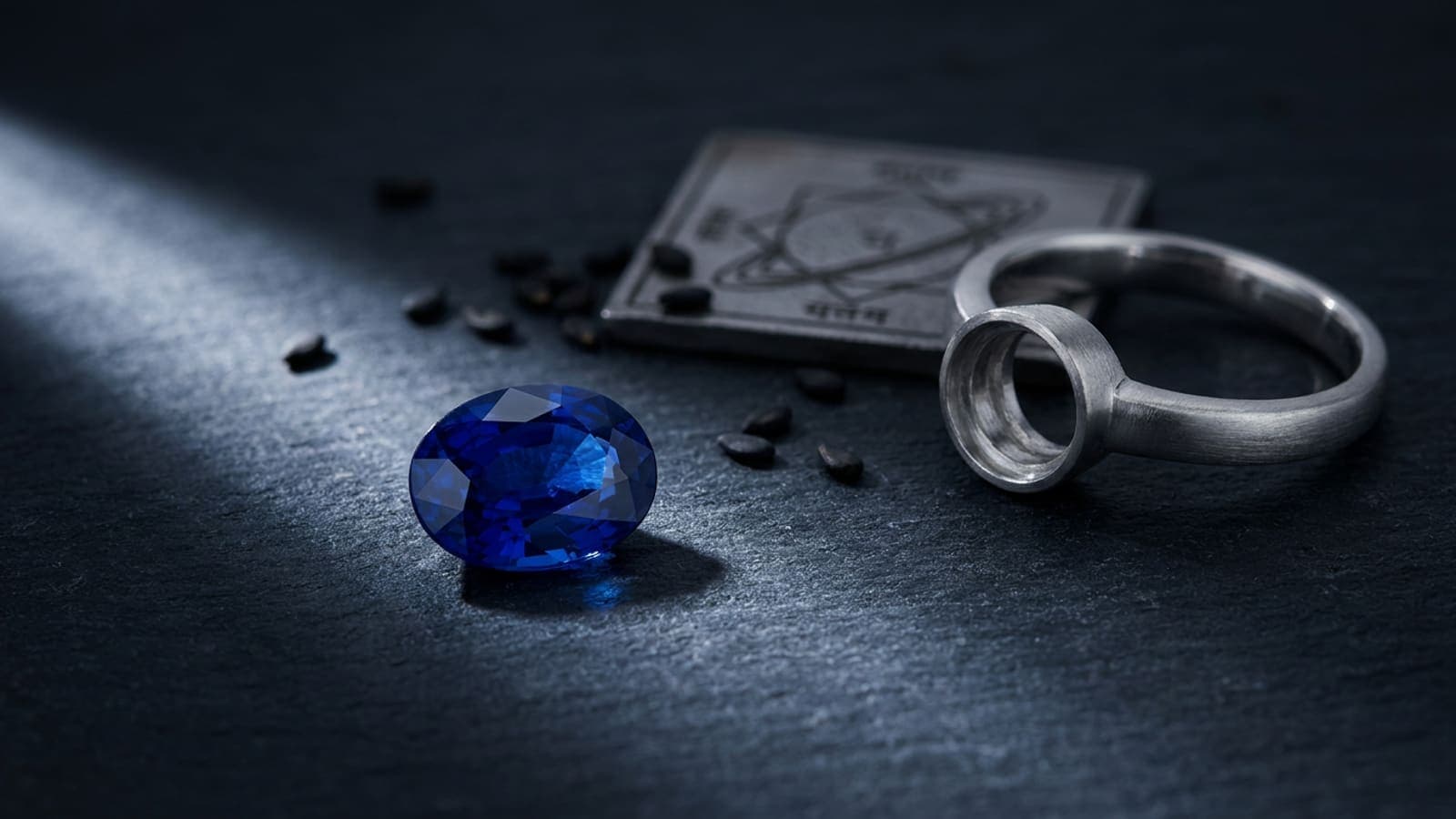
Neelam stone — the fastest-acting and most cautioned navratna.
Neelam (blue sapphire) is the gemstone of Shani — Saturn, the planet of discipline, delay, labour, justice and karmic consequence. Jyotish credits it with acting faster than any other gemstone, sometimes within days, which is exactly why every classical source attaches a trial period to it and to no other stone. When Saturn is a functional benefic in your chart, neelam is prescribed for career stability, focus, freedom from chronic obstruction, and relief during Sade Sati or Shani Dhaiya. When Saturn is a functional malefic, the same stone is said to accelerate the very problems you wore it to solve.
| Vedic planet | Shani (Saturn) |
| Mineral | Corundum (Al₂O₃) — blue from iron + titanium |
| Hardness | 9 Mohs |
| Finger | Middle finger (Madhyama), right hand |
| Metal | Silver or Panchdhatu (iron/steel in some traditions); NOT gold |
| Day to wear first | Saturday (Shanivar) evening, Krishna Paksha acceptable |
| Mantra | Om Praam Preem Praum Sah Shanaischaraya Namah (108×) |
| Trial period | 3 days — unique to neelam among all navratna |
| Best origin | Kashmir (legendary, near-extinct); Ceylon is the practical top choice |
| Honest price band | ₹5,000–₹30,000/ct certified Ceylon; Kashmir is lakhs per carat |
The 3-day trial — how it actually works.
No other navratna carries a trial instruction. For neelam, the classical protocol is: obtain the stone, keep it in contact with your body (tied in a white cloth on the upper arm, or worn as a temporary ring) for three days and nights, and observe what happens. The tradition treats the outcome as a verdict on whether Saturn accepts you.
| Signs during the trial | Traditional reading | Action |
|---|---|---|
| Calm sleep, sudden clarity, small unexpected gains, obstacles clearing | Saturn accepts | Proceed to formal wearing |
| Restless or disturbed sleep, bad dreams | Warning | Extend trial or stop |
| Illness, accidents, sudden losses, family conflict | Rejection | Stop immediately |
| The stone cracks or the setting breaks | Strong rejection | Do not wear; the tradition treats it as absorbed affliction |
| Nothing at all happens | Neutral | Consult the astrologer; often means Saturn is not the operative graha |
Our honest read: this protocol has no scientific basis, and three days of self-observation after an expensive purchase is a textbook setup for confirmation bias in either direction. But we recommend following it anyway, for a practical reason rather than a mystical one — it forces a pause between an emotional purchase and a permanent commitment, and any reputable neelam seller will offer a return window that makes the trial possible. **A seller who refuses a trial return on a neelam is telling you something.** DivineTatva offers a 7-day return specifically so the trial can be done honestly.
Neelam benefits — Saturn's domain, stated plainly.
- 1Career stability and professional endurance
Saturn rules karma-yoga — sustained labour rewarded over time. Neelam is prescribed where a career has stalled despite effort, where recognition never arrives, or where the native repeatedly starts and cannot finish. It is the stone of the long game, not the quick break.
- 2Relief during Sade Sati and Shani Dhaiya
The most common real-world reason Indians buy neelam. Sade Sati is Saturn's 7½-year transit over the natal Moon and its flanking signs; Dhaiya is the 2½-year transit over the 4th and 8th from Moon. Neelam is prescribed to make Saturn's pressure constructive rather than crushing — but only when Saturn is a functional benefic for the lagna. For Mesh or Simha lagna in Sade Sati, most astrologers prescribe a blue sapphire substitute or a Shani remedy without the stone.
- 3Focus, discipline and freedom from distraction
Saturn's positive expression is concentration and structure. Neelam is prescribed for students in long-haul preparation (UPSC, medicine, law), researchers, and anyone whose problem is scattered effort rather than lack of ability.
- 4Legal matters and justice
Saturn is the karaka of justice and of the 8th/12th karmic houses. Traditional prescription includes prolonged litigation, property disputes and matters where the native believes they are in the right but the outcome keeps deferring.
- 5Protection from chronic obstruction
Where Jupiter's pukhraj expands, Saturn's neelam removes. The traditional claim is not gain but the clearing of a persistent, structural block — which is why the effect is described as sudden when it comes.
Who should wear neelam — and who genuinely should not.
| Lagna | Saturn rules | Neelam? |
|---|---|---|
| Vrishabh (Taurus) | 9th, 10th | ✅ Yogakaraka — the single best fit for neelam |
| Tula (Libra) | 4th, 5th | ✅ Yogakaraka — excellent |
| Makar (Capricorn) | 1st, 2nd | ✅ Lagna lord — strongly suitable |
| Kumbh (Aquarius) | 1st, 12th | ✅ Lagna lord — suitable |
| Mithun (Gemini) | 8th, 9th | ⚠️ Mixed — 9th good, 8th complicates; consult |
| Kanya (Virgo) | 5th, 6th | ⚠️ Mixed — consult |
| Mesh (Aries) | 10th, 11th | ❌ Generally avoided — Saturn is a strong malefic for Mesh |
| Kark (Cancer) | 7th, 8th | ❌ Avoid — 8th lordship + maraka |
| Simha (Leo) | 6th, 7th | ❌ Avoid — Saturn is the natural enemy of the Sun-ruled lagna |
| Vrishchik (Scorpio) | 3rd, 4th | ⚠️ Not generally recommended |
| Dhanu (Sagittarius) | 2nd, 3rd | ⚠️ Not generally recommended |
| Meen (Pisces) | 11th, 12th | ⚠️ Not generally recommended |
Beyond the lagna table, three specific cautions. **Do not wear neelam and manik (ruby) together** — Saturn and Sun are bitter enemies in Jyotish, and the combination is considered actively harmful. **Do not wear neelam and moonga (red coral) together** for the same reason with Mars. And **never buy neelam on the strength of Sade Sati alone** — Sade Sati affects everyone at some point, but neelam is only appropriate for those lagnas where Saturn is a functional benefic. The commonest mis-sale in the Indian gem trade is a neelam sold to a panicking Mesh or Simha lagna native during Sade Sati.
How to wear neelam — after the trial passes.
- 1Weight: 3–5 carats for adults
Same rough rule as other navratna — about one ratti (0.91 ct) per 12 kg body weight. Many astrologers deliberately prescribe neelam at the lower end of the range precisely because of its speed.
- 2Metal: silver or Panchdhatu — never gold
Silver is Saturn's metal. Panchdhatu and, in some traditions, iron or steel are also prescribed. Gold belongs to Sun and Jupiter, both of whom are hostile to Saturn — a gold-set neelam mixes conflicting planetary metals and is avoided in classical practice.
- 3Finger: middle (Madhyama), right hand
The middle finger is Saturn's finger. Open-back setting so the stone contacts skin.
- 4Day: Saturday evening, during Shani hora
Unlike most gemstones which are worn at sunrise, neelam is traditionally worn on Saturday **evening** — Saturn's own time is dusk. Krishna Paksha is acceptable for Saturn, unlike other stones which require Shukla Paksha.
- 5Purification and mantra
Soak overnight in raw milk or in water with black sesame (til). Morning of wearing: wash, offer blue flowers and black til, light a mustard-oil diya, and recite Om Praam Preem Praum Sah Shanaischaraya Namah 108 times. Many wearers pair the first wearing with a donation of black til, iron or a blanket — Saturn's traditional daan.
The Kashmir origin claim — and why it is almost always false.
Kashmir blue sapphire is the most famous gemstone origin in the world. The deposit in the Padar region of the Zanskar Himalayas was discovered around 1881 after a landslide, mined intensively for roughly a decade, and was commercially exhausted by the early 1900s. Everything mined since has been sporadic and tiny. Genuine Kashmir sapphires trade at auction for **US$50,000–$200,000+ per carat** and every significant one is documented.
This means the 'Kashmiri neelam' offered in Indian retail at ₹15,000 or ₹50,000 per carat is, with essentially no exceptions, Ceylon or Madagascar material relabelled. Origin determination for sapphire requires spectroscopic and inclusion analysis at a major lab — GIA, SSEF, Gübelin — and their origin opinions are stated as opinions, not certainties. A local certificate asserting 'Kashmir' is not evidence.
| Origin | Reality | Realistic per-carat |
|---|---|---|
| Kashmir | Mine exhausted ~1900; auction-grade only | US$50,000–$200,000+ |
| Ceylon (Sri Lanka) | The practical top choice; excellent colour, widely available | ₹5,000–₹30,000 |
| Madagascar | Large modern supply, often heated, good value | ₹2,000–₹10,000 |
| Bangkok/Thai (treated) | Commercial grade, usually heated | ₹800–₹3,000 |
| 'Kashmiri' at ₹15,000/ct | Ceylon or Madagascar relabelled | Pay the Ceylon price |
Real vs fake neelam — and the honest substitutes.
- 1Hardness 9
Real neelam scratches quartz, topaz and glass; only corundum and diamond scratch it. Blue glass and blue spinel imitations fail this immediately. Test on the pavilion.
- 2RI 1.762–1.770, SG 3.99–4.00
These figures must appear on the lab report. Blue spinel reads RI 1.718, SG 3.60. Iolite (a common cheap substitute) reads 1.53–1.55, SG 2.6. Tanzanite reads 1.69–1.70. The numbers cannot be faked; read them.
- 3Loupe: curved lines mean synthetic
Flame-fusion synthetic corundum — abundant and cheap — shows curved growth striae and spherical gas bubbles. Natural sapphire shows angular colour zoning, silk, or fingerprint inclusions. This one check catches most lab-grown stones sold as natural.
- 4Honest substitutes (upratna)
When neelam is unaffordable or the astrologer wants a gentler Saturn remedy, the classical substitutes are **amethyst (katela)**, **blue spinel**, **lapis lazuli** and **iolite (neeli)**. These are legitimately prescribed — the fraud is selling them AS neelam, not selling them as substitutes. Amethyst at ₹300/ct and neelam at ₹15,000/ct should never be confused on a certificate.
- 5Verify the certificate online
GIA, IGI, GRS, GTL Jaipur — check the report number on the lab's own site. Neelam attracts more fake certification than any other Indian astrological gemstone precisely because the price gap between real and substitute is so large.
Neelam price in India 2026.
| Bangkok/Thai heated, commercial | ₹800–₹3,000 per carat |
| Madagascar, heated, certified | ₹2,000–₹10,000 per carat |
| Ceylon, heated, certified, eye-clean | ₹5,000–₹15,000 per carat |
| Ceylon, unheated, certified | ₹15,000–₹50,000 per carat |
| Fine unheated Ceylon, cornflower blue | ₹50,000–₹2,00,000+ per carat |
| Genuine Kashmir | US$50,000–$200,000+ per carat (auction) |
| Amethyst / iolite substitute | ₹200–₹800 per carat |
| A 3.5ct certified Ceylon ring in silver | ₹25,000–₹80,000 all-in |
One buying rule specific to neelam: because the stone is credited with acting fast and because Saturn's mis-prescription is genuinely disruptive to a person's peace of mind, **never buy neelam from a seller who will not take it back within a week.** The trial period is meaningless without a return window, and a seller who blocks the return has removed the one safeguard the tradition itself insists on.
Frequently asked
Last reviewed: 17 May 2026 · Verified by the DivineTatva expert panel
What are the benefits of wearing neelam (blue sapphire)?
Neelam strengthens Saturn — career stability and endurance, focus and discipline, relief during Sade Sati and Shani Dhaiya, help in prolonged legal matters, and the clearing of chronic structural obstruction. It is credited with acting faster than any other navratna, which is why the tradition attaches a mandatory trial period to it alone.
What is the 3-day trial rule for neelam?
Keep the stone in contact with your body for three days and nights before formal wearing — tied in white cloth on the upper arm or as a temporary ring. Calm sleep, clarity and small unexpected gains are read as acceptance; disturbed sleep, illness, losses or the stone cracking are read as rejection. There is no scientific basis, but follow it anyway: it forces a pause before a permanent commitment, and a seller who won't allow the trial return is a warning in itself.
Who should not wear blue sapphire?
Generally avoided for Mesh (Aries), Kark (Cancer) and Simha (Leo) lagna, where Saturn is a functional malefic — Simha especially, since Saturn is the natural enemy of a Sun-ruled lagna. Also never wear neelam together with manik (ruby) or moonga (red coral): Saturn is at enmity with Sun and Mars. Sade Sati alone is not a reason to wear neelam.
Which finger and metal for neelam?
Middle finger (Madhyama) of the right hand, set in silver or Panchdhatu — never gold, which belongs to Sun and Jupiter, both hostile to Saturn. Wear first on a Saturday evening (Saturn's time is dusk, unlike other stones worn at sunrise) after reciting Om Praam Preem Praum Sah Shanaischaraya Namah 108 times.
Is Kashmir blue sapphire really available in India?
Essentially no. The Kashmir deposit was commercially exhausted by around 1900; genuine Kashmir sapphires trade at auction for US$50,000–$200,000+ per carat and are individually documented. Any 'Kashmiri neelam' offered at ₹15,000–₹50,000 per carat is relabelled Ceylon or Madagascar material. Pay the Ceylon price for Ceylon goods.
What is the price of original neelam in India?
Certified Ceylon heated: ₹5,000–₹15,000 per carat. Certified Ceylon unheated: ₹15,000–₹50,000, rising past ₹2,00,000 for fine cornflower blue. Madagascar runs ₹2,000–₹10,000, Bangkok commercial ₹800–₹3,000. A 3.5-carat certified Ceylon stone set in silver comes to roughly ₹25,000–₹80,000 all-in.
Can I wear amethyst instead of neelam?
Yes, as an acknowledged substitute (upratna) — amethyst (katela), iolite (neeli), blue spinel and lapis lazuli are all classically prescribed Saturn substitutes at ₹200–₹800 per carat. They are a legitimate choice when neelam is unaffordable or when an astrologer wants a gentler Saturn remedy. The fraud is selling them AS neelam, not selling them as substitutes.
Reviewed by the DivineTatva expert panel
Written and reviewed by DivineTatva's consulting Vedic astrologer. Every piece is lab-certified and energised in our Jaipur atelier. Last updated 23 July 2026.