Navgrah Bracelet: What It Is, Who Should Wear It & Why Most Are Fake
A navgrah (navratna) bracelet carries all nine planetary gemstones in one band — ruby, pearl, red coral, emerald, yellow sapphire, diamond, blue sapphire, hessonite and cat's eye. The classical logic is that the nine together balance the whole chart rather than boosting one graha. The commercial reality is harsher: a genuine navratna bracelet cannot cost ₹500, and for many wearers nine stones is the wrong remedy anyway because it puts enemy planets on the same wrist.
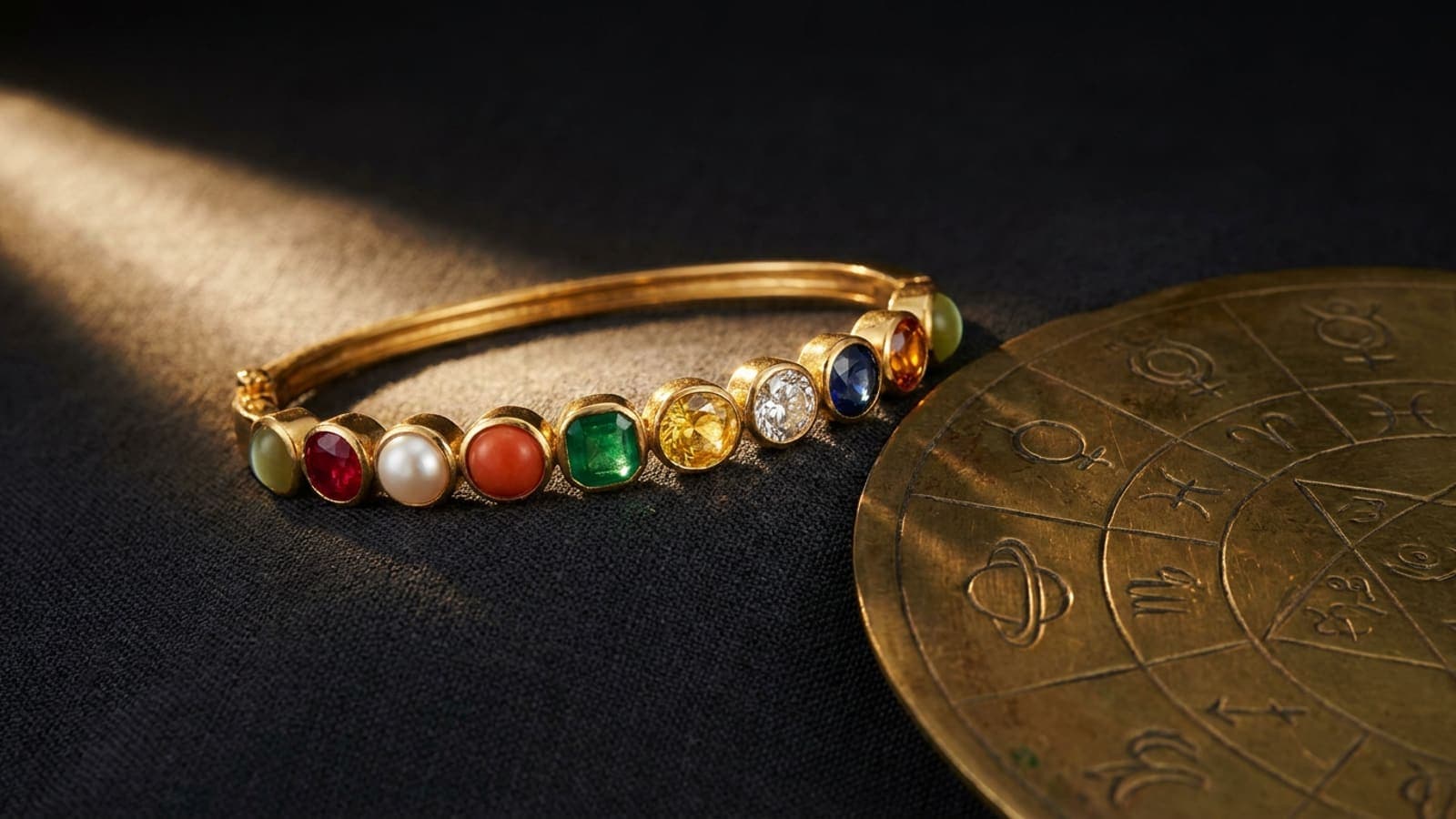
Navgrah bracelet — the appeal and the catch.
A navgrah or navratna bracelet holds all nine planetary gemstones together, in a fixed classical arrangement. Its appeal is obvious: no chart reading, no choosing, no risk of wearing the wrong stone — nine planets covered at once. The classical position supports this in one specific case: where no single graha stands out as the operative one, the navratna is prescribed as a general balancing ornament. But two facts complicate the purchase. First, three of the nine stones (diamond, ruby, blue sapphire) are individually expensive, so a genuine navratna piece starts in the tens of thousands — a ₹500 'navratna bracelet' is glass and dyed quartz. Second, Jyotish holds several of these planets to be mutual enemies, so wearing all nine is precisely what an astrologer avoids for a wearer with a strong Sun-Saturn or Sun-Rahu conflict.
| What it is | All nine planetary gemstones (navratna) in one bracelet |
| Classical basis | Navratna as a general balancing ornament when no single graha dominates |
| Correct sequence | Fixed — Sun at centre/east, others in prescribed order (see below) |
| Metal | Gold traditionally; silver or Panchdhatu for budget versions |
| Day to wear first | Sunday morning, Shukla Paksha |
| Genuine minimum cost | ₹25,000+ — three of the nine stones are individually expensive |
| ₹300–₹1,500 versions | Glass, dyed quartz, synthetic corundum — decorative only |
| Main caution | Nine stones means enemy planets on one wrist; wrong for many charts |
The nine planets and their gemstones.
| Graha | Gemstone (Sanskrit) | English | Governs | Honest cost/ct |
|---|---|---|---|---|
| Surya (Sun) | Manik | Ruby | Authority, vitality, father | ₹5,000–₹80,000 |
| Chandra (Moon) | Moti | Pearl | Mind, emotion, mother | ₹500–₹15,000 |
| Mangal (Mars) | Moonga | Red coral | Courage, energy, blood | ₹800–₹3,500 |
| Budh (Mercury) | Panna | Emerald | Intellect, speech, trade | ₹2,000–₹25,000 |
| Brihaspati (Jupiter) | Pukhraj | Yellow sapphire | Wisdom, wealth, children | ₹3,000–₹25,000 |
| Shukra (Venus) | Heera | Diamond | Love, luxury, art | ₹40,000–₹5,00,000 |
| Shani (Saturn) | Neelam | Blue sapphire | Discipline, career, karma | ₹5,000–₹50,000 |
| Rahu | Gomed | Hessonite garnet | Ambition, foreign, illusion | ₹300–₹3,000 |
| Ketu | Lehsunia | Cat's eye chrysoberyl | Detachment, intuition, moksha | ₹3,500–₹7,500 |
Add those minimums up and the arithmetic settles the fraud question by itself. Even at the lowest honest per-carat rate for each stone, with the smallest astrologically meaningful sizes, a genuine navratna piece cannot be produced for under roughly ₹25,000 — and that is with a tiny diamond. Any navratna bracelet at ₹300, ₹900 or ₹1,500 has substituted glass, dyed quartz, synthetic corundum and cubic zirconia for the real nine.
The correct navratna sequence — and why it matters.
Navratna is not nine stones in any order. The classical arrangement, described in the Garuda Purana and followed in traditional Indian jewellery, places the Sun's ruby at the centre with the remaining eight arranged around it in the order of the planetary directions — Venus (diamond) in the east, Moon (pearl) in the south-east, Mars (coral) in the south, Rahu (hessonite) in the south-west, Jupiter (yellow sapphire) in the west, Mercury (emerald) in the north-west, Saturn (blue sapphire) in the north, and Ketu (cat's eye) in the north-east.
In a bracelet the strict mandala cannot be preserved as it is in a ring or pendant, so traditional makers keep the relative order around the band with ruby as the anchor bead. A bracelet with the nine stones strung in a random or merely decorative order is, in classical terms, jewellery rather than a remedy — and it is a fast way to identify a seller who does not know the tradition. Ask which bead is the anchor and why; the answer tells you what you are buying.
Who should wear a navgrah bracelet — and who should not.
- 1Suitable: no single dominant graha in the chart
The classical case for navratna. Where an astrologer reads the chart and finds no one planet clearly responsible for the native's difficulties — a broadly mixed chart — the navratna is prescribed as a general balancer rather than picking a stone at random.
- 2Suitable: general auspiciousness, not a specific problem
Navratna has long been worn by Indian royalty and in wedding jewellery as an auspicious ornament rather than a targeted remedy. Worn in this spirit — as a meaningful heirloom-grade piece — it needs no chart justification.
- 3NOT suitable: strong Sun–Saturn or Sun–Rahu conflict
This is the real caution. Jyotish treats Sun as an enemy of Saturn, Rahu and Ketu. A navratna puts ruby, blue sapphire, hessonite and cat's eye on the same wrist by design. For a native whose chart already shows an aggravated Sun–Saturn axis, most astrologers explicitly avoid navratna and prescribe a single stone instead.
- 4NOT suitable: when one graha is clearly the problem
If your chart shows a specific afflicted planet and a specific dasha running, the classical prescription is that planet's stone at proper weight — not nine small stones of which one is the relevant one at a fraction of the needed carat.
- 5NOT suitable: budget under ₹25,000
Not a spiritual rule, an arithmetic one. Below that figure you are buying a decorative bracelet, which is a fine thing to buy knowingly and a bad thing to buy as a remedy.
Why most navgrah bracelets sold in India are not navratna.
- 1Price is the first and best test
Nine genuine planetary gemstones at astrologically meaningful sizes cannot be produced under ~₹25,000 even at the cheapest honest per-carat rates. Marketplaces list 'original navratna bracelets' at ₹399 in volume. The arithmetic, not the seller, is the authority here.
- 2The diamond is the giveaway
Look at the clear stone. A real navratna's diamond, however small, will show adamantine lustre and sharp facet junctions. Cubic zirconia — the near-universal substitute — shows more rainbow fire and softer edges, and scratches over time. A 'navratna' whose clear stone is scratched after a year contained CZ.
- 3Ask for a per-stone certificate
A genuine navratna piece can be certified stone by stone; a lab will list nine species on the report. Sellers of composite pieces offer one vague certificate for 'natural gemstones' or none at all. Nine stones should mean nine identifications.
- 4Check the coral and the pearl
These two are the easiest to fake and the easiest to test. Real coral is Mohs 3–4 and will not survive a scratch test; dyed bamboo coral bleeds colour on an acetone swab. Real pearl feels gritty against the tooth edge; imitation pearl feels glassy-smooth.
- 5Sequence check
Ask which bead anchors the arrangement and why. A seller who follows the tradition can answer in one sentence. A seller who arranged the stones by colour cannot.
What to buy instead, for most people.
We do not sell a navratna bracelet, and the reason is on this page: an honest one costs upward of ₹25,000, and for a majority of wearers a single correctly-chosen stone is the better remedy anyway. If you came here intending to buy a navgrah bracelet, here is what the tradition would more often prescribe:
| If your situation is | Better than navratna | Roughly |
|---|---|---|
| One clearly afflicted planet + its dasha running | That planet's single stone at full prescribed weight | ₹5,000–₹60,000 |
| You want a Navagraha remedy without gemstones | Navagraha candles or a Navagraha yantra with the nine mantras | ₹500–₹2,500 |
| Saturn / Sade Sati specifically | Karungali mala or neelam after a proper trial | ₹800–₹40,000 |
| General protection, no specific reading | Rudraksha mala (no lagna restriction) or a 7-chakra bracelet | ₹899–₹3,000 |
| Genuine navratna as an heirloom ornament | A certified navratna ring/pendant from a jeweller, stone-by-stone certified | ₹25,000+ |
The Navagraha route deserves particular mention because it is the classical remedy most people overlook. The nine-planet propitiation in the texts is done through mantra, lamp and daan — not primarily through wearing nine gems at once. A Navagraha candle or yantra practice costs a fraction of a navratna bracelet and is closer to what the tradition actually prescribes for balancing all nine grahas together.
Navgrah bracelet price in India 2026.
| Marketplace 'original navratna' bracelet | ₹299–₹1,500 — glass, dyed quartz, CZ, synthetic corundum |
| Silver navratna with small real stones (low grade) | ₹8,000–₹25,000 — real but sub-astrological carat weights |
| Gold navratna bracelet, certified stones | ₹60,000–₹5,00,000+ |
| Navratna ring/pendant, certified (better value) | ₹25,000–₹1,50,000 |
| Navagraha yantra or candle remedy | ₹500–₹2,500 |
| Single correctly-chosen stone | ₹5,000–₹60,000 |
If you do buy a navratna piece, buy a ring or pendant rather than a bracelet. The classical mandala arrangement can be preserved properly in those forms, the stones sit protected rather than taking daily knocks, and the same budget buys meaningfully larger stones. A bracelet is the least favourable format for the most expensive gemstone combination in Jyotish.
Frequently asked
Last reviewed: 17 May 2026 · Verified by the DivineTatva expert panel
What is a navgrah bracelet and what does it do?
A navgrah (navratna) bracelet carries all nine planetary gemstones — ruby, pearl, red coral, emerald, yellow sapphire, diamond, blue sapphire, hessonite and cat's eye — in one band. Classically it is prescribed as a general balancing ornament for charts where no single planet stands out as the operative one, rather than as a targeted remedy for a specific affliction.
Why can't a navratna bracelet cost ₹500?
Arithmetic. Even at the lowest honest per-carat rates and the smallest astrologically meaningful sizes, nine genuine planetary gemstones — three of which (diamond, ruby, blue sapphire) are individually expensive — cannot be produced under roughly ₹25,000. A ₹299–₹1,500 'original navratna bracelet' contains glass, dyed quartz, cubic zirconia and synthetic corundum.
Who should not wear a navgrah bracelet?
Anyone with a strong Sun–Saturn or Sun–Rahu conflict in the chart, because navratna puts ruby alongside blue sapphire, hessonite and cat's eye by design — and Jyotish treats those as enemies of the Sun. Also unsuitable when one planet is clearly the problem: that planet's single stone at full prescribed weight works better than nine stones at a fraction of the needed carat each.
Is there a correct order for navratna stones?
Yes. The Garuda Purana arrangement places the Sun's ruby at the centre with the other eight in planetary-direction order: diamond east, pearl south-east, coral south, hessonite south-west, yellow sapphire west, emerald north-west, blue sapphire north, cat's eye north-east. In a bracelet the relative order is kept with ruby as the anchor bead. Stones strung by colour rather than sequence are jewellery, not remedy.
How do I check if a navratna bracelet is real?
Start with price — under ~₹25,000 it cannot be genuine. Then check the clear stone (real diamond shows adamantine lustre and sharp facet junctions; cubic zirconia shows more rainbow fire and scratches with wear), ask for a stone-by-stone lab certificate listing nine species, and test the coral (dyed bamboo coral bleeds on an acetone swab) and pearl (real feels gritty against the tooth edge).
What should I buy instead of a navgrah bracelet?
If one planet is clearly afflicted and its dasha is running: that single stone at full weight. If you want a nine-planet remedy without gemstones: a Navagraha yantra or candle practice with the nine mantras (₹500–₹2,500) — closer to what the texts actually prescribe for balancing all nine. If you want general protection without a chart reading: a rudraksha mala or a 7-chakra bracelet, neither of which has lagna restrictions.
Reviewed by the DivineTatva expert panel
Written and reviewed by DivineTatva's consulting Vedic astrologer. Every piece is lab-certified and energised in our Jaipur atelier. Last updated 23 July 2026.