How to Do Rudraksha Mala Jaap: Technique, Mantra & Number of Rounds
Rudraksha Mala jaap is the practice of repeating a Shiva mantra — one recitation per bead — across 108 beads. Correct posture, hand position, mantra choice, and Sumeru-bead protocol make the practice more focused and meaningful. This guide covers everything from your first session to a full 11-mala sadhana.
What Is Jaap and Why the Mala Matters
Jaap (Sanskrit: japa) is the meditative repetition of a sacred name or mantra — a practice prescribed across the Vedas, Upanishads, and Puranas as one of the most accessible paths to mental purification and spiritual progress. The mala (bead string) serves as a tactile counter so the mind stays on the mantra rather than on numbers. Each of the 108 beads corresponds to one mantra recitation. The Rudraksha Mala is specifically prescribed for Shaivite mantra practice — the beads themselves are sacred to Shiva, making the tool and the mantra aligned in tradition.
The Best Time to Do Rudraksha Mala Jaap
Brahma muhurta — approximately 1.5 hours before sunrise (roughly 4–6 am depending on season and location) — is considered the most potent time for jaap in Vedic tradition. The mind is naturally quieter, the environment less stimulated, and this time is associated with Brahma (the creative principle) and Shiva in his meditative aspect. If Brahma muhurta is not practical for you, evening sandhya (dusk) is the second recommended window. Consistency at the same time each day is far more important than achieving Brahma muhurta precisely.
| First preference | Brahma muhurta — 4 to 6 am (90 min before local sunrise) |
| Second preference | Evening sandhya — 30 min around dusk |
| Acceptable | Any fixed daily time you can maintain consistently |
| Avoid | Immediately after heavy meals; during extreme fatigue; in chaotic environments |
Preparation & Purification Before Jaap
- 1Wash hands and face
Physical cleanliness is the minimum preparation. If possible, bathe before morning jaap.
- 2Choose a clean asana
Sit on a woollen or cotton mat (asana) — never directly on the floor. Face north or east. These directions are associated with spiritual energy flow in Vedic tradition.
- 3Create a focused space
Light a diya (lamp) or incense if available. The ritual of setup primes the mind for focused practice.
- 4Set a sankalpa (intention)
Briefly state your intention internally — e.g., 'I perform this jaap for Shiva's grace and mental clarity' — before beginning.
Hand Position: Why the Index Finger Is Never Used
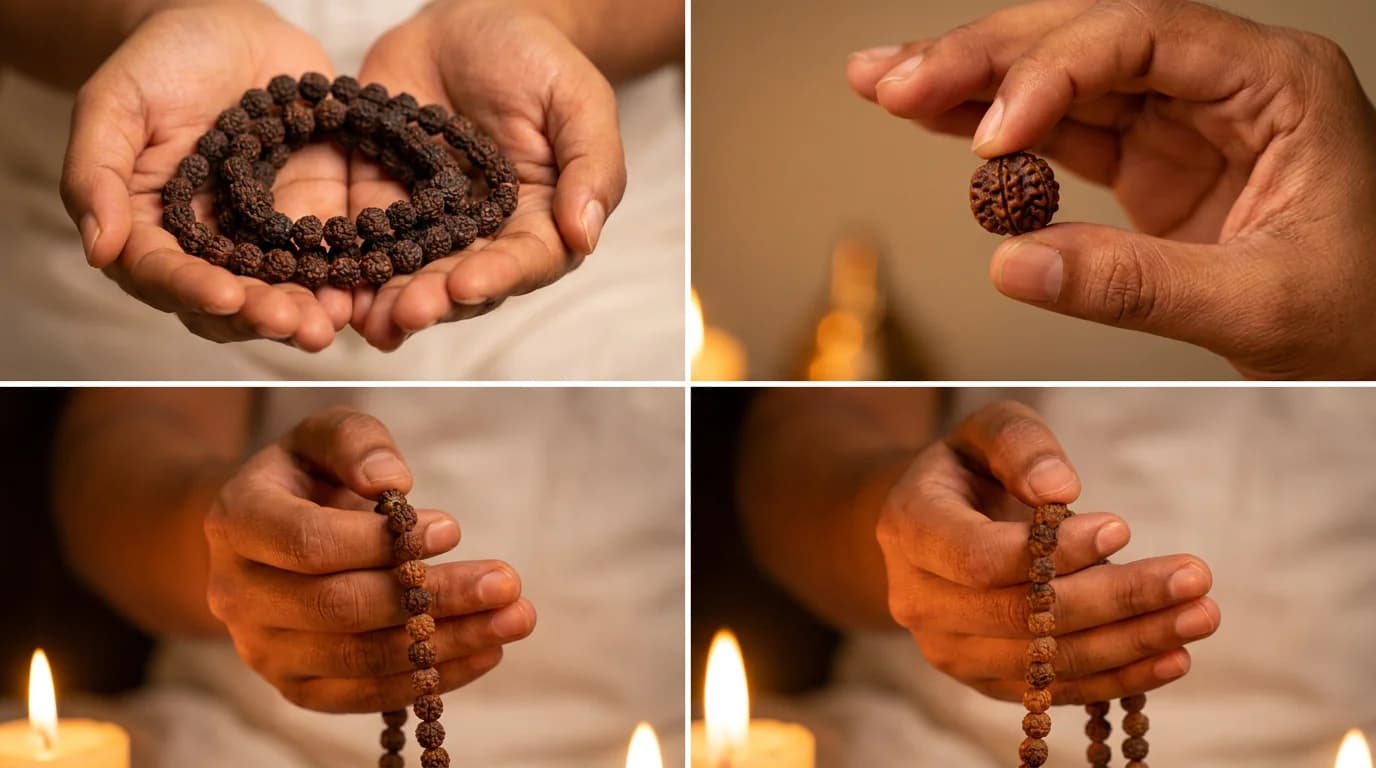
Hold the mala in your right hand. Drape it over your middle finger. Use your thumb to move each bead toward yourself (inward rotation) after each mantra recitation. Your index finger (tarjani) should remain raised or folded — it is never used to touch the mala during jaap.
The reason: in Vedic mudra tradition, the index finger represents the individual ego (ahamkara) — the sense of 'I am separate from the divine'. Excluding it from jaap is a symbolic act of surrendering the ego to the mantra and to Shiva. This teaching is consistent across Shaivite, Vaishnava, and Tantric jaap traditions.
| Holding hand | Right hand (left hand acceptable if right hand injured or absent) |
| Bead movement | Thumb moves bead toward you — inward rotation |
| Which fingers touch mala | Middle finger (support) + thumb (movement only) |
| Index finger | Never touches mala during jaap — represents ego (ahamkara) |
| Optional | Mala can be held inside a gomukhi bag (cloth bag) for added concentration in traditional settings |
Step-by-Step Rudraksha Mala Jaap
- 1Seat yourself
Sit in Sukhasana (cross-legged) or Padmasana if comfortable. Keep the spine upright. Rest the left hand on your left knee in Chin Mudra (tip of index finger touching tip of thumb, other fingers relaxed).
- 2Hold the mala
Take the mala in your right hand, draped over the middle finger, held at roughly heart level. Keep the elbow slightly elevated — do not let the mala drag on your lap.
- 3Find bead 1
Locate the bead immediately adjacent to the Sumeru (the large head bead). This is your starting bead — number 1.
- 4Begin mantra
Take a breath in. As you exhale, recite 'Aum Namah Shivaya' — silently (manasic japa) or in a low murmur (vachik japa). Simultaneously, move bead 1 toward you with your thumb.
- 5Continue bead by bead
One breath-cycle and one mantra = one bead moved. Maintain awareness on the mantra and the feel of the bead. When the mind wanders — and it will — gently bring it back to the sound of the mantra without self-criticism.
- 6Reach the Sumeru — reverse
After bead 108, your thumb will reach the Sumeru. Stop. Touch the Sumeru to your forehead briefly. Reverse the direction of the mala and begin bead 108 → bead 1 for round two. Never cross over the Sumeru.
- 7Close the session
After completing your rounds, hold the mala to your forehead (third eye centre) for 5–10 seconds. Offer a brief mental prayer of gratitude. Place the mala in its red or yellow pouch.
Which Mantra to Use: Mukhi-by-Mukhi Reference
The primary mantra for any Panchmukhi mala is Aum Namah Shivaya. If you have a Guru-diksha mantra, use that. The table below shows the traditional mantra association for different mukhi types, useful if you add combination beads to your practice.
| 5 Mukhi (Panchmukhi) | Aum Namah Shivaya — universal Shiva mantra |
| 1 Mukhi | Aum Hreem Namah — solar, liberation mantra |
| 2 Mukhi | Aum Namah — unity mantra |
| 3 Mukhi | Aum Kleem Namah — fire mantra, confidence |
| 4 Mukhi | Aum Hreem Namah — Brahma, creativity |
| 6 Mukhi | Aum Hreem Hoom Namah — Kartikeya mantra |
| 7 Mukhi | Aum Hoom Namah — Mahalakshmi, Saturn mantra |
| 8 Mukhi | Aum Hoom Namah — Ganesha, obstacle removal |
| Mahamrityunjaya | Aum Tryambakam Yajamahe... — healing, universal for all rudraksha |
How Many Rounds Per Day? A Practical Guide
The minimum recommended jaap for measurable effect in tradition is 1 mala (108 recitations) per day. For establishing a new sadhana, commit to a 40-day cycle (one mandala) of minimum 1 mala daily without breaking the streak. If you miss a day, the tradition recommends doubling the next day's count to maintain the cycle's integrity.
| Round Count | Total Recitations | Time (~) | For Whom |
|---|---|---|---|
| 1 mala | 108 | 10–15 min | Daily minimum — beginners and busy practitioners |
| 3 malas | 324 | 30–45 min | Regular sadhana — establishes deeper habit |
| 7 malas | 756 | 70–90 min | Intensive sadhana — retreat or special occasions |
| 11 malas | 1,188 | 110–130 min | Deep sadhana — traditional count for full anushthana |
| 108 malas | 11,664 | 10–12 hours | Purashcharana — full ritual cycle over several days |
Frequently asked
Last reviewed: 17 May 2026 · Verified by the DivineTatva expert panel
Can I do jaap with Rudraksha Mala using any mantra, not just Aum Namah Shivaya?
Yes. If you have a Guru-diksha mantra, always use that — it takes precedence. Aum Namah Shivaya is the default for Panchmukhi because it is the Panchakshara (5-syllable) mantra of Shiva, matching the 5 faces. Mahamrityunjaya is also widely used for Rudraksha mala jaap.
What happens if I accidentally cross the Sumeru bead during jaap?
Nothing catastrophic — traditions are guidelines, not curses. The teaching is that crossing the Sumeru dissipates the energy built up in that round. If it happens, simply reverse direction at the Sumeru, pause, and begin the next round. Stay mindful going forward.
Can I do jaap silently or does it have to be spoken aloud?
Both are valid. Vachik japa (spoken aloud) is considered easier for beginners. Manasic japa (mental, silent) is considered more powerful and subtle. Whispering (upamshu japa) is intermediate. Progress naturally from spoken to silent as your concentration improves.
Should I breathe in a specific pattern during jaap?
No specific pranayama is required. Natural breath is fine — inhale before the mantra, exhale as you recite and move the bead. Some practitioners synchronise with slow even breaths. Avoid holding the breath or forcing any pattern; jaap itself is the practice.
Can I do Rudraksha Mala jaap while walking or commuting?
Traditional practice recommends a fixed seat for full benefit. However, silent mantra repetition while holding the mala is better than no practice at all. Consider commuting jaap as supplementary — keep your formal seated session for the mornings.
Reviewed by the DivineTatva expert panel
Written and reviewed by DivineTatva's consulting Vedic astrologer. Every piece is lab-certified and energised in our Jaipur atelier. Last updated 14 June 2026.