Rudraksha Mala Benefits: What Shiva's Sacred Bead Does for Mind & Body
Per the Shiva Purana and Devi Bhagavata, Panchmukhi Rudraksha — the 5-faced bead sacred to Lord Shiva — calms an agitated mind, sharpens focus, and invites divine grace. These are Vedic traditional claims backed by centuries of sadhana practice, not clinical trials. Users consistently report a sense of groundedness with regular jaap.
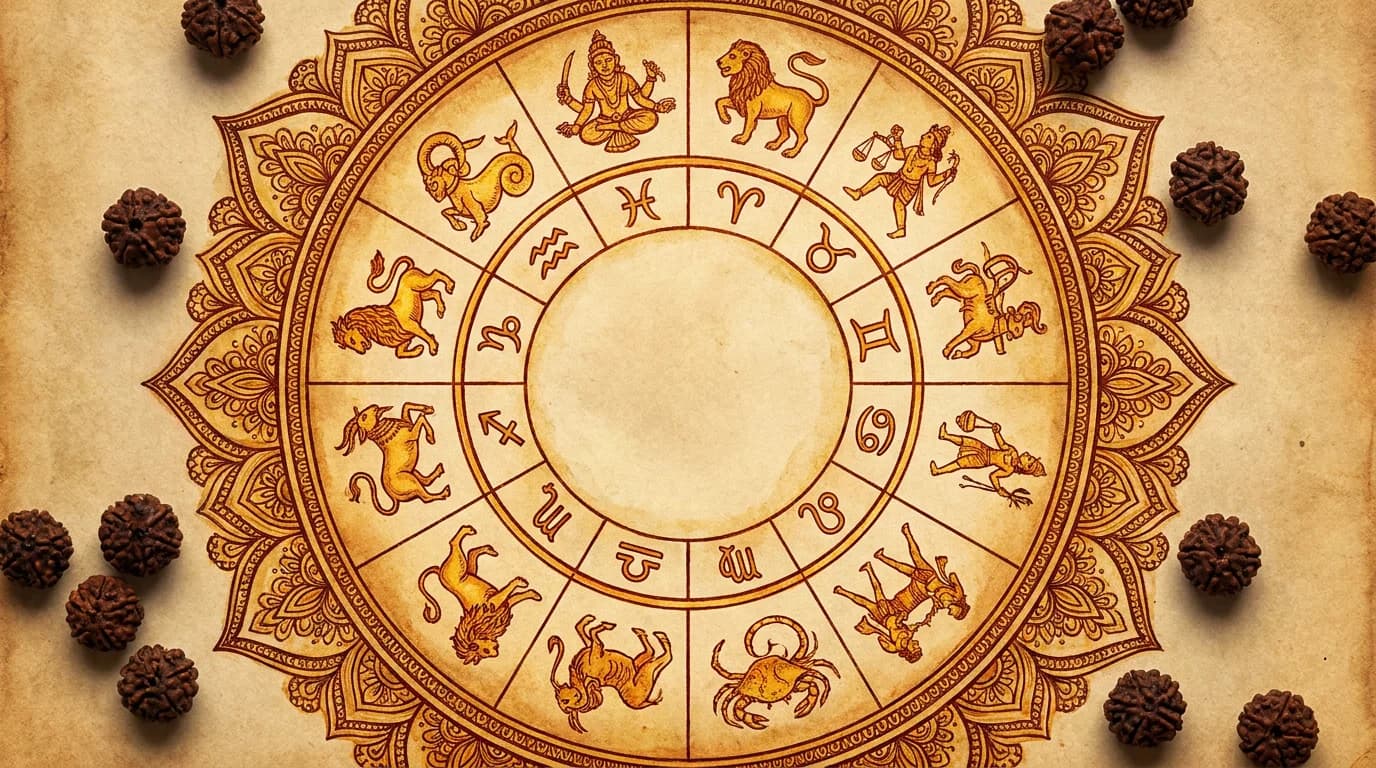
What the Shiva Purana & Devi Bhagavata Say About Rudraksha
The Rudraksha Mala's benefits are not modern wellness marketing — they are documented across multiple Vedic scriptures. The Shiva Purana (Vidyeshvara Samhita, chapters 25–26) states that one who wears rudraksha and recites Shiva's name is freed from the fear of Yama (death), accumulates merit equal to giving charitable donations, and attains liberation. The Devi Bhagavata Purana (Book 11) is even more specific: Panchmukhi rudraksha corresponds to the Panchabrahma — the five cosmic forms of Shiva — and is said to bestow all blessings on the wearer without restriction of caste, gender, or spiritual attainment.
| Shiva Purana on Panchmukhi | Represents Kalagni Rudra — the form of Shiva as cosmic fire; pacifies and purifies the wearer |
| Devi Bhagavata on wearing | One who wears rudraksha while performing jaap gains merit as though performing a thousand yagas (fire rituals) |
| Padma Purana on protection | Rudraksha protects from negative energies, accidents, and evil eye when worn continuously |
| Mantra prescribed | Aum Namah Shivaya — the Panchakshara (5-syllable) mantra, mirroring the 5 faces of Panchmukhi |
Panchmukhi Rudraksha Benefits: The Five Faces and What Each Represents
Each of the five faces (mukhis) of the Panchmukhi bead corresponds to one of the Panchabrahma — the five manifestations of Shiva that govern the five elements and five senses. Wearing the bead is, symbolically, wearing all five aspects of Shiva simultaneously.
| Face 1 — Sadyojata | West direction; Earth element; governs smell and stability; bestows material security |
| Face 2 — Vamadeva | North direction; Water element; governs taste and creativity; brings emotional balance |
| Face 3 — Aghora | South direction; Fire element; governs sight; burns away negative karma |
| Face 4 — Tatpurusha | East direction; Air element; governs touch; sharpens mental clarity |
| Face 5 — Ishana | Upward direction; Space/Akasha element; governs hearing; opens spiritual perception |
This is why Panchmukhi is considered complete in itself — one bead, five cosmic principles. A full 108-bead mala compounds this effect across the length of each jaap session.
Mental Calm, Stress Relief & Focus: What Practitioners Report
While the scriptural claims are vast, what DivineTatva customers and traditional practitioners most consistently report is far more immediate: a sense of calm during and after jaap sessions, reduced reactivity to stress during the day, and improved ability to focus during study or creative work. These outcomes align with what research shows about regular meditation and mantra practice generally — regardless of bead material.
| Calm during jaap | Consistent user report — attributed to combination of mantra vibration, rhythmic breath, and tactile bead movement |
| Stress reduction | Traditional claim (Shiva Purana) + consistent with research on mantra-based meditation reducing cortisol |
| Focus improvement | Reported by students and professionals; consistent with mindfulness research |
| Sleep quality | Some users report improved sleep when mala is kept on the nightstand (not worn during sleep per most traditions) |
| Spiritual connection | Widely reported deepening of personal sadhana within 21–40 days of consistent jaap |
What the Science Does and Does Not Say
Some preliminary studies — including work by Dr Suhas Rao and several Indian universities — have investigated the bioelectric properties of rudraksha, suggesting the bead may generate a mild electromagnetic field that interacts with human skin. These findings are interesting and worth noting. However, no double-blind, peer-reviewed clinical trial has confirmed that wearing rudraksha independently produces health or cognitive benefits. The benefits described in this article are Vedic traditional claims, consistent with thousands of years of practice, and supported by user reports — not medical evidence. Rudraksha is not a substitute for medical or psychological advice.
Rudraksha Mala vs Crystal Bracelet: Two Different Traditions
Both Rudraksha and crystal (gemstone) tools are used in Indian spiritual practice, but they belong to different systems and serve different purposes.
| Aspect | Rudraksha Mala | Crystal Bracelet |
|---|---|---|
| Tradition | Shaivite / Vedic — scripture-based | Vedic astrology / Tantra / crystal healing |
| Primary use | Mantra jaap (active practice, counting) | Passive wearing for energy/planetary benefit |
| Governing system | Mukhi count → deity → quality | Crystal type → planet/chakra → quality |
| Personalisation | Mukhi selected for universal (Panchmukhi) or specific need | Stone selected per birth chart / dosha |
| Care | Weekly oiling, avoid water, store in pouch | Cleanse under moonlight or with sage; recharge in sun/moon |
| Science status | Preliminary bioelectric studies; no clinical trials | No peer-reviewed clinical trials; user-reported |
| Honest position | Vedic tradition + user-reported calm — not medical claims | Vedic astrology + user-reported — not medical claims |
Both are valid tools within their own traditions. Many sadhaks wear both — a Rudraksha Mala for active jaap and a crystal bracelet for passive daily wear aligned with their birth chart.
Who Benefits Most from Rudraksha Mala?
Panchmukhi Rudraksha suits everyone, but certain groups report the most tangible shift in their practice.
- 1Meditation practitioners
The mala gives a tactile anchor for the mind during jaap, dramatically reducing mental drift compared to silent meditation.
- 2Students and knowledge workers
Regular jaap (15–20 minutes before study) is reported to improve pre-session focus — consistent with the focus effect of any short mindfulness practice.
- 3Those experiencing anxiety or stress
Shiva Purana specifically prescribes rudraksha for 'chinta' (anxiety). Regular mantra counting has a rhythm that naturally calms the nervous system.
- 4Spiritual seekers beginning sadhana
Panchmukhi is the recommended starting mala because it has no restrictions and introduces the practitioner to the full system of Shaivite jaap.
- 5Leaders and executives
Tradition associates Panchmukhi with clarity of judgment, wisdom, and composure — qualities Shiva embodies as Mahayogi.
Frequently asked
Last reviewed: 17 May 2026 · Verified by the DivineTatva expert panel
Which rudraksha mala is best for beginners?
Panchmukhi (5-faced) Rudraksha Mala is universally recommended for beginners. It has no rashi, gender, or lifestyle restrictions, and the mantra — Aum Namah Shivaya — is the simplest and most powerful for a Shaivite practice. DivineTatva's 108-bead Siddha Mala at ₹999 is a good starting point.
Does Rudraksha Mala really reduce stress?
Per Vedic tradition (Shiva Purana), yes. Scientifically, regular mantra-based meditation (of which jaap is a form) is well-established to reduce stress markers. The specific contribution of the bead material vs the practice itself has not been separated in clinical studies. Honest answer: the practice works; the bead enhances the practice meaningfully for most practitioners.
Can I wear Rudraksha Mala without doing jaap?
Yes — wearing alone is considered auspicious per Vedic tradition. However, the benefits described in scriptures are explicitly tied to both wearing and reciting the mantra. Passive wearing without jaap is beneficial; combining both is described as far more potent.
How long does it take to see benefits from Rudraksha Mala?
Most practitioners report a noticeable shift in mental calm within 21–40 days of consistent daily jaap (1 mala per day minimum). Scriptural tradition marks 40 days (one mandala) as the minimum cycle for establishing a new sadhana.
Is there any scientific proof for Rudraksha benefits?
Preliminary studies on rudraksha's bioelectric properties exist but no peer-reviewed clinical trials confirm specific health benefits. The calm and focus reported by practitioners align with established research on mantra meditation generally. We present rudraksha benefits as Vedic tradition and user-reported, not medical claims.
Can wearing Rudraksha Mala help with sleep?
Some practitioners keep the mala on the nightstand (not worn during sleep per most traditions) and report improved sleep quality. This is user-reported, not clinically proven. Evening jaap before bed — with its rhythmic, calming mantra repetition — is well within the established benefits of relaxation practice.
Reviewed by the DivineTatva expert panel
Written and reviewed by DivineTatva's consulting Vedic astrologer. Every piece is lab-certified and energised in our Jaipur atelier. Last updated 15 June 2026.