Amethyst Bracelet Price in India: What ₹349 vs ₹1,499 Actually Buys You
An amethyst bracelet is a stretch band strung with natural amethyst — the purple, iron-coloured variety of quartz worn for calm, focus and intuition. In India prices run roughly ₹349 to ₹1,499, set by stone authenticity, bead size, colour grade and whether a per-piece lab certificate is included. This guide decodes that ladder.
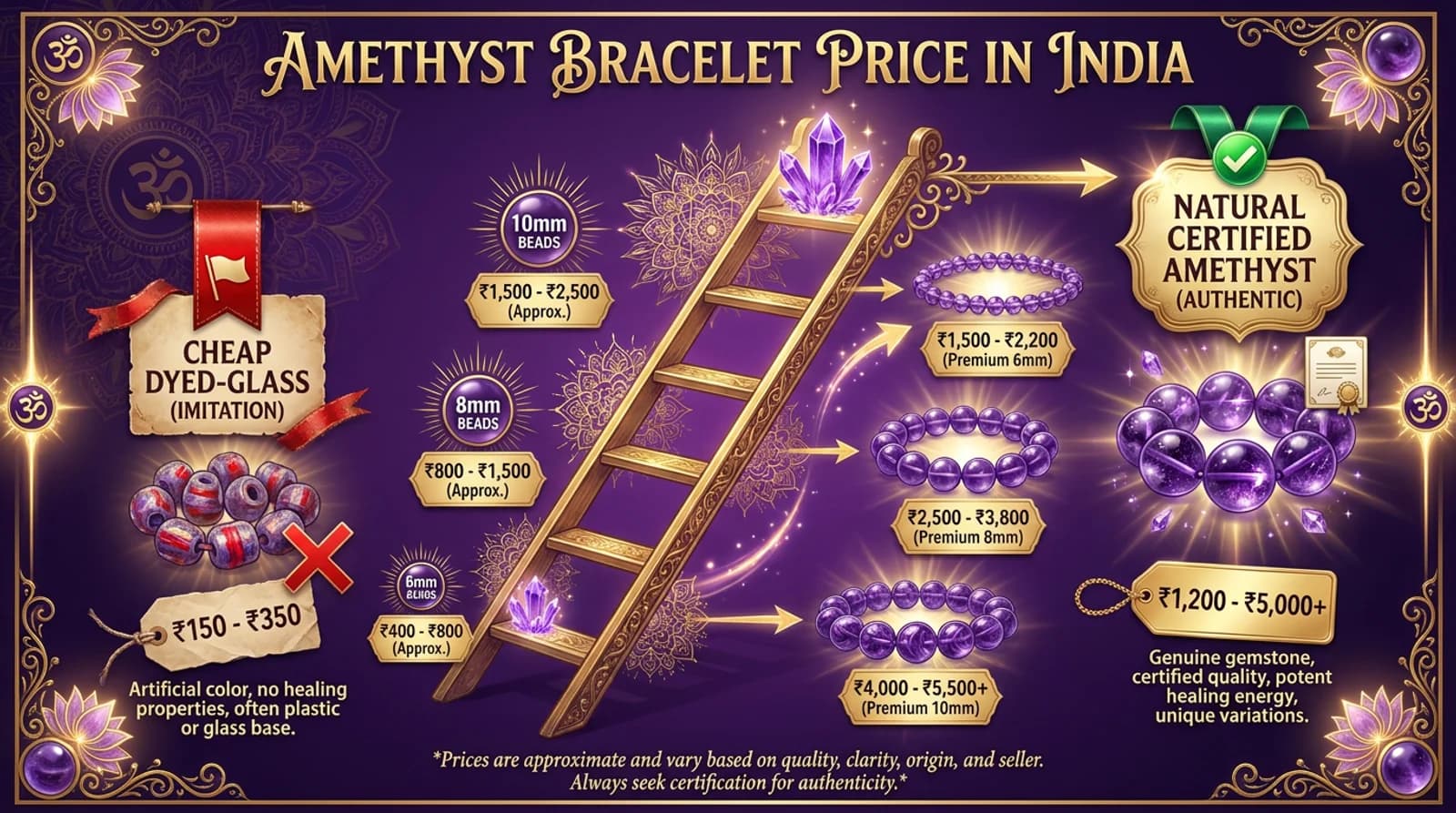
Amethyst Bracelet Price in India: The Snapshot
An amethyst bracelet in India costs roughly ₹349 to ₹1,499. The lower end is mass-produced commodity stone — often pale, dyed or glass-mixed — with no certificate. The upper end is natural, lab-certified amethyst with visible colour-zoning, a chosen bead size and a downloadable third-party certificate per piece. Price tracks authenticity, not just looks.
| Typical India price range | ₹349 – ₹1,499 |
| Entry / commodity band | ₹349 – ₹599 |
| Mid certified band | ₹699 – ₹999 |
| Premium certified band | ₹1,099 – ₹1,499 |
| Most common bead size | 8mm |
| Payment | COD + prepaid (UPI/card) |
| Sizing | Free-size stretch elastic |
These wellness associations — calm, focus, sleep, intuition — come from Vedic and metaphysical tradition and user experience, not clinical proof. An amethyst bracelet is not a treatment for any condition and is not a substitute for medical, financial or professional advice.
What Each Price Band Actually Buys You
Two bracelets photographed under bright studio light can look identical online and cost four times apart. The difference lives in the stone, the certificate and what happens after a month of wear. Here is what your money is really paying for at each rung of the ladder.
| Price band | Stone reality | Certificate | What to expect |
|---|---|---|---|
| ₹349–₹599 | Often dyed quartz, glass or very pale chips; flat uniform purple | None, or a generic printed card | Cheap entry; colour may be fake or fade fast; no traceability |
| ₹699–₹999 | Natural amethyst, light-to-medium tone, some zoning | Per-piece lab certificate (good sellers) | Honest everyday bracelet; real stone, sensible value |
| ₹1,099–₹1,499 | Natural amethyst, deeper even purple, clean beads, larger size | Downloadable third-party certificate per piece | Gift-grade colour and clarity with full authenticity proof |
A ₹349 band is not automatically a scam — but at that price something is usually compromised: the stone, the certificate or the size. A ₹1,499 band should never disappoint on all three. The middle band is where most honest buyers land.
The 5 Things That Set an Amethyst Bracelet's Price
Amethyst is not rare, so wild prices rarely reflect the raw stone alone. Five factors move the number on the tag — and knowing them lets you tell a fair ₹999 from an overpriced one.
- 1Authenticity of the stone
Natural amethyst costs more than dyed quartz or glass. Genuine stone shows subtle colour-zoning and tonal variation; a flat, identical purple across every bead is the tell of dye or glass.
- 2Colour grade and tone
Even, medium-to-deep purple commands a premium. Pale, washed-out or unevenly blotchy beads are cheaper. Deep 'Siberian-style' tone is the most expensive natural grade.
- 3Bead size
Larger beads use more rough and weigh more, so an 10mm bracelet costs more than a 6mm one of the same quality. 8mm is the popular all-rounder.
- 4Certification
A genuine per-piece lab test adds real cost and real trust. A self-printed '100% Certified' badge with no document adds neither.
- 5Finishing and brand
Knot quality, durable elastic, clasp work, packaging and astrologer-energising add a few hundred rupees. Jaipur lab-tested pieces sit in a fair, transparent band.
| Biggest legitimate price driver | Stone authenticity + certificate |
| Most overpaid-for factor | Brand badge with no lab document |
| Best value bead size | 8mm |
| Red-flag price | Deep-purple 'natural' bracelet under ₹350 |
Bead Size and Price: 6mm, 8mm and 10mm Compared
Bead size is the easiest lever on price and the one most buyers overlook. Bigger beads aren't 'better' — they simply use more stone and suit different wrists and styling. Match the size to your wrist and intent rather than to the highest number.
| Bead size | Best for | Look & feel | Relative price |
|---|---|---|---|
| 6mm | Slim wrists, daily layering, subtle wear | Delicate, low-profile, easy under cuffs | Lowest |
| 8mm | Most adults, all-day wear, the default choice | Balanced presence, visible colour, versatile | Mid (most popular) |
| 10mm | Larger wrists, bold styling, statement gifting | Heavy, prominent purple, strong presence | Highest |
For a first amethyst bracelet, 8mm is the safe pick: enough stone to show real colour-zoning, comfortable for sleep and work, and priced in the sensible middle. Step up to 10mm only if you specifically want a bolder look or have a broader wrist.
Certified vs Commodity: Why the Same Stone Costs More
The single biggest reason two amethyst bracelets differ in price is the certificate behind them. A commodity bracelet asks you to trust a photo. A certified one hands you a document — and a way to spot a fake yourself before you ever wear it.
| What you get | Commodity (₹349–₹599) | Certified (DivineTatva) |
|---|---|---|
| Stone | Often dyed/glass; unverified | Natural amethyst, lab-tested per piece |
| Certificate | None or generic card | Downloadable third-party certificate, your exact piece |
| Real-vs-fake guidance | None | On-page coldness test, bubble check, colour-zoning macros |
| Colour over time | May fade or wash out | Honest natural tone, care guidance included |
| Recourse if wrong | Limited | Traceable certificate ID |
Quick self-tests help you sanity-check any purchase: real amethyst feels cool to the touch and warms slowly; glass warms fast and may show tiny round bubbles inside the bead; and natural stone shows uneven colour-zoning rather than one perfectly flat purple. A certificate plus these checks is what your extra rupees are buying — confidence, not just colour.
Buying Smart Online: COD, Sizing and a 6-Point Checklist
Buying an amethyst bracelet online in India is low-risk when COD and free-size stretch are on the table — you inspect the stone in hand before paying, and one elastic band fits most wrists. Run this checklist before you order so price and quality actually match.
- 1Confirm it's natural amethyst
Look for stated 'natural amethyst' and visible colour-zoning in close-up photos, not a flat dyed purple.
- 2Demand a per-piece certificate
A downloadable third-party lab certificate for your exact bracelet beats any '100% Certified' badge.
- 3Pick your bead size
8mm for most; 6mm for slim wrists; 10mm for a bold look. Check the size is listed, not assumed.
- 4Check sizing and cord
Free-size stretch elastic suits most; confirm the inner circumference and cord durability.
- 5Use COD to inspect first
Cash on delivery lets you do the coldness and zoning checks before paying.
- 6Read the honest claims
Trust sellers who frame benefits as traditional belief, not medical cures.
| Safest payment to verify quality | Cash on Delivery (COD) |
| Sizing | Free-size stretch elastic |
| Origin | Jaipur-made, lab-certified |
| Must-have before paying | Per-piece downloadable certificate |
Protecting Your Investment: Care That Preserves Value
A certified bracelet keeps its colour and worth only if you care for it correctly. Amethyst's purple is durable but not immune to sunlight and chemicals — a few simple habits keep your ₹999 piece looking like the day it arrived.
Amethyst is water-safe for a quick rinse, but its purple colour can fade in prolonged direct sunlight — cleanse under moonlight or running water, avoid perfume and harsh chemicals, and keep the elastic cord dry to preserve stretch.
| Quick cleanse | Rinse under running water, pat dry |
| Energy cleanse | Moonlight overnight (not harsh sun) |
| Avoid | Perfume, harsh chemicals, prolonged sunlight |
| Cord care | Keep elastic dry to preserve stretch |
| How long to feel effects | Often a few days to a few weeks; varies by person |
Any sense of calm or focus you notice builds gradually and reflects intention, ritual and personal expectation as much as the stone itself. Care for the bracelet as a meaningful object, not a medicine — and it will hold both its colour and its certified value for years.
Frequently asked
Last reviewed: 17 May 2026 · Verified by the DivineTatva expert panel
How much does an amethyst bracelet cost in India?
Expect roughly ₹349 to ₹1,499. The ₹349–₹599 band is usually commodity or dyed stone with no certificate. ₹699–₹999 buys honest natural amethyst with a per-piece lab certificate, and ₹1,099–₹1,499 gets deeper colour, larger beads and full downloadable certification. Price tracks authenticity, bead size and certification far more than brand name.
Why are some amethyst bracelets so cheap?
A bracelet under about ₹350 with deep, perfectly even purple is a red flag. At that price something is usually compromised — dyed quartz or glass instead of natural amethyst, no lab certificate, or very pale chips. Genuine natural amethyst with a per-piece certificate carries real testing and finishing costs, which is why honest pieces sit higher on the ladder.
Is an 8mm amethyst bracelet worth the higher price?
For most buyers, yes. 8mm beads show real colour-zoning, stay comfortable for all-day and sleep wear, and sit in the sensible middle of the price range. 6mm is cheaper and suits slim wrists; 10mm costs more for a bolder, heavier look. Choose by wrist and styling, not by assuming bigger is better.
Does a certificate really justify a higher price?
Yes, when it's a genuine per-piece third-party lab certificate you can download for your exact bracelet — that's traceable proof your stone is natural amethyst. A self-printed '100% Certified' badge with no document adds nothing. The certificate, plus simple coldness and colour-zoning checks, is what your extra rupees buy: confidence, not just colour.
How do I tell if a pricey amethyst bracelet is actually real?
Real amethyst feels cool and warms slowly; glass warms fast and may show tiny round bubbles inside the bead. Natural stone shows uneven colour-zoning and tonal variation, not one flat, dyed purple. Pair these checks with a downloadable per-piece lab certificate. With COD you can run the tests in hand before paying anything.
Can I buy an amethyst bracelet online in India with COD?
Yes. Cash on Delivery is widely available and is the safest way to verify quality, because you inspect the stone and run the coldness and colour-zoning checks before paying. Most bracelets are free-size stretch elastic that fit the majority of wrists, so online sizing risk is low. Prefer sellers offering a per-piece certificate alongside COD.
Does a more expensive amethyst bracelet work better?
Price reflects stone authenticity, colour grade, bead size and certification — not metaphysical strength. The calm, focus or intuition associated with amethyst come from Vedic tradition and personal belief, not clinical proof, and a certified bracelet is no medical treatment. A higher price buys genuine, traceable, better-looking stone; any felt effect depends on your own intention and ritual.
Reviewed by the DivineTatva expert panel
Written and reviewed by DivineTatva's consulting Vedic astrologer. Every piece is lab-certified and energised in our Jaipur atelier. Last updated 16 March 2026.