Which Hand to Wear Black Obsidian: Left vs Right, Best Day & How to Wear
A black obsidian bracelet is volcanic-glass beads, often paired with iron-rich hematite, worn for grounding and protection from negative energy. Tradition says wear it on your left wrist to absorb and shield, right to project willpower outward. Start on a Saturday (Shani's day) for grounding intentions. This is belief and ritual, not proven medicine.
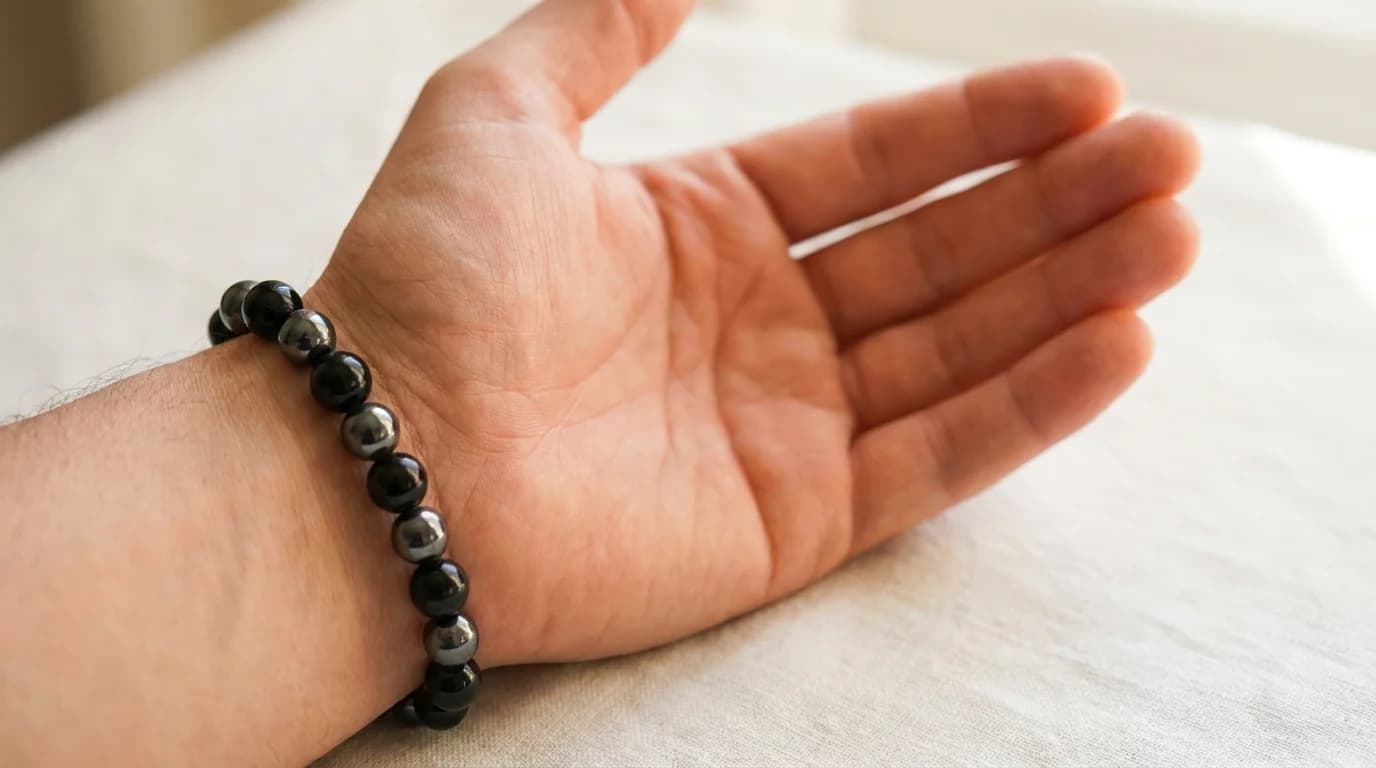
Black Obsidian Bracelet: Which Hand?
Wear a black obsidian bracelet on your left wrist if you want it to absorb negative energy, calm an overactive mind and shield you from buri nazar — in Vedic and energy tradition the left side is the receiving, intuitive side of the body. Wear it on your right wrist when you want to project grounded willpower, discipline and confidence outward into the world.
Most people choose the left wrist because black obsidian and hematite are valued mainly as protective, grounding stones — and protection is about what you take in and filter out. If you are right-handed, the left wrist is also simply more comfortable for daily wear. There is no rule that breaks if you swap; this is a tradition-based guideline, not a medical instruction.
| Left wrist (receiving) | Absorb negativity, shield from buri nazar, calm the mind, ground anxiety |
| Right wrist (projecting) | Send out willpower, discipline, focus and grounded confidence |
| Most common choice | Left wrist, for protection and daily comfort |
| Hard rule? | No — guideline from energy/Vedic tradition, not a law |
Left vs Right Wrist Compared
The left-versus-right logic comes from the idea that energy flows in one side and out the other. The left (non-dominant for most people) is the passive, receiving side; the right is the active, giving side. Match your goal to the side, then keep it consistent so the habit and intention stay linked.
| Factor | Left wrist | Right wrist |
|---|---|---|
| Tradition role | Receiving / absorbing | Projecting / giving |
| Best for | Protection, calm, shielding from negativity | Confidence, drive, grounded action |
| Buri nazar / evil eye | Preferred — filters incoming energy | Possible, but less common |
| Anxiety & overthinking | Strong fit — grounding inward | Secondary |
| Comfort (right-handed user) | More comfortable, fewer knocks | More wear and tear |
| Hematite's heavy, grounding feel | Settles the receiving side | Steadies the active side |
If you are unsure, default to the left wrist. You can always move it after a few weeks if you feel you want the bracelet to support outward drive rather than inner shielding.
Best Day to Start: Saturday & Shani
In Vedic astrology black, iron-rich stones are linked to Shani (Saturn) and to Mangal (Mars) through hematite's iron content. Because Saturn governs discipline, grounding, patience and protection from delays and obstacles, Saturday (Shanivaar) is the traditional day to begin wearing a black obsidian and hematite bracelet for the first time.
- 1Pick a Saturday morning
Saturday is Shani's day; morning, after a bath, is considered an auspicious, clean start.
- 2Cleanse the bracelet first
Rinse off store and travel energy with sage smoke, moonlight or selenite before the first wear (never salt water — see care below).
- 3Set a clear intention
Hold the bracelet, breathe, and silently state what you want it to support: protection, calm, grounding.
- 4Wear on your chosen wrist
Left for absorbing/shielding, right for projecting. Slide it on and wear it through the day.
| Planet linked | Shani (Saturn); Mangal (Mars) via iron/hematite |
| Best day to start | Saturday (Shanivaar) |
| Best time | Morning, after bathing |
| Chakra association | Root (Muladhara) — stability and grounding |
Timing is a tradition that adds intention and ritual meaning — it is not a clinical requirement. If you cannot wait for Saturday, any clean, calm moment with a clear intention is fine.
How to Wear It the Right Way
A well-fitted bracelet sits snug but not tight — you should be able to slip one finger under it. Too loose and it knocks against surfaces; too tight and it is uncomfortable through the day. Measure your wrist with a strip of paper and a ruler, then match it to the bead count below.
| Wrist size | 8mm beads (count) | 10mm beads (count) | Fit |
|---|---|---|---|
| 15–16 cm | ~18–19 | ~14–15 | Petite |
| 16–17 cm | ~19–20 | ~15–16 | Average women |
| 17–18 cm | ~20–21 | ~16–17 | Average men |
| 18–20 cm | ~21–23 | ~17–18 | Larger / men |
- 1Choose bead size
8mm is lighter and everyday; 10mm has more presence and the heavy, grounding hematite feel many men prefer.
- 2Wear it on skin
Direct skin contact is traditional, but it works over a sleeve too — comfort matters more than dogma.
- 3Keep it consistent
Wear it daily on the same wrist so the habit reinforces the intention; consistency beats occasional use.
- 4Pair thoughtfully
Black obsidian and hematite work well together — both grounding, both protective. You can wear them together; see the FAQ on combining stones.
Who Should Wear Black Obsidian & Hematite
Black obsidian and hematite are traditionally chosen by people who feel scattered, anxious or energetically drained, and who want a grounding, protective anchor. The combination is popular with both men and women, and 10mm beads in particular suit those wanting a bolder, heavier piece.
| Good fit | Anyone feeling ungrounded, anxious, overstimulated or exposed to negativity |
| Rashi note | Often chosen by Makar/Kumbh (Saturn-ruled) and Vrishchik/Mesh (Mars-linked) — but suits any sign |
| For men | Yes — 10mm beads are a popular, understated daily choice |
| Goal | Grounding, protection from negative energy and buri nazar, calmer focus |
There is no rashi that is forbidden from wearing it. Vedic guidance about gemstones and planets is traditional belief; black obsidian and hematite are commonly treated as broadly suitable grounding stones rather than a restricted, prescription-only gem. If you follow strict astrological practice, confirm with your own astrologer.
Cleanse, Charge & Care
Cleanse a new bracelet before first wear and roughly once a month after that, so it stays energetically fresh. Charging restores its grounding intention. The one thing to remember with this pairing is that hematite contains iron, so water is its enemy.
Keep this bracelet dry — hematite contains iron and can develop surface rust if soaked, so avoid wearing it in the shower or pool and never cleanse it in salt water; wipe with a soft dry cloth and cleanse with moonlight, sage or selenite instead.
| Cleanse method | Sage/incense smoke, full-moon moonlight, or rest on selenite |
| Charge method | Overnight moonlight; morning sun briefly; or a clear intention/visualisation |
| How often | Cleanse roughly monthly, or after stressful days |
| Avoid | Salt water, long water soaks, harsh chemicals, perfume, sanitiser |
| Daily care | Wipe with a soft dry cloth; store away from moisture |
Genuine materials make care worthwhile: real obsidian shows a curved, glassy (conchoidal) fracture and feels cool to the touch, while true hematite is heavy and gives a faint tug to a fridge magnet. Our bracelets ship with a per-piece lab certificate so you can verify what you are caring for.
Does It Work? Belief vs Evidence
Here is the honest position. The grounding, protective and calming effects attributed to black obsidian and hematite come from Vedic, feng-shui and metaphysical tradition plus personal belief — not from clinical trials. There is no medical proof that any stone treats anxiety, blocks negative energy or removes buri nazar.
| Claim | What's verifiable | What's belief |
|---|---|---|
| Grounding & calm | Many users report feeling steadier/focused | Consistent with ritual, intention and placebo |
| Protection / buri nazar | — | Vedic & feng-shui tradition, not proven |
| Shani/root-chakra link | — | Astrological & energy belief system |
| The stones are real | Conchoidal fracture, cool touch, magnet tug, lab cert | — |
We think honesty builds more trust than over-promising. Wear the bracelet for its meaning, its grounding ritual and the calm that a consistent intention can bring — and treat it as a complement to, not a substitute for, medical, financial or professional advice.
Frequently asked
Last reviewed: 17 May 2026 · Verified by the DivineTatva expert panel
Black obsidian bracelet — which hand should I wear it on?
Wear it on your left wrist if your goal is protection, calm and shielding from negative energy or buri nazar, because the left is the receiving side in energy tradition. Wear it on your right wrist to project willpower, discipline and confidence outward. Most people choose the left for protection and everyday comfort. This is a tradition-based guideline, not a fixed rule, so choose the side that matches your intention.
What is the best day to start wearing it?
Saturday (Shanivaar) is traditional, because black iron-rich stones are linked to Shani (Saturn), the planet of discipline, grounding and protection. Start in the morning after a bath, cleanse the bracelet first, set a clear intention, then put it on. Timing adds ritual meaning rather than any proven effect — if you cannot wait for Saturday, any calm, clean moment with a sincere intention works fine.
Can I wear black obsidian and hematite together?
Yes. Both are grounding, protective stones with no traditional conflict, which is exactly why this pairing exists. Black obsidian is the volcanic-glass shield against negativity; hematite is the heavy, iron-rich grounding anchor linked to the root chakra and to Shani/Mangal. Worn together they reinforce each other. Just keep the bracelet dry, since hematite contains iron and can surface-rust if soaked.
Who should wear a black obsidian bracelet?
Anyone who feels scattered, anxious, overstimulated or energetically exposed and wants a grounding, protective anchor. It suits both men and women — 10mm beads are popular with men for a bolder feel. In Vedic terms it is often chosen by Saturn-ruled signs (Makar, Kumbh) and Mars-linked signs (Vrishchik, Mesh), but no rashi is forbidden. If you follow strict astrology, confirm with your own astrologer.
Are there any side effects of wearing black obsidian?
There are no medical side effects from wearing a stone bracelet. Some people in metaphysical tradition say obsidian can feel intense at first because it is said to surface buried emotions, so they ease in by wearing it a few hours a day. Practically, the only real care issue is the hematite: keep it dry, since iron can rust if soaked. It is not a substitute for medical or professional advice.
How do I cleanse and charge my bracelet?
Cleanse before first wear and about once a month using sage or incense smoke, full-moon moonlight, or by resting it on selenite. Charge it overnight in moonlight, briefly in morning sun, or simply by holding it and restating your intention. Never use salt water or long water soaks — hematite contains iron and can develop surface rust. Wipe with a soft dry cloth and store away from moisture.
How do I know my black obsidian and hematite are real?
Real obsidian breaks with a curved, glassy (conchoidal) fracture, feels cool to the touch and may show a faint sheen. Genuine hematite is noticeably heavy for its size and gives a faint tug toward a fridge magnet — many fakes are non-magnetic glass or resin. The most reliable proof is documentation: each DivineTatva bracelet ships with a per-piece lab certificate identifying the stones.
Reviewed by the DivineTatva expert panel
Written and reviewed by DivineTatva's consulting Vedic astrologer. Every piece is lab-certified and energised in our Jaipur atelier. Last updated 4 April 2026.