Which Hand to Wear a Citrine Bracelet: Left vs Right (Feng Shui & Vedic)
A citrine bracelet is a stretch or beaded wrist band of citrine — yellow-to-golden quartz known as the "stone of abundance" or merchant's stone. In Feng Shui and Vedic practice the left wrist is the receiving side and the right is the giving side, so the hand you choose follows the intention you set: drawing wealth in versus projecting it out.
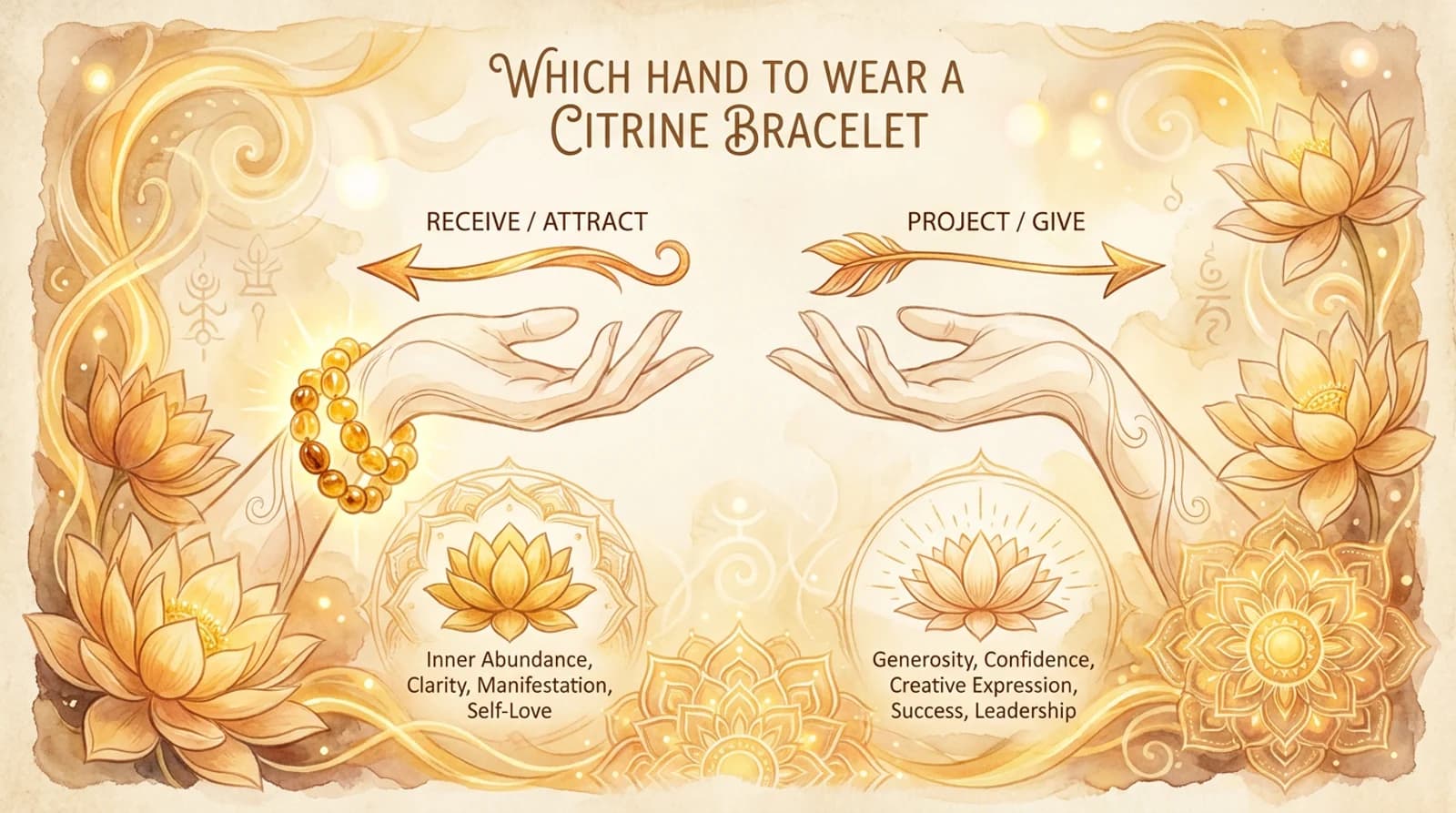
Which Hand to Wear a Citrine Bracelet?
Wear a citrine bracelet on your left wrist if your goal is to receive — to draw in money, opportunity, calm and confidence. Wear it on your right wrist if your goal is to give out or project that energy: closing deals, presenting, negotiating or radiating confidence outward. This left-receives, right-gives rule is shared by both Feng Shui and Vedic wrist traditions, which is why most people new to crystals are told to start on the left.
There is no medical or scientific reason one wrist works better than the other. The choice is a belief-based, ritual convention that helps you set and remember an intention — not a proven mechanism. If you are right-handed and the bracelet gets knocked about during work, comfort and protecting the stone matter more than the rule; a citrine you actually keep wearing does more for you than a 'correct' wrist that sits in a drawer.
| Want to receive (money, luck, calm) | Left wrist |
| Want to project (deals, confidence, influence) | Right wrist |
| Tradition behind it | Feng Shui + Vedic (left = receiving, right = giving) |
| Default for beginners | Left wrist |
| Proven medical effect of hand choice | None — ritual/intention convention |
Left vs Right Wrist, By Intention
In Feng Shui the left side of the body is considered the passive, inward, receiving channel and the right the active, outward, giving channel. Vedic wrist custom maps neatly onto this: the left hand (especially for women and for most wearers seeking inflow) is the receiving wrist. Use the table to match your main goal to a wrist — then wear it consistently rather than swapping daily.
| Your goal | Wrist | Why (tradition) | Honest note |
|---|---|---|---|
| Attract money & abundance | Left | Left is the receiving side — wealth flows in | Pairs with effort and planning, not instead of them |
| Business growth & sales | Right | Right projects confidence and 'closes' | Helps your mindset; doesn't replace the pitch |
| Calm, focus, less anxiety | Left | Receiving steadiness into the body | Reported calm is consistent with ritual/placebo |
| Confidence on stage / interviews | Right | Right radiates presence outward | Acts as a confidence cue you control |
| General daily wear | Left (default) | Most prosperity intentions are 'inflow' | Comfort can override the rule |
What about the non-dominant hand? Many practitioners suggest the non-dominant wrist simply because the stone stays cleaner and undamaged there. If you are right-handed, that is your left wrist anyway — which conveniently matches the receiving rule. Left-handers seeking inflow can still wear citrine on the left for intention and accept slightly more wear and tear, or choose the right and frame it as projecting prosperity.
How to Wear a Citrine Bracelet Correctly
How you wear citrine matters as much as which hand. The point of these small steps is to turn the bracelet into a clear, repeatable intention-setting habit — the part that genuinely shapes behaviour. None of this is medical instruction; it is the traditional ritual that gives the stone its meaning for you.
- 1Cleanse it first
Before first wear, cleanse the new bracelet (moonlight, selenite, or a quick water rinse) to 'reset' it from handling. See the care section for the citrine-specific method.
- 2Pick your wrist by intention
Left to receive wealth and calm; right to project confidence and close deals. Decide once and keep to it.
- 3Set a clear intention
Hold the bracelet, take a breath, and state a specific, realistic goal — 'I'm focused and open to new income this quarter' beats a vague wish.
- 4Wear it on skin where you can
Comfortable, snug but not tight; 8mm beads suit most adult wrists and are the popular all-day size.
- 5Wear consistently
Daily wear builds the habit and the association; reserve swapping wrists for a genuine change of goal.
- 6Protect it during rough work
Remove for heavy gym, cleaning or swimming so beads and elastic last longer.
| Most popular bead size | 8mm (all-day comfort) |
| Best contact | Snug on skin, not tight |
| Take it off for | Bathing, swimming, gym, cleaning chemicals |
| Stack with | Pyrite or green aventurine for a wealth set (optional) |
Best Day to Start & Who Should Wear It
Citrine is traditionally linked to Jupiter (Guru) and the solar plexus chakra — the body's centre of confidence, willpower and 'fire'. Because Thursday is Jupiter's day in the Vedic week, many wearers choose a Thursday morning to start a new citrine bracelet and set their abundance intention. This is a meaningful cultural ritual, not a rule that changes the stone's properties.
| Planet (Vedic) | Jupiter — Guru |
| Best day to begin | Thursday (Jupiter's day) |
| Chakra | Solar plexus (confidence, willpower) |
| Suited to | Business owners, students, anyone seeking confidence & clarity |
| Pairs naturally with | Sagittarius / Pisces energy and prosperity intentions |
Who should wear citrine? It is a gentle, broadly suitable stone with no rashi that is traditionally forbidden, so business owners, freelancers, students and anyone wanting steadier confidence can wear it. Side effects are not physical — at most some people feel 'too wired' or over-eager when first focusing on money goals; if a stone ever feels distracting, take it off. Citrine is a supportive ritual, not a substitute for medical, financial or professional advice.
Does Citrine Actually Attract Money? Belief vs Evidence
Citrine's nickname — the 'merchant's stone' — comes from a real historical habit of traders keeping it in cash boxes for prosperity. That is tradition and folklore, not proof. There is no clinical evidence that citrine attracts money or changes your finances. What is honest to say: wearing a wealth intention on your wrist can keep you focused, optimistic and consistent, and many users report feeling calmer and more confident. Those effects are consistent with intention, ritual and placebo.
| Claim you'll see online | What tradition says | What's actually verifiable |
|---|---|---|
| 'Citrine attracts money' | Merchant's stone of abundance | No clinical proof; supports focus/optimism |
| 'Boosts business growth' | Linked to Jupiter & confidence | May reinforce confident, consistent action |
| 'Opens the solar plexus chakra' | Solar plexus = willpower centre | Belief-based; no measurable chakra effect |
| 'Cures anxiety' | Calming, grounding stone | Not a treatment — see a professional for anxiety |
We say this plainly because it builds trust, not because we don't love the stone. Treat citrine as a beautiful, meaningful cue that supports your own effort — pair it with real planning, saving and work. If a seller promises guaranteed wealth, that is a red flag, not a feature.
How to Cleanse, Charge & Care for Citrine
Citrine is durable but its golden colour can fade with prolonged sun exposure, so cleanse it briefly under moonlight, selenite or a quick water rinse and avoid leaving it in direct sunlight; keep it away from harsh chemicals, perfume and water while bathing. This is the single most important care correction, because much online advice still tells you to 'charge citrine in the sun' — which can dull the very colour you paid for.
| Hardness | Mohs ~7 — scratch-resistant, everyday-friendly |
| Cleanse with | Moonlight, selenite, or a brief water rinse |
| Best charging | Moonlight or selenite — not prolonged sun |
| Avoid | Direct sun for hours, perfume, harsh chemicals, bathing |
| How often | A quick cleanse weekly or after intense use |
A short cleanse routine: rinse or smoke-cleanse the beads, dry them, then leave the bracelet out overnight in moonlight while you restate your intention. Re-set the bracelet on your chosen wrist in the morning. That's enough — citrine does not need aggressive 'recharging', and over-handling stretch elastic shortens its life.
Real, Certified Citrine — And What It Should Cost
Most commercial 'citrine' is heat-treated amethyst — still real quartz, but its golden colour is produced in a kiln, not by nature. Natural yellow citrine is rarer and pricier. Both are genuine quartz and fine to wear; the issue is honesty. We state on the product page whether a stone is natural or heat-treated, and ship a Jaipur lab certificate with a real report number you can verify — not a vague '100% certified' badge.
Quick real-vs-fake tells: natural citrine usually shows subtle, uneven colour zoning, while heat-treated stones often have a strong concentrated orange-brown near the tips. Glass fakes look too uniform, may have tiny bubbles, and feel warmer to the touch than real quartz. Genuine citrine can fade slightly after long sun exposure; dyed glass won't behave like quartz at all. When in doubt, the lab report settles it.
| Type | Colour clue | Rarity | Typical INR range |
|---|---|---|---|
| Natural citrine | Soft, even pale-to-golden yellow | Rarer | Higher tier — premium pricing |
| Heat-treated amethyst (most 'citrine') | Concentrated orange-brown at tips | Common | Affordable everyday tier |
| Dyed glass (fake) | Too uniform, bubbles, warm feel | Avoid | Cheapest — not real quartz |
| Common size | 8mm beaded stretch bracelet |
| Certificate | Jaipur lab report with verifiable number |
| Treatment disclosure | Natural vs heat-treated stated on PDP |
| Payment & shipping | COD available, free shipping, stated return window |
Frequently asked
Last reviewed: 17 May 2026 · Verified by the DivineTatva expert panel
Which hand should I wear a citrine bracelet on?
Wear it on your left wrist to receive — to draw in money, luck, calm and confidence — and on your right wrist to project that energy outward when closing deals, presenting or negotiating. This left-receives, right-gives rule comes from Feng Shui and Vedic tradition. It's a ritual convention to anchor your intention, not a medically proven mechanism, so comfort and protecting the stone can reasonably override it.
Can I wear a citrine bracelet on my right hand?
Yes. The right wrist is the giving or projecting side in both Feng Shui and Vedic custom, so it suits goals like business growth, sales, confident presentations and radiating prosperity outward. Right-handers may find the stone gets knocked about more there, so wear it during lower-impact activity and remove it for heavy work. Either wrist is fine — pick by intention and comfort, then wear it consistently.
What is the best day to start wearing a citrine bracelet?
Many wearers begin on a Thursday morning, because citrine is linked to Jupiter (Guru) and Thursday is Jupiter's day in the Vedic week. Cleanse the bracelet first, set a clear, realistic intention, then put it on your chosen wrist. This is a meaningful cultural ritual that helps you start with focus — it doesn't change the stone's physical properties, so any day you'll actually commit to wearing it works too.
Does a citrine bracelet really attract money?
Citrine is the traditional 'merchant's stone' of abundance, but there's no clinical proof it attracts money or changes your finances. What's honest: wearing a wealth intention on your wrist can keep you focused, optimistic and consistent, and many users report feeling calmer and more confident. Treat it as a supportive cue that pairs with real planning, saving and effort — not a substitute for financial advice or work.
Who should wear a citrine bracelet, and are there side effects?
Citrine is gentle and broadly suitable — business owners, students, freelancers and anyone wanting steadier confidence and clarity can wear it, with no rashi traditionally forbidden. There are no physical side effects; at most, some people feel over-eager when first fixated on money goals. If it ever feels distracting, take it off. It supports your effort and is not a substitute for medical, financial or professional advice.
How do I cleanse and charge a citrine bracelet?
Citrine is durable but its golden colour can fade with prolonged sun exposure, so cleanse it briefly under moonlight, selenite or a quick water rinse and avoid leaving it in direct sunlight; keep it away from harsh chemicals, perfume and water while bathing. Skip the common 'charge in the sun' advice, which can dull the colour. A quick weekly cleanse, or after intense use, is plenty.
Is my citrine real or heat-treated amethyst?
Most commercial citrine is heat-treated amethyst — still genuine quartz, but its golden colour was produced in a kiln, not by nature; natural yellow citrine is rarer and pricier. Both are real and fine to wear. Natural stones show soft, uneven colour zoning, while treated ones often have concentrated orange-brown tips. Glass fakes look too uniform and feel warm. We disclose treatment on the page and include a verifiable Jaipur lab certificate.
Reviewed by the DivineTatva expert panel
Written and reviewed by DivineTatva's consulting Vedic astrologer. Every piece is lab-certified and energised in our Jaipur atelier. Last updated 25 March 2026.