5 Mukhi & 7 Mukhi Rudraksha Price in India: INR Ladder by Size, Grade & Certificate
A Nepali rudraksha is a single dried seed of the Elaeocarpus ganitrus tree from Nepal's Arun Valley. The number of natural clefts (mukhi) sets its type and price: a certified 5 Mukhi (Panchmukhi) bead in India typically starts near ₹250–₹500, while a 7 Mukhi (Saptamukhi) starts near ₹900, rising with size, grade and X-ray certificate.
What a Nepali Rudraksha Is — and Why Mukhi Sets the Price
A Nepali rudraksha is a single dried seed of the Elaeocarpus ganitrus tree grown in Nepal's Arun Valley. The name joins "Rudra" (Shiva) and "Aksha" (eye). Natural vertical clefts called mukhi run across the seed; their count names the bead — 5 Mukhi (Panchmukhi) or 7 Mukhi (Saptamukhi) — and is the single biggest driver of its price in India.
Common 5 Mukhi seeds are abundant, so they sit at the bottom of the price ladder. Rarer counts like 7 Mukhi cost more because fewer seeds form those clefts naturally. Nepali beads are also larger (roughly 18–35mm) with deeper, cleaner mukhi lines than Indonesian/Java beads (5–15mm), which adds to cost.
| Botanical source | Elaeocarpus ganitrus seed, Arun Valley, Nepal |
| Mukhi | Natural clefts; defines bead type and price |
| 5 Mukhi (Panchmukhi) | Most common; linked to Jupiter / Shiva |
| 7 Mukhi (Saptamukhi) | Rarer; linked to Saturn (Shani) / Lakshmi |
| Nepali size range | ~18–35mm, deep well-defined mukhi |
| Certification | Lab / X-ray confirms true mukhi count |
Tradition vs evidence: Vedic and metaphysical tradition links these beads to calm, focus and protection. There is no clinical proof of medical benefit. Many wearers report a genuine sense of calm consistent with intention, ritual and the placebo effect. A rudraksha is not a substitute for medical, financial or professional advice.
5 Mukhi & 7 Mukhi Rudraksha Price in India: The INR Ladder
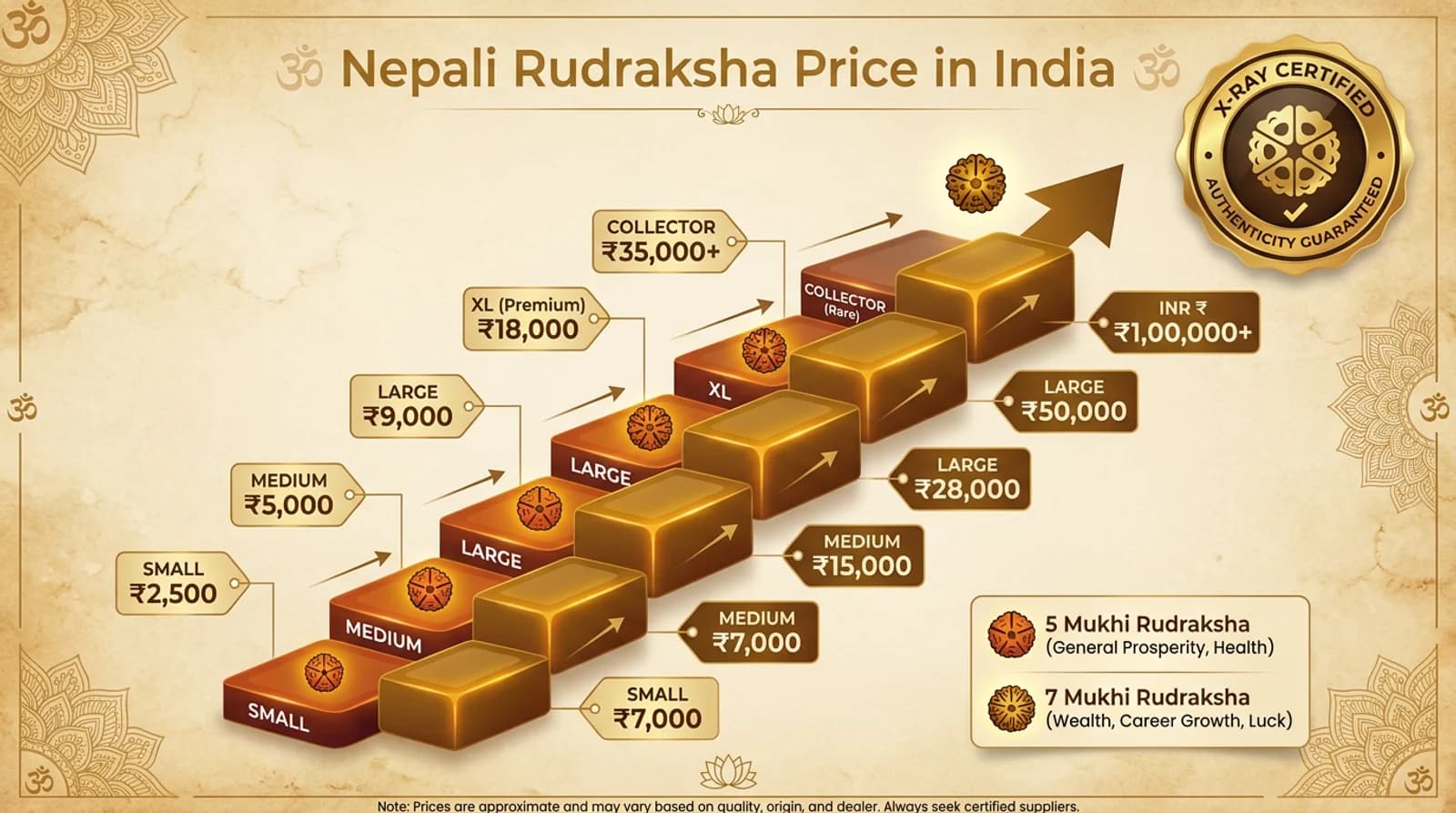
Here is an honest, India-native price ladder for a single certified Nepali bead. Ranges reflect what genuine, lab-checked beads realistically cost in INR; they are indicative and move with seed availability and grade. Beware listings far below the floor — that usually signals a smaller Indonesian bead or a polished fake sold as Nepali.
| Tier (size) | 5 Mukhi (Panchmukhi) | 7 Mukhi (Saptamukhi) |
|---|---|---|
| Small (~16–20mm) | ₹250 – ₹500 | ₹900 – ₹1,500 |
| Medium (~20–24mm) | ₹500 – ₹900 | ₹1,500 – ₹2,800 |
| Large (~24–28mm) | ₹900 – ₹1,800 | ₹2,800 – ₹4,500 |
| Collector (~28mm+, top grade) | ₹1,800 – ₹4,000+ | ₹4,500 – ₹9,000+ |
Why 7 Mukhi costs roughly 3–4x a 5 Mukhi of the same size: 5 Mukhi seeds are the most common form in nature, while 7 Mukhi seeds are far scarcer, so supply alone lifts the floor. Add-ons such as a per-bead X-ray report, silver capping or a kantha (mala) thread are charged separately.
| X-ray certificate add-on | Typically ₹100–₹300 per bead |
| Silver cap / pendant | From ~₹300 depending on weight |
| COD | Available across India |
| GST & shipping | Shown at checkout; no hidden export USD markup |
Export-oriented sites price in USD for Nepal-to-world shipping, which inflates the India landed cost. Buying Jaipur-made and Jaipur-shipped removes that currency and freight premium — the gap this page exists to close.
What Actually Drives a Nepali Rudraksha's Price
Two beads of the same mukhi can differ in price several times over. These are the honest levers, in rough order of impact, so you know what you are paying for rather than guessing.
- 1Mukhi count (rarity)
The biggest lever. Common 5 Mukhi sits lowest; scarcer 7 Mukhi commands a multiple of it for the same size and grade.
- 2Size (mm)
Larger Nepali beads are rarer and more striking. Price climbs steeply from ~18mm to 28mm+; collector sizes carry a premium.
- 3Grade & surface
Symmetry, deep clean mukhi lines, no insect holes, no chipping and a firm grain raise the grade — and the price.
- 4Origin proof
Genuine Nepali (Arun Valley) seeds cost more than Indonesian seeds relabelled as Nepali. Size and mukhi depth are the giveaways.
- 5Certification
A per-bead X-ray report proving the true compartment count adds a small, worthwhile cost and protects against fakes.
- 6Finish & accessories
Silver capping, pendant settings and energising/abhishek services add to the final billed amount.
Belief-vs-evidence note: none of these factors make a bead 'work' in a medical sense. They affect authenticity, durability and beauty. Spiritual benefit is a matter of tradition and personal belief, not a clinically measured outcome.
5 Mukhi vs 7 Mukhi: Benefits, Who Wears Which, and Cost
5 Mukhi is the everyday all-rounder; 7 Mukhi is the specialist many choose during Saturn's testing phases. Both claims below are belief-based (Vedic tradition), not medical fact — wearers commonly report a calming ritual benefit rather than a measurable cure.
| Aspect | 5 Mukhi (Panchmukhi) | 7 Mukhi (Saptamukhi) |
|---|---|---|
| Ruling influence | Jupiter / Shiva | Saturn (Shani) / Lakshmi |
| Tradition says | Calm, focus, balance; general wellbeing | Relief during Sade Sati / Shani; flow of effort and prosperity |
| Best suited to | Almost anyone; students, daily wear | Those feeling Sade Sati or Shani pressure |
| Rarity & price | Common, lowest tier | Scarcer, 3–4x the 5 Mukhi cost |
| Evidence | No clinical proof; calming ritual reported | No clinical proof; calming ritual reported |
Who should wear 5 Mukhi rudraksha? In practice, almost anyone — it has no strict gender, age or rashi restriction in tradition, which is part of why it is recommended as a first bead. Many people wear a 5 Mukhi daily and add a 7 Mukhi specifically through a Sade Sati period.
Rudraksha for Sade Sati and 7 Mukhi for Shani: Saturn's roughly seven-and-a-half-year transit (Sade Sati) is traditionally associated with hard work and delays. A 7 Mukhi is worn as a calming, intention-setting support during this phase. Treat it as a ritual anchor alongside, never instead of, practical effort and professional advice.
Nepali vs Indonesian Rudraksha: Why Price Differs
The most common reason a 'cheap Nepali' bead is suspicious is that it is actually Indonesian (Java). Both are real rudraksha, but Nepali seeds are larger with deeper mukhi and cost more — so an Indonesian bead sold at Nepali prices is mislabelled, while a Nepali-priced bead arriving tiny is a red flag.
| Feature | Nepali (Arun Valley) | Indonesian / Java |
|---|---|---|
| Typical size | ~18–35mm | ~5–15mm |
| Mukhi lines | Deep, well-defined | Shallow, finer |
| Surface | Bold thorny grain | Smoother, denser |
| Price | Higher | Lower |
| Common use | Single statement bead | Fine malas of many beads |
How to identify an original Nepali rudraksha honestly: there is no single magic test. Size and deep mukhi are the first clues; an X-ray showing one seed compartment per mukhi line is the strongest proof. Water-sink and copper-coin tests are folk methods and are not reliable on their own — we explain why in our real-vs-fake guide.
X-Ray Certificate, COD and Transparent Returns
A rudraksha's mukhi count is decided inside the seed, not just on the surface ridges. Cutting a fake to add fake lines is easy; faking the internal compartments is not. That is why we put an X-ray image and a per-bead certificate on the page — one mukhi should equal one seed compartment.
- 1One mukhi = one compartment
Each true mukhi line corresponds to one internal seed chamber. The X-ray lets you literally count them.
- 2Per-bead certificate
Your specific bead is documented — not a generic stock certificate. Many lab certs in the market are generic or fake; ours is tied to the piece.
- 3Cash on Delivery
Pay on arrival across India. Inspect the bead and paperwork before you commit.
- 4Transparent returns
Clear Jaipur-based return terms if the certificate or bead does not match — no countdown-timer pressure.
| Authenticity proof | X-ray image + per-bead certificate on page |
| Lab | Independent X-ray for mukhi count |
| Payment | COD and prepaid; INR pricing |
| Origin | Jaipur-made, lab-certified, India-shipped |
Does rudraksha really work? Honestly: there is no clinical evidence that a bead changes health, money or planetary outcomes. What a certified bead guarantees is authenticity — that you own a genuine, correctly counted Nepali seed. Any calm or focus you feel is best understood through ritual, intention and belief.
Which Hand, How to Wear, Mantra and Care
There are no rigid rules, but tradition offers simple, practical guidance. Worn on the body it is usually kept clean and treated with a little respect; that ritual framing is most of the reported benefit.
| Which hand / wrist | Left wrist = receiving side; common for daily wear |
| Best day to start | Monday (Shiva) or after a simple cleanse |
| 5 Mukhi beej mantra | Om Hreem Namah |
| 7 Mukhi beej mantra | Om Hum Namah |
| Cleanse & energise | Rinse in clean water, dry, set intention; some prefer astrologer/abhishek energising |
| Side effects | None medically; remove if skin irritation from thread/metal occurs |
How to cleanse and energise a rudraksha: rinse gently in clean water, pat dry, hold it, and chant the beej mantra a few times while setting your intention. Many wear it daily; this is optional and belief-based, not a medical instruction.
Care (follow this verbatim): Keep your Rudraksha dry and avoid soap, detergents or harsh chemicals, which strip its natural oils. Wipe with a soft cloth and apply a light coat of mustard, sesame or olive oil every few weeks to prevent cracking.
Frequently asked
Last reviewed: 17 May 2026 · Verified by the DivineTatva expert panel
What is the 5 Mukhi rudraksha price in India?
A single certified Nepali 5 Mukhi (Panchmukhi) bead in India typically starts around ₹250–₹500 for small sizes, ₹500–₹900 for medium, and ₹900–₹1,800 or more for large and collector grades. Price rises with size, surface grade and a per-bead X-ray certificate. Prices far below this floor usually mean a smaller Indonesian bead or a fake sold as Nepali.
How much does a 7 Mukhi rudraksha cost compared to a 5 Mukhi?
A 7 Mukhi (Saptamukhi) usually costs about 3–4 times a 5 Mukhi of the same size, because 7 Mukhi seeds are far rarer in nature. Expect roughly ₹900–₹1,500 for small and ₹2,800–₹4,500 or more for large certified beads. The mukhi count, not branding, is the main price driver.
Why is a Nepali rudraksha more expensive than an Indonesian one?
Nepali beads from the Arun Valley are larger (about 18–35mm) with deeper, well-defined mukhi lines, while Indonesian/Java beads are smaller (5–15mm). Both are genuine rudraksha, but Nepali seeds are scarcer and more striking, so they cost more. A tiny bead sold at Nepali prices is a clear red flag worth questioning.
Does a rudraksha really work, or is it belief?
Honestly, there is no clinical proof that a rudraksha changes health, finances or planetary effects. Its benefits come from Vedic and metaphysical tradition plus personal belief, and many wearers report genuine calm and focus consistent with ritual, intention and the placebo effect. It is not a substitute for medical, financial or professional advice.
What does X-ray certification prove about a rudraksha?
A rudraksha's true mukhi count is set by internal seed compartments — one mukhi should equal one compartment. Surface lines can be faked, but the internal chambers cannot easily be. An X-ray lets you count them and confirm the bead is genuine and correctly graded. Our per-bead certificate is tied to your specific piece, not a generic stock document.
Which hand should I wear a rudraksha on and how do I start?
Tradition treats the left wrist as the receiving side, so many wear it there for daily use. You can start on a Monday after a simple cleanse: rinse in clean water, dry it, hold the bead and chant its beej mantra (Om Hreem Namah for 5 Mukhi, Om Hum Namah for 7 Mukhi) while setting your intention. There are no strict rules.
Are there any side effects of wearing a rudraksha?
There are no known medical side effects from wearing a genuine rudraksha. Rarely, some people get minor skin irritation from a metal cap or thread rather than the bead itself; switch materials or stop wearing it if that happens. Keep the bead dry, avoid soap and chemicals, and oil it lightly every few weeks to prevent cracking.
Reviewed by the DivineTatva expert panel
Written and reviewed by DivineTatva's consulting Vedic astrologer. Every piece is lab-certified and energised in our Jaipur atelier. Last updated 19 May 2026.